Hotel reputation management in the age of the instant review

Yelp, TripAdvisor, Hotels.com… The web has given travelers have so many ways to evaluate, select, book and review hotels. How do hotels manage their reputations proactively and honestly?


Hotels must actively manage their online reputations.
Unique Hotels Group / Foter / CC BY-SA 2.0

Our president Gary Kimball has some advice, which he shares with Hotel Business Review:

Hotels should look at how they are allocating their precious marketing and public relations dollars. This means comparing the value of social media buzz to advertising and print and broadcast media coverage. A review in a popular blog or traditional media like The New York Times or Travel + Leisure can do wonders in building awareness. But those readers may still seek online reviews before making decisions.

Read more at HotelExecutive.com.

Are Automated Posts the Best Solution for Your Social Media Efforts?

Many companies and the marketing and communications agencies that represent them use social media management tools such as SproutSocial, Hootsuite or Radian6 to manage their social media accounts.

Many social media professionals love the scheduling features of these tools. Often scheduling tweets and Facebook posts in advance is done to save time, but is this having a negative effect on your engagement?


keiyac / Foter / Creative Commons Attribution 2.0 Generic (CC BY 2.0)

1. Don’t be a robot. If your company’s tweets are posted everyday at 10 am, noon and 2 pm, followers will notice that. It will seem like you are simply tweeting three times a day because that’s what you’re expected to do, not because you have genuinely useful or relevant information to share. Also, it seems robotic, like a real person didn’t take the time to craft the tweet him or herself.

2. Interaction goes both ways. If your posts are all scheduled, you will be missing opportunities to interact with your followers. Say someone asks a question on Facebook. Ideally you would respond to their question in a timely fashion. One way to be sure you catch notifications quickly is to have your social media management tool up in the background of your computer, so that while still working on other projects, you can occasionally check to make sure you haven’t missed anything.

3. Stay up to date on the news. If your posts for the day are all already scheduled, you may not be taking into account breaking news and events that come up that affect your industry or company. When these things happen it is important that you respond as soon as possible, so as not to get lost in the crowd. Simply taking a half hour during the day to go through your news feed as well as search the news for any relevant industry updates, is a great way to share or retweet the timely news your audience wants to know.

There is absolutely a place for scheduling automated posts, such as if you want to share company news or a link to your newest blog post. However, scheduled posts have to be mixed with live posts in order to most effectively communicate with your audience.

Socially Irresponsible

Some small business owners don’t believe in using experts for social media engagement and content development. They see the practice as novel and unproven – until it isn’t.

Such is the case of The Union Street Guest House in Hudson, N.Y. This picturesque small town inn quickly discovered the demonstrative impact of social media when comments about a fines-for-reviews policy hit the inn’s Facebook page and Yelp, the popular online review site.

According to an ABC News story resulting from the social media dust-up, the inn claims its “policy” was posted to its website as a tongue-in-cheek response to a wedding from years ago and should have been taken down. The policy in essence stated bridal parties would be fined $500, taken from deposit monies, for each negative review the inn might receive connected to a particular wedding or event.

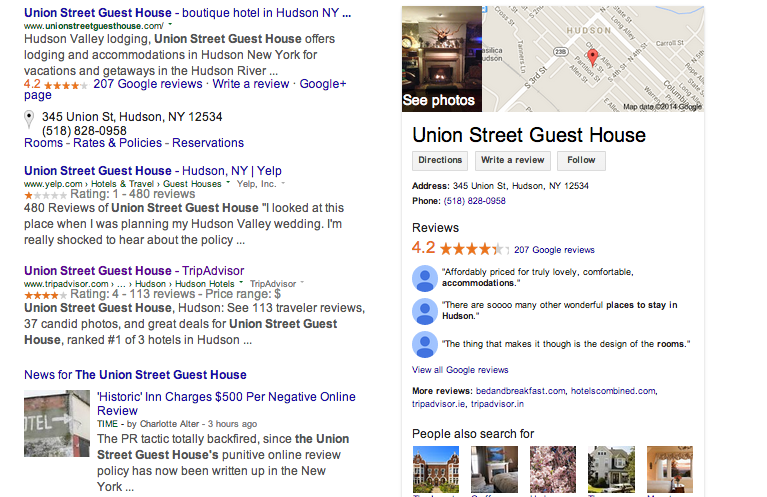
A Google search for the inn's name brings with it a wealth of negative online content that will impact the business' bottom line.

A Google search for the inn’s name brings with it a wealth of negative online content that will impact the business’ bottom line.

Unfortunately, a simple Google search of the inn’s name now produces both a link to the inn’s website, as well as countless social media and news articles referencing this not-so-amusing policy.

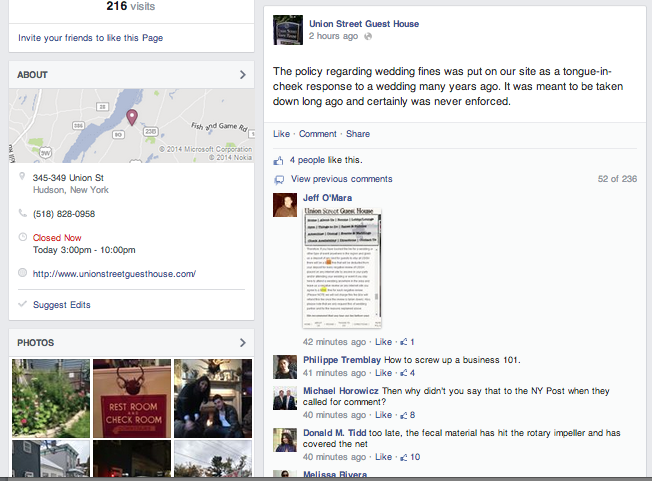
The result is a Search Engine Optimization nightmare for the inn coupled with a runaway train of negative comments on its Facebook page (more than 200 at this writing; although it appears the inn may now be deleting posts from its Facebook page).

Since this firestorm hit mainstream media, the inn's Facebook page has been inundated with negative posts.

Since this firestorm hit mainstream media, the inn’s Facebook page has been inundated with negative posts.

The news coverage and social media firestorm – with only a half-hearted response from management that appears to have since been deleted  – have created a massive public relations problem to overcome. This isn’t the type of crisis you wait out. And without a strategy for responding to and recovering from this communications nightmare, The Union Street Guest House is likely to see a steep decline in business, assuming it has the wherewithal to survive at all.

Small businesses are successful because they do what they do well. Where they often fail is when they try to do something outside of their expertise.

By consulting with a social media professional or brand content specialist, small businesses can avoid errors – even tongue-in-cheek responses – that might not seem substantial at the time, but with an extra set of trained eyes, can be seen for the potential disasters they are and thus avoided. Alternatively, bringing in the professionals after a crisis has erupted is not optimal, but it can mean the difference between staying in business or going under.

Most freelancers or public relations agencies can find equitable arrangements with small businesses that won’t break the bank, and can avoid or attempt to correct business-ending mistakes.

For a free consultation on how working with a public relations agency can help protect and promote your business, please contact me at rhughes@kimballpr.com.

Consistency Matters on the Social Web

When it comes to managing social media platforms, consistency matters. From the content that is shared to the voice/tone, being consistent is vital. Below we explore a few ways to keep everything in sync.


mkhmarketing / Foter / Creative Commons Attribution 2.0 Generic (CC BY 2.0)

A few things to consider …

  • Frequency matters. Ensure content is shared regularly on platforms. Posting four to five times a week? Stick with that posting schedule that disperses your posts evenly across the week. Avoid disappearing on platforms for an extended period of time.
  • Avoid randomness. Stick with content related to the industry or your brand identity. It can be confusing when seemingly random content is shared especially if someone is visiting the page for the first time.
  • Voice consistency matters. Be sure the voice and tone is similar when posting, responding or engaging with others especially if a few people manage the account. This helps establish a friendly rapport.
  • Keep the company name consistent. Avoid confusion and stick with the same company name. For example, decide whether or not your will use your company or brand’s full name or acronym.
  • Keep the logos uniform across all platforms. If you have different versions of your logo, ensure you are using the same one across social accounts. This helps people find and recognize you across platforms.

Feel free to share any additional tips in the comments!

Photo credit: mkhmarketing / Foter / Creative Commons Attribution 2.0 Generic (CC BY 2.0)

Responding to Consumers on Social Media

It’s vital to respond to posts, tweets, questions, etc., on social media, but there’s a right way to handle responding. It’s important to be present for your customers. You certainly do not want to be a ghost on your social media accounts. Below, we explore the right versus wrong ways to respond.

ivanpw / Foter / CC BY
  1. Wrong: Do not acknowledge a mistake a customer brings to your attention via social media. Right: No matter how small the mistake, always acknowledge a mistake and apologize promptly.
  2. Wrong: Listen but don’t respond. Being a ghost and not responding to customers is not a good reflection on your company/brand. Right: It’s important to respond to both positive and negative posts.
  3. Wrong: Respond to everyone with a generic message so everything is consistent. Right: Craft responses that can be personalized to handle different types of comments.
  4. Wrong: If there’s an issue, don’t ask for personal information such as an email address or phone number when responding. Right: Ask the customer to email you (be sure to provide an email address that will go directly to you and not a generic email response center). This also ensures the conversation will be handled privately and not online.
  5. Wrong: Take your time to respond to followers. Right: Ensure someone at your company responds to posts in a timely manner and directs the posts to the appropriate person if there’s a question or issue.

Social media managers, do you have any additional tips to share? Comment below.

Photo credit: ivanpw / Foter / CC BY

Why it’s a bad idea to link Facebook and Twitter posts

I sometimes cringe when I see Facebook and Twitter posts/accounts linked. Linking accounts automatically posts the same content from one account directly to another account. My initial thought when I see a Facebook account linked to a Twitter account or vice versa is a robot is running the account. I fear no one is listening to their customers on a given platform if the two are linked.

Brands may think it makes sense to link these accounts for a few different reasons. Someone running the account simply may not realize he/she should not be linking the accounts. Brands may think it saves a significant amount of time and cuts out a step.

Though it may save brands a minute or two, it may hurt the business in the long run. Yet, some companies still link their posts. Below, I’ll discuss why it make sense not to connect Facebook and Twitter accounts.

striatic / Foter.com / CC BY

Here are a few reasons not to link Facebook and Twitter posts/accounts:

  • Linking accounts gives brands a robotic feel. It can make it seem like brands are not listening.
  • Less clicks may occur when posts are the same across networks.
  • It lacks personality. It’s like a machine is just spewing out information and tweets instead of a human.
  • There’s no conversation/engagement when Facebook is linked to Twitter. Brands could be engaging with other accounts and mentioning Twitter handles.
  • Often people pause when they see accounts linked and may be less likely to visit a page.

If time is an issue, which it is for most, take advantage of a social media management platform. This will allow brands to login to one account to manage multiple social media networks. This way businesses won’t have to login to Facebook and Twitter separately. We like HootSuite and SproutSocial for managing our accounts.

Photo credit: striatic / Foter.com / CC BY

4 Social Media Mistakes Brands Make

Social media can enhance brands, but sometimes brands make social media errors that could potentially hurt its reputation. Let’s face it, not all brand are flawless when it comes to social media. Brands large and small have all made a mistake at one point or another, but you don’t want your brand to lose credibility due to social media mistakes.

Social media platforms should be a priority. After all, posts are there for everyone to see. Below are 4 common social media mistakes brands make.

fireflythegreat / Foter.com / CC BY

Don’t Make These Mistakes

  • Incorrect links. Nothing is worse than coming across an article with a link that leads to the wrong website or does not work. Always double check links!
  • Long links. The never ending link is hard on the eyes and it can appear spammy. Please use a link shortener.
  • Generic posts or irrelevant posts. Posting generic posts or completely irrelevant can make your followers stray. Be original and creative.
  • Little or no Engagement. Being a ghost on social media platforms may be the worst mistake a brand can make. Let other know you’re listening. Make a point to interact with your followers.

Those are just a few mistakes brands make. Which mistake makes you cringe the most?  Comment below.

Photo credit: fireflythegreat / Foter.com / CC BY

Refreshing Your Content This Fall

Autumn is the perfect time to evaluate your company’s social media performance. You can consider what has and hasn’t worked, and adjust accordingly to make the most of the holiday season. It’s also the ideal time to map out your content strategy for the following year based on this year’s analytics.

Below are five tips to help you refresh your content this fall.

Nature Pictures by ForestWander / Foter / CC BY-SA

5 tips to refresh your content this autumn 

  • Are you attending conferences and events this fall? Make the most of them by doing your research early. Ensure you have your booth numbers and appropriate hashtags.
  • Peruse each platform and see how you can make your content more visually appealing.
  • Check out the competition and see what  they’re posting. Are they sharing seasonal articles and specials?
  • Sift through your current content. See how you can make it more exciting and shareable.
  • Relate some of your content to the season. If you own a salon, consider creating fall specials, sharing the latest trendy fall looks, etc. Overall, be aware of fall holidays, awareness months and seasonal weather.

Do you have any tips to add? Do you review your content each season?

Photo credit: Nature Pictures by ForestWander / Foter / CC BY-SA

Marketing on the 9/11 Anniversary? Don’t

“When in doubt, leave it out.”

This was the sage advice of one of my first journalism professors in college. It served me well in everything from sussing out facts for news stories to drawing up guest lists for family parties. It’s also good advice for brands and organizations to consider as part of their social media policies, and their approach to anniversaries of remembrance like Sept. 11.

This week – 12 years from the attacks of Sept. 11 – we saw far too many businesses using social media to remember the fallen while also making sure you remember their products.

On The Crisis Show, which aired on the anniversary of 9/11, I joined Shel Holtz and host Rich Klein to discuss these efforts. We highlighted some of the more thoughtless attempts to newsjack the 9/11 anniversary, as well as the reactions those efforts engendered. It’s a cautionary tale of how even the best intentions on social media can fail without sound strategy, planning and a crisis response plan.

What we saw on social media on this anniversary was how tone deaf some brands can be, and how few plan for all potential outcomes. The list of offending brands – both exploitative in their efforts and those just trying to mark the day as best they could while failing in the attempt – is too long to include here.

The best advice I can share is beautifully summarized in a short online article in The Atlantic. The writer, Derek Thompson, took a page from my journalism professor’s book and offered one simple rule for advertising on 9/11: Don’t. This rule applies equally well to marketers, social media practitioners and PR pros.

The events of that day still haunt us as a nation. So brands should consider honoring the day with a moment of silence, time off for employees to participate in the National Day of Service Congress called for in 2009 or by making a charitable donation. But don’t market such efforts or your products and services. Those who mourn don’t need to hear from brands on this day.

Next year, when we mark the 13th anniversary of our national loss, I encourage brand managers everywhere to follow the prescient advice of my old professor: When in doubt, leave it out.

What’s one more social media platform?

There is such thing as being on too many social media platforms.

When new platforms are introduced, too often companies and brands feel the need to jump on the “exciting new platform” bandwagon. By the time agencies like ours are called in, we find important research, including audience and competitive analysis, wasn’t done. If you don’t have the advantage of working with a public relations agency to help establish or advance your social media strategy, at least ask the following questions before adding yet another new social platform to your list of things to manage.

webtreats / Foter / CC BY

Before you decide to jump on another platform, ask yourself these important questions:

  • Is my audience on the platform I’m thinking about joining?
  • Will my audience be receptive to the new platform I’m thinking about joining?
  • Does it make sense for me to join the new platform? (For example, if you’re thinking about setting up a Pinterest account, but you do not have any visual content to share, it probably does not make sense to join yet.)
  • Do I have relevant and interesting content to post? Will others view my content and will it be shareable?
  • Do I have the extra time and resources to devote to this new platform? Take into account how long it will take to set up, the cost of the graphics for the platform, daily monitoring, creating valuable content, etc.
  • If I create a new account will I be “present?” Sometimes companies create an account and then forget about it or they simply don’t have the time. Having an account where you’re invisible may not send the right message about your company.  Don’t be a robot. Be present.

You don’t need to be on every social media platform to succeed at social media. Sometimes less is more.

If you do not have the resources, time or your audience is not on a certain social outlet, it does not always make sense to be on that platform. It’s better to invest your time on a few social platforms that make sense for your business rather than being on several platforms where you’re not able to devote your the time.

Which platforms make the most sense for your business? Have you had more success on some platforms versus others?

Photo credit: webtreats / Foter / CC BY