Newsjacking: Using breaking news to a brand’s advantage 

Some believe newsjacking is a dirty word. It is seen by some as akin to ambulance chasing. In reality, it is simply a part of the news cycle. In fact, while the term newsjacking carries a negative connotation for some, it actually helps journalists tell better, more accurate stories while also positioning sources as industry or trend experts. When executed properly, this tactic can present a client with an invaluable opportunity to showcase their expertise directly to their target audience on a newsworthy topic that is engaging readers, viewers or listeners at that moment.

Newsjacking allows companies to elevate their brand authority and credibility by positioning a leader within the company as a subject matter expert to share insights on a topic in the news that is relevant to the company’s key messaging or an SME’s area of expertise. An article published in the media can be invaluable when it comes to building credibility for a brand through third-party validation. 

Executing a Newsjacking Strategy

Let’s say the CEO of an insurance company for commercial trucking fleets is looking to generate press coverage for the brand. The PR team sees the federal government is requiring commercial fleets to implement technology-based monitoring systems in commercial trucks. If this CEO is well-versed on the issue, the PR team can reach out to media outlets covering this issue with two or three thoughts to consider to gauge interest in an interview or commentary. 

Next, the PR team will likely reach out to relevant publications offering the CEO’s insights/opinions on the impact of these requirements, the impact on risk reduction efforts and future insurance rates, as well steps fleet owners can take to ensure compliance. 

If the CEO is offered an opportunity to comment and the outlet uses the CEO’s insights, newsjacking likely earned a win for the company and broadcast insight and working knowledge of a meaningful trend trucking companies face. Consequently, the media audience for that story may see the insurance company as a potential resource to help them improve their businesses.

Newsjacking Done Right

Newsjacking requires a deft touch.  

Before making an attempt to newsjack, ensure you are working with a PR team that understands the fundamentals, including how to: 

  1. Set the foundation. Before a PR team can offer an executive’s commentary to a reporter or outlet, they’ll want to make sure they have a valid online presence including an online biography stating experience and credentials, a high-res headshot, a company website that is up-to-date and reflects the current brand identity and ideally previously published articles—even if simply on Linked In or the company website—on industry topics and trends. 
  2. Identify/qualify an opportunity. To newsjack successfully, understanding the universe of current and recent news coverage is essential. Pitch an angle that was already addressed, and you can be perceived as being out of touch. You also need to game out any sensitivities. If the issue involves life/safety or health issues, among others, the pros and cons of newsjacking need to be weighed to avoid unanticipated blow-back on more sensitive matters.
  3. Suppress promotion.  Newsjacking done right is an opportunity to help a reporter better understand a subject or provider deeper insights, rather than promoting the company’s products or services. Stick to the issues. The opportunity for the company will be a secondary benefit if the reporter includes your comments.
  4. Move quickly. Newsjacking is an in-the-moment opportunity requiring rapid action. PR teams should interpret relevant breaking news through the lens of what the company can say and immediately gather insights and commentary. PR pros who aren’t deeply plugged into the company’s executives, lines of business and appetite for media topics will fall short on newsjacking every time. The faster your PR team, and your company, can react and respond, the more likely a journalist will include your thinking in a story.
  5. Leverage the opportunity. Any media placement, whether sourced from a newsjacking opportunity or elsewhere, is most effective when leveraged across multiple channels. PR teams should know to promote media placements on social media channels, the company website, in marketing materials and more, letting their audience know their expertise has been validated by a third-party. 

Newsjacking is a powerful and effective tool to generate earned media coverage to increase your brand’s visibility and credibility. At Kimball Hughes PR, newsjacking consistently allows us to position our clients as subject matter experts in their varied B2B and B2C industries. If you have questions about how a newsjacking strategy can work for your brand, please drop us a comment.

The Search is Over: Why You Need Public Relations More Than Ever

Online searches will never be the same, and for some, this is a good thing. For others, the struggle is about to get real.

On June 30, Google initiated its 2025 Core Update. Expected to roll out over a three-week period, this new iteration of Google’s algorithm will bring significant changes to search rankings. The new algorithm will focus on high-quality content and user experience, prioritizing helpful, relevant and authoritative content.

As with everything these days, this change leans on AI. Because AI-generated summaries (a/k/a zero-click searches) are, so far, less than perfect, brands should anticipate their messaging, positioning, tone and outright fact-based details may be summarized incorrectly by Google, potentially pulling in third-party or outdated information about the brand. As a result, brand websites could experience a drop in site traffic beginning this summer.

Brands can also expect to see a further decline in keyword-centric search engine optimization campaigns. Meanwhile, optimizing for voice, visual and video search will become of increased importance. This is already happening as organic search results are pushed further down by Google as more real estate goes to paid advertising, sponsored content and Google’s own products.

At the heart of these changes are brand authority and credibility. Those who lack a strong online presence—meaning frequent, engaging and varied source content—will be left behind in this new era of online search. For brands, public relations should be considered an increasingly critical tool for reputation management, promotion and search more generally.

The Credibility Factor

Creating frequent, original content, in a myriad of ways across a range of websites and social channels, is the best and most effective response to this seismic shift in online search.

PR pros can employ a range of tools to meet the changing landscape of search driven by AI. Securing multiple and regular opportunities for subject matter experts or brand leaders to represent their organizations outside of owned media (brand websites, blogs, social channels, etc.), will be paramount. These can include:

  • Podcasts, audio as well as video
  • Trade publication media interviews
  • Contributed articles to trade and other vertical media outlets
  • Guest blogs
  • Tier One media interviews or opinion pieces (i.e., Wall Street Journal, FOX News, Financial Times, The New York Times, etc.)

Additionally, brands will need to focus more on their owned content as part of their response to this change. Creating more robust content on platforms like LinkedIn Company Pages, brand websites and blogs, newsletters and online video content will be critical. Additionally, brand leaders will need to rethink the look, tone and substance of that content by unloading jargon and using more casual language to increase the likelihood of being found as voice search continues to grow.

As of June 2025, digital marketing firm SevenAtoms reported one in five global internet users now employ voice commands to search online, with 153.5 million U.S. adults expected to use voice assistants in 2025. That content will also need to incorporate more brand-focused Q&A information to respond to both voice and conversational search terms as traditional SEO continues to decline. Finally, it will be important to maximize brand websites for rapid loading as well as speedy mobile optimization.

When a brand’s public relations team secures credible, third-party media coverage and mentions in relevant, reputable media, this content will provide much of the high value, authoritative signals now prioritized in all search through varied placements and backlinks. Credibility, context and expertise are all core tenets of any effective public relations campaign, making PR the most effective way to help brands insulate themselves from the pace of change. Done well and with frequent, authoritative content and sources, some brands may see their search results improve overtime, allowing their SEO dollars to be repurposed elsewhere, perhaps to their public relations campaigns, as competition for human eyeballs continues to grow almost as quickly as the pace of AI adoption.

Envisioning a Clearer Line from PR to Sales

How do you measure the return on investment (ROI) on your public relations (PR) services? It’s a question asked of every public relations professional by clients and prospects frequently.

It’s also a question we wish we could answer with detailed rows of figures, colorful line graphs and a direct line to sales, but even in 2024, it’s not that easy.

Though we can — and do — give clients comprehensive measurement reports listing the circulation, readership, viewership or listenership of media outlets where they’ve been featured, as well as share-of-voice (SOV) reports, Google Analytics, and more, the industry is yet to develop that perfect algorithm or tool that demonstrates a direct line from PR to sales.

By no means does this mean our work is not generating sales and/or leads. In fact, experienced PR pros have clients say, time and time again, “We had a call come in from a prospect who said they were inquiring about our services after reading our contributed article in XYZ publication.”

For those in our profession, a statement like this is the ultimate compliment. We know, and the client knows, we not only positioned them in front of their target audience through a thoughtfully designed PR strategy, we helped bring, through our work, a prospect to their door.

So, how do you know your PR strategy is working?

A good PR partner will start with obtainable goals and consider a variety of factors to measure their progress. Key measures should include:

Comprehensive Metrics: These are critical in measuring PR success, but once again, you likely will not find an accurate direct link to sales. But there are plenty of metrics your PR team can examine to measure the success of a campaign.

For example, they should carefully review and measure unique monthly visitors to the host site, share of voice, tone, sentiment, reach, key word ranking, social media traffic and more. That information should be shared with you on a monthly basis with a media mentions report of articles, podcasts or other media where your company was featured during that month.

At the same time, to boost those metrics, your PR team should be working to secure backlinks in your media coverage where possible. Though some publications will not allow this, when permitted, a backlink can be quite valuable. Backlinks denote authority and raise the search engine optimization (SEO) of your website, as well as the authority of your content. If the publication’s own domain authority or SEO is considerable, that lends greater credibility from Google’s perspective. With backlinks and your website’s Google Analytics, your PR team can benchmark and track progress as to how the PR work is impacting web traffic to your site.

While ad value equivalency and media impressions were once the holy grail of PR measurement, these two metrics have since largely fallen out of favor. They are a “holdover over from print” and no longer accurate, according to PRWeek. Though impressions can tell you how many viewed and an article from a circulation perspective it fails to tell you how many times a physical article was passed around, how an article has been featured and circulated on social media, how long a viewer stays on an article and more.

Share of Voice: Share of voice, which should be included in the comprehensive metrics above, deserves a shout out of its own here as a key measure as it can offer a company critical insight into their own media footprint as it compares to their competitors.

The term share of voice denotes a measurement that encompasses a company’s print, radio, broadcast and podcast presence, as well as its online mentions and website traffic, among other factors. Share of voice is measured with a calculation of a company’s mentions divided by total market measures.

At Kimball Hughes PR, we’ve seen tremendous success for our clients in terms of growing share of voice via a strategic PR campaign. In fact, after one year of a PR engagement with our team, one of our clients saw their share of voice increase from just under 10% to more than 75% compared to their competitors. In addition to posting thoughtful press releases in tandem with the client, we accomplished this by leveraging insight from the client’s leadership team, by telling stories about relatable personal interests, tapping into industry trends and more to get in front of their key audiences in print, online, via broadcast and streaming platforms, via podcasts, blogs and more. Further, once these pieces of content were published, we provided recommendations and suggested messaging to amplify the article’s reach through social media.

New Business Origination and Leads: While these tools are helpful, as mentioned at the top, one of the best ways to measure PR success, is through a client’s new business wins after the prospect has read their insight in earned media coordinated by your PR team. There, you see PR’s direct link to sales.

No doubt, new tools will be introduced in the months and years to come to better measure PR success. In the meantime, be patient and open to considering multiple metrics in evaluating the success of your PR campaign.

As days go by: blogging matters

urkel.png

Blogging can be fun; it can be tedious. It’s a task for an intern, or for everyone to share. No matter how you look at it, what you say online is crucial to growing your business while also demonstrating your expertise. Let me explain…

We’ll start by exploring a little thing called Search Engine Optimization (SEO). People who know and use your business can get to your website whenever they want by entering your URL into their web browser.

What about growth, though? When new customers or clients are searching for the product or service you offer, you want them to find your website first. That is what SEO does. You can make sure that your website is clear and informative, stating exactly what it is you do; relevant information helps your website appear higher on the list of results when certain terms are searched. You can even pay for advertising around the keywords that people are typing in to increase the position in which your website appears.

But all of that applies only to your relatively static website. Each time you create a blog post, you create a new web address with relevant content for the audience you want to reach. You’re gaining credibility by talking about what you know best, and you’re stretching your online presence by providing new information for clients and customers to find when they search for a service like yours online. So now, instead of appearing in search results only once, each blog post has the potential to appear as a separate site, increasing your online presence dramatically.

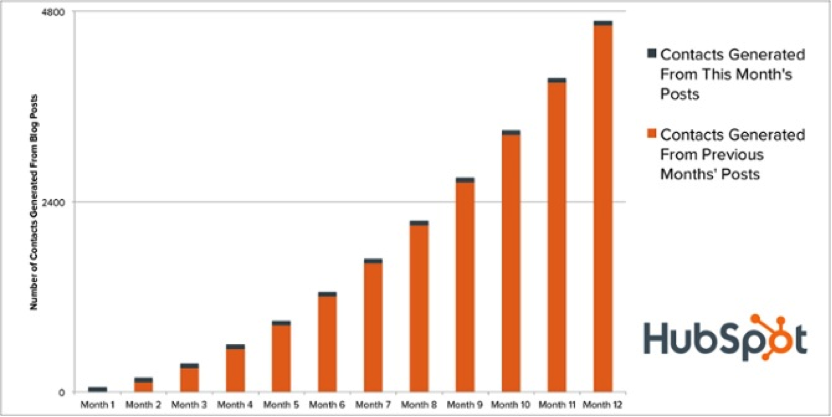
What happens after you blog? Does that post disappear deep into the archives of your website? Nope! Hubspot, an inbound marketing company, explains the idea of “compounding posts,” which basically means that you may get 100 views on the first day you publish your post, but over the next few months, a good post will continue to generate traffic to your website, sometimes exponentially.

hubspot graph

From a PR perspective, contacts generated and credibility gained are really going to make the difference. By blogging regularly, you gain a captive audience that will now see your press releases as soon as they’re posted, while we’re still in close contact with other news sources that will reach the rest of the population you’re hoping to target. You put yourself a step ahead of the game, so as days go by, it’s bigger growth for your company.

Getting started, or ramping it up (if you’re already blogging)

As far as content for blog posts, write about what you know best—piece of cake! Images make a post more attractive, so don’t forget to include one or two. Social Marketing Writing has some stats that will improve your blogging performance. My top three favorites include:

  • Once you accumulate 51 posts, blog traffic increases by 53%, goes up by 3 times when you hit 100 posts, and by 4.5 times after 200 posts. Posting more often will help you get there!
  • Blogs get the highest traffic on Monday mornings, so at the least, plan to have a post published every Monday morning.
  • Posts published on Thursdays get the most social shares.

Blogging is a low-cost way to keep in touch with your clients and grow your business. We think it’s an essential part of any company’s marketing and PR strategy.

To find out more about how we can help you achieve results through blogging, contact us today!