Socially Irresponsible

Some small business owners don’t believe in using experts for social media engagement and content development. They see the practice as novel and unproven – until it isn’t.

Such is the case of The Union Street Guest House in Hudson, N.Y. This picturesque small town inn quickly discovered the demonstrative impact of social media when comments about a fines-for-reviews policy hit the inn’s Facebook page and Yelp, the popular online review site.

According to an ABC News story resulting from the social media dust-up, the inn claims its “policy” was posted to its website as a tongue-in-cheek response to a wedding from years ago and should have been taken down. The policy in essence stated bridal parties would be fined $500, taken from deposit monies, for each negative review the inn might receive connected to a particular wedding or event.
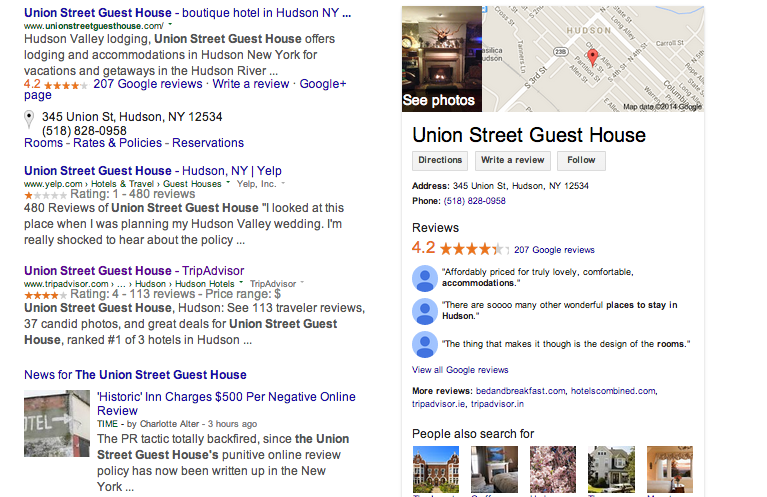
A Google search for the inn's name brings with it a wealth of negative online content that will impact the business' bottom line.

A Google search for the inn’s name brings with it a wealth of negative online content that will impact the business’ bottom line.

Unfortunately, a simple Google search of the inn’s name now produces both a link to the inn’s website, as well as countless social media and news articles referencing this not-so-amusing policy.

The result is a Search Engine Optimization nightmare for the inn coupled with a runaway train of negative comments on its Facebook page (more than 200 at this writing; although it appears the inn may now be deleting posts from its Facebook page).
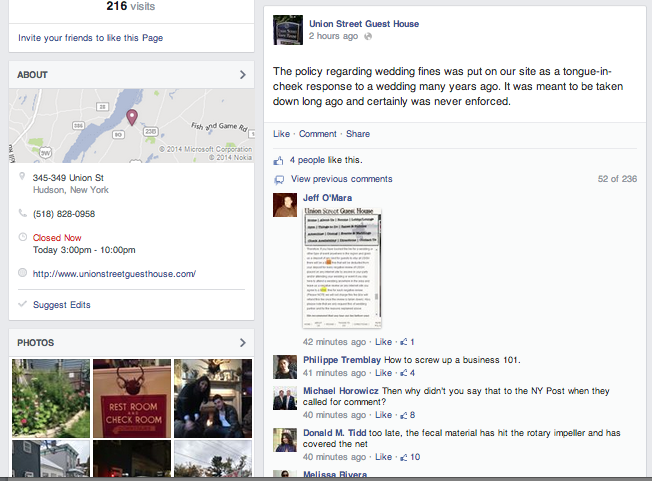
Since this firestorm hit mainstream media, the inn's Facebook page has been inundated with negative posts.

Since this firestorm hit mainstream media, the inn’s Facebook page has been inundated with negative posts.

The news coverage and social media firestorm – with only a half-hearted response from management that appears to have since been deleted  – have created a massive public relations problem to overcome. This isn’t the type of crisis you wait out. And without a strategy for responding to and recovering from this communications nightmare, The Union Street Guest House is likely to see a steep decline in business, assuming it has the wherewithal to survive at all.

Small businesses are successful because they do what they do well. Where they often fail is when they try to do something outside of their expertise.

By consulting with a social media professional or brand content specialist, small businesses can avoid errors – even tongue-in-cheek responses – that might not seem substantial at the time, but with an extra set of trained eyes, can be seen for the potential disasters they are and thus avoided. Alternatively, bringing in the professionals after a crisis has erupted is not optimal, but it can mean the difference between staying in business or going under.

Most freelancers or public relations agencies can find equitable arrangements with small businesses that won’t break the bank, and can avoid or attempt to correct business-ending mistakes.

For a free consultation on how working with a public relations agency can help protect and promote your business, please contact me at rhughes@kimballpr.com.

Employee Travel: Preparing for Summer Travel

For Kimball Communications, summer is packed with conferences, workshops and events. Our employees attend conferences across the U.S., and since we cannot physically be together each day it’s important to have a plan before traveling. You, too, can keep everything running smoothly by following this simple, yet effective strategy.


Eelke de Blouw / Foter / Creative Commons Attribution-NonCommercial 2.0 Generic (CC BY-NC 2.0)
  • Prepare ahead of time. Have an internal meeting to go over everyone’s travel plans. Be sure you know when and where everyone will be throughout the summer. Keep a calendar of employee’s travel arrangements and daily schedules.
  • Stay connected. Technology is key. Skype, voice call, text and email will keep everyone informed.
  • Be aware of time zones. Remember, there’s a good chance you will not be on the same time zone. Schedule calls with each other appropriately.
  • Delegate tasks. Make sure all your bases are covered. Assign timely tasks to colleagues. This will ensure deadlines are still met and will simplify things tremendously.
  • Reach out to clients. Ensure clients are aware when you’ll be out of the office. It’s important to let clients know there will always be someone they can reach out to if a problem or question arises.

How do you stay connected during travel? Follow #KPRontheroad to see where we’ve been, and where we’re going, this summer.

Photo credit: Eelke de Blouw / Foter / Creative Commons Attribution-NonCommercial 2.0 Generic (CC BY-NC 2.0)

Don’t be a phony: Wikipedia and PR

David Kracht / Foter / CC BY-NC-SA 2.0The PR industry extended an olive branch to Wikipedia this week.

Earlier this week a consortium of PR agencies released a joint statement on their intention to comply with Wikipedia’s terms of service. This may seem like an empty gesture, but it is considered a significant step towards resolving a conflict between the communications industry and Wikipedia’s vigilant volunteers.

If you are not familiar with this conflict, here’s the short of it: Edits to a Wikipedia entry by a paid representative of an individual or organization constitute a conflict of interest and violate Wikipedia’s terms of service and goals. However, PR pros and freelancers have been paid to edit entries for nearly as long as the online encyclopedia has been around. Read up on the 2011 dust up between a British PR firm and the online encyclopedia for a clearer picture of the relationship.

Though I generally disagree that someone involved with an organization is incapable of updating basic information about that company without falling susceptible to promotional urges, I understand Wikipedia’s policy. It helps keep entries honest, factual and balanced. But more importantly, I understand that it is a community with rules and guidelines; it doesn’t matter whether or not the PR industry likes them. We have to play by the rules or risk our clients’ reputations and exclusion from the community.

Plus, trying to control a conversation—whether through spin or ham-fisted encyclopedia edits—necessarily relies on subterfuge and dishonesty. That never ends well. Instead, PR pros need to make their clients a part of the conversation.

On Wikipedia, that means requesting an edit and making your case for it. There’s even a page full of resources for paid editors, including the proper channels for requesting a change. If you need to make a change to a client’s Wikipedia entry, start there.

For a bit more inside baseball on the relationship between Wikipedia and the communications industry, check out the entry on conflict-of-interest editing, WikiProject Cooperation and WikiProject Integrity. These—and the terms of service—are essential reading if you are considering editing a Wikipedia page for a client or employer.

To get a peek into how Wikipedia’s community of moderators and editors resolves perceived conflicts of interest, check out the talk section of the Cracker Barrel page.

There are as many opinions on this matter as there are Wikipedia pages. Where do you stand? Does editing Wikipedia entries for pay violate your professional ethics? Have you done it? Talk to us about it in the comments.

Get Heard With Fewer Words

As people get more and more news from blogs, Facebook posts and tweets, content is becoming shorter and shorter. In fact, new guidelines put out by the Associated Press request that stories be no more than 500 words. Simply put, people want to read something short, sweet and to the point.


Fletcher Prince / Foter / Creative Commons Attribution 2.0 Generic (CC BY 2.0)

The same is true with journalists and editors. They get hundreds of emails a day, so chances are they aren’t interested in reading a long, detailed pitch and press release from you. They want to know the important facts as quickly as possible.

If your story isn’t getting heard, try making brevity and succinctness your focus. Here are some ways to do that:

Media Pitches:

  • Have a strong, attention-getting and short subject line
  • Make the media pitch a short and intriguing summary of the story in the body of the email
  • Be sure to focus on the timeliness and the local connection of the story, if applicable
  • Encourage interaction by providing multiple ways for the journalist to contact you, should they want more information

Press Releases:

  • Write more like a journalist, focusing on the news aspect of the story
  • Include the Who, What, When, Where, Why, and How in the first couple paragraphs – that way if that’s the only thing they read they still get the gist of the story
  • Always limit press releases to one page
  • Save them as PDFs so they can be universally opened and send them as an attachment to your pitch email
  • Attach pictures if you have them that journalists can use to go with the story

Another suggestion is to use your media contact database to its full potential; at Kimball Communications our database tells us an editor’s preferred form of contact. Some prefer phone, email or Twitter, this is a good thing to use in order to follow up with them and gauge their interest in your story.

The Secret to National Media Coverage

There is a very simple formula you can use to secure free, national coverage by media outlets throughout the United States.

Few PR professionals are aware of it, but those who use it are wildly successful.

It’s called … seriously? You know there is no silver bullet to successfully enhancing your business’ reputation. It takes hard work, planning and no shortage of skill and dedication.

In any event, everyone at Kimball Communications wishes you a very happy April Fool’s Day.

april-fools-day-meme

Image courtesy of quickmemes.com

Ignorance Is Not a Brand Attribute

Media outlets everywhere have covered Groupon's Presidents' Day marketing stunt. The question is if this hurts or helps the brand in the long term.

Many media outlets, like the Chicago Tribune, have covered Groupon’s President’s Day marketing stunt. The question is if this stunt hurts or helps the brand in the long term.

As marketing tools, sometimes stunts work. They get the media’s attention. They take your brand “viral.” They get people talking about you. They create “buzz.”

When activists delivered a 13-foot tall gluten-free cake to Capital Hill in May 2011 to advocate that the Food and Drug Administration enforce gluten-free labeling standards, the stunt worked. There was plenty of media coverage. It supported the mission to which the activists were committed. It alerted consumers to issues surrounding the food they eat.

However, Groupon’s latest stunt – calling Alexander Hamilton “undeniably one of our greatest presidents” to promote a Presidents’ Day special – will not serve the brand well.

Sure, Groupon is quirky. Some might say it’s quirky to the point of being ridiculous. I’ll also grant you the Groupon stunt is getting buzz. There’s plenty of media coverage (heck, it prompted me to write this spiffy blog post).

But this stunt also gives the impression Groupon doesn’t know the facts (e.g., Hamilton was U.S. Secretary of the Treasury, not President). In trying to look too cool for school, Groupon instead comes across as out of touch with details – something that might make consumers wary. Thoughtful consumers might at first be amused. But on reflection, will they trust leaving their credit card information with a company that portrays ignorance as an attribute?

Hamilton’s briefly mistaken moment in U.S. presidential history won’t sink Groupon – assuming people are still using it. In fact, in the short run, it will have everyone talking about Groupon. That is what stunts do; they create buzz.

It’s the long run that is a problem. How does Hamilton fit the brand? More importantly, how does portraying a fundamental misunderstanding of history convince consumers to spend their Hamiltons, and Washingtons and Lincolns with Groupon?

Any good public relations professional will tell you buzz doesn’t always last and stunts like this don’t help the long term reputation of Groupon with consumers.

Mr. Hamilton would not be amused or impressed by Groupon’s stunt. Those using his likeness shouldn’t be either.


3 Business Success Trends for 2014

take the plungeWelcome to 2014. This year will be more competitive. This year, the marketing din is going to get a lot louder. This year is also going to be the year you get savvy about marketing your small or medium size business. To help you do so, here are three trends that will affect the business landscape, and your own bottom lines.

Social Media Is Not Optional. The days of just dipping your toe in the social media waters are long gone (circa 2011). You’re either engaged in social media marketing or you’re not, and – trust me on this one – you have to be engaged. No modern, effective marketing plan is complete without a social media component. Get expert advice on how to start. Pick your platforms with care. Develop a content strategy that is authentic to your brand and develop protocols and best practices for conversing with your followers. When all of that is done, then you can jump into the social media pool. (Remember, no toe dipping. This year calls for a full on, no hesitation cannon ball into the deep end – but you have to plan it out first.)

The Value of Public Relations Is Growing. While publishers may be consolidating media outlets, the ironic twist is the demand for quality content is disproportionately expanding. What this means for your brand is opportunity; opportunity to develop meaningful content and, more importantly, content people want to share. One caveat – that content must rarely be brand-centric. While the content should be relevant to your space, it cannot put your brand front-and-center if you want it to be seen as authoritative, authentic and of innate value to the public. PR is increasingly going to require a mix of earned and owned media, but that owned media – if executed well – can pay significant dividends. This content marketing (or brand journalism) trend is growing rapidly, and your public relations advisor or team needs to be leading the charge.

Smartphones Are Windows to the World. As mobile access continues to become part of everyone’s new normal, brands need to consider how to engage their consumer audiences via this medium. A responsive designed website is just the start of ensuring your brand and/or products are accessible on any mobile device. You’ll also want to track your website’s analytics to monitor your level of mobile web traffic and adjust your marketing efforts accordingly. Additionally, opt-in SMS text messaging campaigns and branded Apps are two mobile marketing tools we’ll be seeing more of in the year ahead.

These and other tactics are the new business as usual tools. More and more, companies will need to adapt to the latest technologies if they want to engage with their audiences. Meanwhile, the New Year offers new challenges and ample opportunity. On behalf of everyone at Kimball Communications, may your businesses find success in overcoming the former and excel at leveraging the latter.

Apology Chips Away at the Lululemon Brand

The merits or lack thereof regarding Chip Wilson’s comments during a recent Bloomberg TV interview not withstanding, when the public takes umbrage with statements made on behalf of a brand there are ways to apologize and ways not to apologize.

The Lululemon athletica founder’s Nov. 8 YouTube apology posted to the Lululemon Facebook page is a lesson in the latter.  Even the company he founded was careful, in response to media inquiries about Wilson’s video apology, to distance itself saying the posting was, “Chip’s reaction and statement – Lululemon did not issue one.”

The YouTube mea culpa – of sorts – starts with Wilson declaring he is “sad.” With his very first words, he failed in his attempt. Any media advisers working with him never should have let him say it. The public doesn’t care if he is sad. They do care if he takes ownership of what he said. They do care if he regrets having said it. They do care if he declares his comments as being wrong, hurtful or even ill-considered. And they do care if he apologies to those whom he might have offended. Simple and direct apologies in circumstances such as these are important. When the public is angry, don’t quibble. Apologize succinctly and with sincerity.

Second, his message seems targeted at those who work for Lululemon, and not the customers and general public he was perceived as having insulted in the Nov. 5 Bloomberg interview.

Third, aside from the distracting background gong you hear at the 10 second mark, Wilson is clearly reading from cue cards. If you want to look disinterested, disengaged and scripted during a public apology, the best way to accomplish this trifecta is to read off of cue cards into a camera.

Wilson was ill-advised in the making of this video. His lack of media training (often disregarded by businesses until – and even after – a crisis erupts) is evident in both the Bloomberg interview and in his video. Imagine how beneficial media training now seems to executives at Lululemon in retrospect. The initial damage might never have occurred.

Taking a step back from the specifics, the message is entirely wrong – as perhaps was the venue (Facebook). When messaging to employees or other internal stakeholders, keep that message out of the public eye. If you are apologizing to your loyal customers, do exactly that as plainly and sincerely as possible.

The public will generally forgive a brand and its spokespeople if they react quickly, with great care and sincerity, and if they clearly apologize and take responsibility for their words or actions. Anything less usually only compounds the problem, as Wilson has aptly demonstrated.

Effective apologies come in many forms. Unfortunately for Wilson and the brand he created, his YouTube effort is not among these forms.

PR pros, take a lunch break!

Lunch at Koinonia

Wouldn’t it be nice to eat without getting mayo all over your keyboard?

We’re all guilty of not talking a lunch break and eating over our laptops at times. Even if we do step out for a “break,” we’re usually fiddling with our phones, checking emails, etc. Many PR professionals eat lunch at their desks. “Sixty-nine percent of PR professionals eat lunch at their desk rather than joining that chatty klatch heading out to a nearby deli, according to the PR Daily Salary and Job Satisfaction Survey” (PR Daily) With the year coming to a close, PR pros are especially busy planning for 2014, but it’s not an excuse to skip lunch.

Why it’s vital to take a lunch break

  • Food=fuel. If you take some time for lunch, you’ll have more energy to tackle the next project.
  • If you step away from your desk, you’ll be able to clear your mind and take a break from the digital world.
  • Heidi Mitchell (WSJ) discusses other benefits of taking a lunch break in this video, “Is Taking a Lunch Break Better for Your Health?

A few things you may want to do on your break

  • Refuel, but not with coffee. Try an apple or fruit instead.
  • Take your dog for a stroll if you’re nearby or work from home.
  • Take some time to breathe in the fresh air to help relax your mind.
  • Pamper yourself occasionally. Why not schedule a massage?

Like this post if you’re sitting at your desk reading on your “lunch break.”

Photo credit: NatalieMaynor / Foter.com / CC BY

Managing Your Small Business’ Online Reputation

Congratulations! You've taken your business online. So how do you leverage this into new customers or clients while also protecting your reputation?

Congratulations! You’ve taken your business online. So how do you leverage this into new customers or clients while also protecting your reputation?

Congratulations intrepid entrepreneur! If you’ve taken the plunge and launched your small business into the social media space, you’ve taken a bold step that offers many risks and rewards.

More than 72 percent of U.S. adults who go online use social networking sites, according to the Pew Internet & American Life Project. By choosing to put your brand out there, a bevy of potential rewards (i.e., Likes, followers, sharing blog posts, positive reviews and online recommendations) await your brand. With a little effort applied to communication your messages, attention to superior online customer service that reflects your brand and by trying to genuinely connect with your customers, you can turn your social media presence into a noteworthy repository of goodwill for your business that reward you handsomely over time.

The effort is also not without risk.

In the days before social media, one bad customer experience typically translated to the customer telling 10 friends of their displeasure. With the advent of social media, however, your brand runs the risk of being shamed before 100 or 1,000 social media followers. For some power networkers, those numbers are substantially higher.

It’s imperative small businesses understand, on average, about 46 percent of web users turn to social media before making a purchase to decide if the business or product is “trustworthy” or reputable. This means, to paraphrase a legendary phrase from actress Zsa Zsa Gabor, you are what the online community says you are.

On Oct. 18 at Parx Casino in Bensalem, Pa., small business owners that include restaurants, outdoor and adventure destinations, bed & breakfasts and others will gather for Visit Bucks County’s Annual Membership Meeting. Attendees will have an opportunity to attend a morning seminar on establishing and maintaining online presences to help their businesses grow.

As one of the featured speakers, I’ll be sharing insights and tips on how these businesses can protect and defend their online reputations. I’ll offer examples of good, and not so good, online customer service. In addition I’ll provide insider tips for managing these online presences under a variety of circumstances.

Check back on this blog next week for some top line thoughts on the subject as well as insights and anecdotes offered by some of the small businesses I meet with at the VBC Annual Meeting.

photo credit: <a href=”http://www.flickr.com/photos/infusionsoft/4820986909/”>Infusionsoft</a&gt; via <a href=”http://photopin.com”>photopin</a&gt; <a href=”http://creativecommons.org/licenses/by-nd/2.0/”>cc</a&gt;