
3 Ways to Earn Credibility with the Media and Grow Your Reputation

The secret to earning your way into news coverage, earned media as it’s called in public relations, is to give journalists what they need without talking about your company, product or service. You are not the story. 

Every organization looking to grow understands, or should understand, the importance of positive media exposure. As AI search overtakes traditional online search, earned media defines how your organization shows up in AI search results. Third-party validation has never meant more in the world of brand reputation. However, getting there without being promotional is where countless organizations struggle.

Insights Matter

Whether your company is in insurance, technology, financial services or manufactures children’s toys, as an established industry player you are sometimes closer to related emerging issues or trends than the media. You have the ability to explain and contextualize these developments for audiences eager to understand them better.

Your company or your title give you entry to the conversation with journalists, but they cannot be the conversation. What journalists want is your thinking on customer behavior, economic shifts, emerging risks, operational trends or simply reactions to industry news. They may ask what these changes mean for your company, but that is secondary. If you can paint a picture of the industry without mentioning your company, products or services, you will be seen as offering useful intelligence for the journalist and helpful guidance for the audiences. Promotional efforts kill these opportunities.

Own Your Space

Don’t attempt to be a Jack of all trades in terms of topics to tackle with the media. By selecting a few key topics or areas of interest within your industry, you can more likely establish clear positions, opinions and deeper insights than your competition. Credibility means having a strong and unique point of view and the means to support that viewpoint. And that is the stuff of great storytelling that journalists love. 

One way to do this is to demonstrate useful insights when you have nothing to promote. Speak to journalists on background. Help them understand complex issues. Offer to educate them if asked or point them to others who can speak on the record if you cannot. This demonstrates you’re more than an expert; you’re a resource.

Show Up

Journalists will talk to the professionals who show up, have a clear point of view and are willing to be candid and human. But the most important of these traits is showing up. 

Some executives see media interviews as not being central to the organization’s mission. In times gone by, you could make that argument. It no longer applies. AI is scraping media to determine not only how, but who, shows up when customers or clients search for goods, products and services. Media is the first stop in building those search results. Failing to prioritize public relations ensures you will be left behind. That’s not a threat or a prediction; it’s where we are headed. 

Consequently, journalists will work with those who show up with something important to say that also speaks to their audiences. Those who prove unreliable are simply removed from the equation by journalists who need to move quickly to produce good content.

Credibility with the media is earned, not given. That credibility will increasingly prove to be one of a few gold standards that will shape the reputations of organizations and their leadership as AI takes center stage in all our lives. 
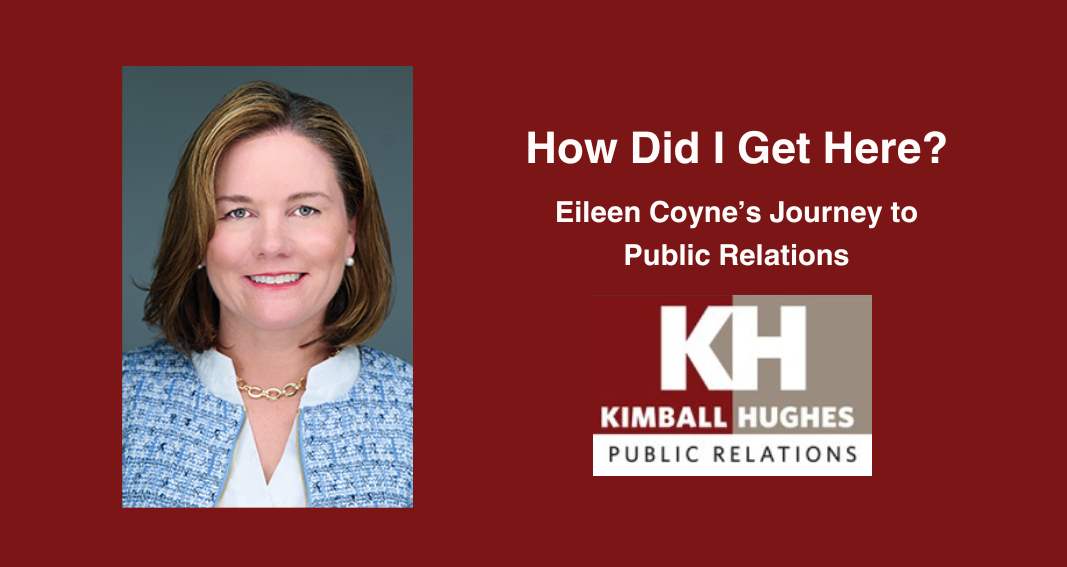
How I Got Here: Eileen Coyne’s Journey to PR

Many career paths are unplanned. As specialists in insurance communications, we hear from insurance professionals all the time who found their way to their professions through unplanned or unexpected means. The same can be true of public relations. Whether it’s journalism, marketing or human resources—the PR field is uniquely suited to diverse backgrounds. That is why we are sharing this blog series breaking down how our team members came to find their current PR roles. For any new grads trying to figure out what they want to do, or even established professionals looking to make a change, we hope this series can shed some light on the PR field. 

What did you go to school for?

I studied communications in college and pursued a journalism concentration. It was my senior year of high school when I decided I wanted to become a journalist. I had the opportunity to take part in a senior work week at a Philadelphia television news station and was immediately sold on the fast pace and excitement of television news. 

What did you envision your job would be?

Envisioning a future as a television news field reporter at first, I took a summer internship at a Baltimore television news station. It was a memorable experience where I had the opportunity to accompany reporters to the scenes of breaking news, record my own tapes and write up brief segments for the producers. Realizing I enjoyed the writing more than the behind-the-camera work, I took a second internship at a major metro paper. After first seeing my byline in print, I focused my aspirations there. 

What was your first job out of college?

After college, I landed a job as a reporter in Washington, DC for the Bureau of National Affairs. I covered the banking beat and had the opportunity to report on regulatory issues and federal hearings on Capitol Hill where I was able to learn more about the policy process firsthand. It was an amazing experience that allowed me to immerse myself in our nation’s capital and continue to improve my reporting and writing skills as a young journalist. 

How did you end up in your current role?

After working as a business reporter for different publications, I shifted into public relations. As a reporter, you can develop a love-hate relationship with PR folks. Not a fan of the pushy, salesy PR pros, I came to appreciate the good PR pros—those who shared thoughtful ideas to help me shape a future story, who connected me with valuable sources, who anticipated my needs and who respected my time and my deadlines. After covering banking and insurance for years as a reporter, I worked as a PR pro at a national carrier and then moved to serving the insurance industry from the agency side. After taking some time to raise my kids, I came across a position at Kimball Hughes PR specializing in insurance. It was a perfect fit. It’s been 10 years and I haven’t looked back.

What has surprised you most about your career or yourself given your current role?

Becoming a solid reporter, editor and writer was always something I aspired to, but I never saw myself in PR or as a specialist in insurance and risk management. That insurance focus has been a fun surprise and one of the most rewarding parts of my career. 

What have you learned from your career journey?

Careers take twists and turns. The best laid plans will shift with good bosses, bad bosses, promotions and layoffs—as well as with kids, family moves and other life and work events. Be ready to roll with it. The younger me never would have guessed I’d be a PR pro let alone one who specializes in insurance, but I wouldn’t have it any other way. 

What lesson or myth-busting idea would you want to share with someone thinking about a career in public relations?

Journalists often joke that former reporters who switch to PR have crossed to the “dark side.” I’m not on the dark side. I continue to do what I first sought out to do—storytelling. The format is just different. I help my clients tell their stories, connecting their expertise to timely trends and issues that matter to journalists and their readers. I continue to love the business of the news and I thrive here, but from a different perspective—finding ways to showcase my clients’ expertise, boosting their visibility and credibility among their target audiences.

Claude Mark: Why AI writers can no longer hide

For those who felt AI had given them license to embrace their inner-but-challenged wordsmith persona, August 10, 2026 will forever be a black mark on their calendars. 

That’s the day Anthropic, the company that created AI tool Claude, announced it will now embed what it called an “imperceptible watermark” directly into all AI-generated text. In practical terms, if a user employs Claude to write, edit or refine any text, that AI watermark will follow said text forever. You can download or copy and paste the text; either way, that text carries an AI Scarlet Letter for all to see. 

TechCrunch reported Anthropic’s move was designed to comply with the European Union’s AI Act, and more specifically, it’s Transparency Code. The Act took effect on Aug. 2. Other companies offering AI platforms, according to TechCrunch, have also committed to complying with the EU’s AI Act. Generally, this likely means all AI text will eventually bear watermarks.

AI users should proceed with caution. Even if one were to write an op/ed or other contributed article and merely run it through AI for a grammar check or simple edit to tighten language, that original content—once inserted into a Claude AI platform, and likely others in the future—will be watermarked as AI generated.

For business and nonprofit executives who regularly submit thought leadership content to third-party publishers, this development may cause any content touched by AI even slightly to run afoul of an outlet’s writers’ guidelines. The result could lead to rejection of the article or an outright ban of the author to make future contributions to the outlet. It all depends on the outlet’s AI particular policies. 

For the AI-built Colleen Hoover wannabes out there, this latest AI development appears to be a potential roadblock to the write-without-much-effort movement AI seems to have fostered. However, for those seeking genuine creativity and deep, experiential expertise across a range of content types, this development is a good thing. It forces writers and those who aspire to write to embrace an essential truth: write what you know; not what Claude or others know. This is a net positive for the writers as well as the readers. It also helps to better safeguard authenticity. 

For executives looking to share their thinking within their industries or broader communities, understanding the burgeoning restrictions on AI content and how third-party publishers are handling AI-generated or edited content is paramount. Expert commentary and content have long been a central element of any reputation management program. AI offered the potential to put this at risk. Handled correctly, with care and understanding of the perspectives of publishers, companies and non-profits will be better prepared to recognize and abide by guardrails put in place to ensure genuine and original thinking still hold sway in the writing process. And, of course, a good public relations team can further ensure those reputations are better protected, the content is original and no executive is harmed by the use of artificial intelligence.

How I Got Here: Logan Thompson’s Journey to PR 

Image

Many career paths are unplanned. As specialists in insurance communications, we hear from insurance professionals all the time who found their way to their professions through unplanned or unexpected means. The same can be true of public relations. Whether it’s journalism, marketing or human resources—the PR field is uniquely suited to diverse backgrounds. That is why we are sharing this blog series breaking down how our team members came to find their current PR roles. For any new grads trying to figure out what they want to do, or even established professionals looking to make a change, we hope this series can shed some light on the PR field.  

What did you go to school for? 

Communications with a concentration in PR. It took me three semesters to decide on my major, but I always loved writing, so communications seemed like a natural fit.  

What did you envision your job would be?  

Just like when choosing my major, I was undecided. I thought about working for a non-profit, going into government PR or working a beauty brand. Ultimately, working at an agency, with a natural range of client types, allows me to do a little bit of everything I always hoped I might do in this field.  

What was your first job out of college?  

After college I ran an Instagram page selling second-hand clothes from my parents’ house! I also waitressed on the side. My first real job was working at a PR agency specializing in real estate and beauty PR. I worked with a variety of B2B and B2C clients, including residential builders, property management companies, a haircare line and a hand sanitizer brand.  

How did you end up in your current role? 

After being laid off in early 2025, I worked in email marketing for a few months before ultimately recognizing that PR was my true calling. After that, I set out to find another job at a PR agency and came across Kimball Hughes PR on LinkedIn. I was unsure about working in insurance at first. However, now I enjoy it a lot and have been able to learn about a lot of interesting industries through the lens of insurance, including commercial property construction and beauty.  

What has surprised you most about your career or yourself given your current role? 

When I started in PR, I thought working for glamorous industries, like beauty or celebrity PR would be what I enjoyed the most. After having the opportunity to work in those fields and now being in the insurance industry, I’ve been surprised I enjoy working with seemingly less-glamorous industries more. It’s been interesting to push myself outside of my comfort zone and learn about industries I probably never would have had the chance to before.  

What have you learned from your career journey? 

Having confidence in yourself and not being afraid to fail is vital to growing professionally. Sometimes I have had to follow the fake-it-til-you-make-it mindset, but having the courage to go outside of my comfort zone and make mistakes is what has allowed me to grow and add to my knowledge base.  

What lesson or myth-busting idea would you want to share with someone thinking about a career in public relations? 

For someone thinking about a career in public relations, I recommend starting out at an agency. Doing so provides exposure to a range of client types and industries you cannot get working for a single brand or going in-house. Agency life moves at a fast pace. It forces you to multi-task and move from industry to industry all in the course of a single day. This career path allows you to find the types of accounts you enjoy (and don’t enjoy) and flex your skills across accounts with different needs.