Conferences Are Having a Moment. Make The Most of It.  

If your calendar is dotted with dozens of highly concentrated, short meetings reflecting a time-zone you don’t live in, you’re likely headed to an industry conference. 

In-person conference attendance is having a moment.

Prior to 2020, non-marquee conferences were struggling. The big shows—SXSW, CES, WSIA’s Annual Conference, Franchise Expo and others—were holding their own while smaller industry-specific events were being squeezed. Budgets, time out of the office and corporate travel budgets were all factors as webinars and social media networking promised to fill in the gaps. And of course, COVID slowed down momentum for in-person conferences.

However, in 2025 the pendulum swung again. Journalists, whose travel budgets were never grand, began hitting the conference circuit again looking for sources just as companies again saw value in these in-person opportunities to build relationships and bring in new business. 

What changed?

The need for access became paramount. After years of Zoom-interviews, media outlets recognized they needed to network. Sitting down, in-person, with sources helps foster stronger ties and deeper conversations. Experts in attendance help journalists provide their audiences with what they’re looking for.

There is a bit of tech fatigue at play. With the rise of AI and the questioning of authenticity in content, many of us simply appreciate the opportunity to reconnect in a business-like environment. In an age of hybrid and remote work, conferences may be the new water cooler moment we’ve all been craving while still basking in the joy of a commute-less workday. 

Hence the conference renaissance. 

More companies are sending employees and executives to industry events. More vendors are reserving booth space. Far more media are attending looking for sources than in many of the prior years combined. And more opportunity exists for attendees to maximize their return on investment as conferences and associated travel costs rise.

There remain, of course, the traditional table stakes of conference attendance:

  • Brand exposure to prospects
  • Lead generation
  • Networking & education

However, those are only the immediate, and most obvious, benefits. 

For those who wisely engage with attending media, the benefits are manifest. As a communications professional, I’m biased. I believe the best and most often overlooked conference benefits come from engaging with attending media.

Inclusion in a journalist’s coverage of the event—high profile coverage within the industry itself—helps to create content your sales team can leverage on multiple fronts. 

Instead of an obvious sales pitch, your sales team can lead with your industry insights and analysis that carries the third-party endorsement of the media. Trade media news coverage in which you’re included can also help shorten the sales cycle as it creates greater awareness. That coverage can also last well-beyond the conference whereas the expensive conference booth is only on display for two or three days.

Making a plan weeks before you travel can also create business opportunities you won’t find on the conference floor. Use the app to make connections. Reach out over LinkedIn to connect with prospects. Have your public relations agency or communications team set up interviews with attending media. Today’s conference attendees can’t afford to merely arrive. You’ve got to make your presence known weeks in advance to maximize your ROI. 

Additionally, sending your star players, and even junior staff, to industry conferences aids in workforce retention. It helps build a better skilled, more informed team. From the education programs to networking events, your employees can gather industry insights and learn from experts, all of which can benefit the company over the long term. 

Registering for a conference isn’t a passive investment. Every conference needs a strategy, with time allocated for business meetings, booth coverage, media engagement, networking and not an insignificant amount of walking the conference floor. And don’t forget education sessions to skill build your team. 

Absent a sound conference strategy and a plan to execute it, all you may walk away with are some cool group selfies, a pile of vendor swag and a very expensive booth that does you no good once it’s packed up and shipped back to storage.


What the New York Giants’ injury update teaches us about the risks of speculating

In Week Two of the NFL season, New York Giants star quarterback Jaxson Dart suffered a frightening knee injury against the Los Angeles Rams on Monday Night Football. 

Some doctors who analyze NFL injuries on social media speculated from watching the replay that he might have torn his MCL or ACL; a potentially season-ending injury.

Shortly after being taken off the field, Giants General Manager Joe Schoen told ESPN sideline Reporter Laura Rutledge Dart was “going to be OK.” 

By Tuesday, the outlook completely changed. 

An MRI revealed a more serious injury than originally expected. By Wednesday, Dart opted for season-ending knee surgery. 

News coverage of this sudden about-face prompted questions from fans and the media: Why had Schoen told a national TV audience Dart was “going to be OK” when he clearly wasn’t?

There is a public relations lesson here for anyone asked to speak during a fast-moving situation.

Reassurance can sound like a diagnosis

Schoen may simply have wanted to reassure fans Dart would ultimately be OK. We can’t know exactly what he intended. But the audience heard something more specific: Their quarterback would be fine.

In the heat of the moment, Schoen—a trusted authority figure in the world of the NFL and its faces—offered reassurance, seemingly based on his own speculation. They should have waited for the MRI. Team representatives could have simply shared what they knew without speculating.

For example, Shoen could have told fans: “Dart is being evaluated for a knee injury. We won’t know the extent until tomorrow’s MRI.”

Speculation from a trusted authority can sound like a definitive statement. It can drive fans, as well as the team itself, to make assumptions that have real-world consequences. If the facts change, the public may question the organization’s credibility and how it communicates.

The early reassurance became the story

When new information contradicts an earlier message, attention shifts. Dart’s injury remained the most important issue, but fans and reporters also began asking why the Giants sounded so certain before the MRI. That inconsistency drew swift scrutiny. It also raised questions about Schoen’s credibility and whether fans can trust the team’s next update.

That is the cost of avoiding speculation and delivering false certainty. Schoen could have been passing along exactly what he had heard from the medical staff. It would not change how his words landed. As the person speaking for the organization, he was responsible for leaving room for circumstances to change or evolve.

This lesson applies well beyond sports. A company facing a service outage may believe its systems will be restored quickly. A business investigating an incident may have an encouraging first report. In either case, an executive can create a second problem by turning a preliminary view into a promise.

When an update is needed before all the facts are in, spokespeople can:

  • Prepare before speaking. Take a step back, anticipate questions from the media and agree on what has been verified. 
  • Lead with what is confirmed. Share what happened and what the organization knows so far. 
  • Name what remains unknown. Make clear which conclusions depend on further testing or investigation. 
  • Set a realistic next step. Tell people when to expect another update without predicting what it will say.
  • Align on the message before an incident. Prepare for these types of fast-moving PR situations in advance by creating simple holding statements with the people who have the facts. In the Giants’ case, their leaders, medical staff and communications team should have aligned, before the season, on proper messaging for an injured player during the game.

The pressure to say something reassuring is real. Silence can feel evasive, especially when people are worried. But an honest update does not require a confident forecast. Share what is confirmed and be honest about what is yet to be known. For the Giants, that meant acknowledging Dart’s knee injury and explaining the team needed the next day’s MRI to determine its extent.

Schoen would have been in a stronger position with Giants fans and the NFL media if he had said this plainly. In a hectic moment, lack of a definitive response might feel unsatisfying; however, it is better than promising an outcome that may not result.

Widow’s Bay: Communications Lessons from this Year’s Emmy Darling

Photo by AppleTV

This week’s 78th Primetime Emmy’s saw a dark horse sweep the comedy categories. The Apple TV hit “Widow’s Bay” won a historic 14 awards, breaking the record for most awards won in a single night by a freshman comedy.

For those who haven’t yet tuned in, the series centers around a fictional New England island community afflicted by a strange curse that manifests in different supernatural occurrences terrorizing residents. We follow Mayor Tom Loftis—played by Matthew Rhys, who nabbed two lead acting awards at the Emmy’s this year—as he tries to turn the town into a tourist hot-spot and bring the island into the 21st century.

The show’s inciting incident is a familiar set up for PR professionals. Miraculously, Rhys’ character secures a visit from a New York Times travel reporter to profile the town. However, we quickly see the idyllic charm presented to the writer is only a veneer for something much more sinister. The mayor’s endeavors, while often misguided, offer a look at the power of earned media and how leading with false promises can end badly. 

The Value in Third Party Validation  

Widow’s Bay invites viewers to witness how off-putting the mayor’s aggressive self-promotion appears. It isn’t until The New York Times, a well-known and trusted publication verifies the town’s potential as a charming, coastal getaway that the tourism floodgates fully open. 

Fans of the show watch as the reporter enjoys a picturesque Cape Cod-like experience on the island, while any threat to image the mayor is promoting is snuffed out or concealed. Consequently, an idyllic experience is what the reporter conveys to readers, resulting in a flock of visitors to the island. The show accurately represents the hoped-for or intended outcome of earned media—building trust and credibility to ultimately affect peoples’ perceptions and behavior. We take issue with the deception or concealed realities—always something to be avoided in public relations—but the impact, especially in a world where consumers rely on AI search results fueled by earned media along with online reviews, aligns with the core function of good public relations.

Unfortunately, once the tourists arrived, the island’s penchant for the macabre begins to seep through. Earned media lends brands a sense of credibility, but it’s up to the organization and its leadership to deliver the proof. 

Reputational Risk

From the beginning, Rhys’s portrayal of the mayor is of someone frequently trying to cover up the town’s sordid past from being exposed, first to the reporter and later the tourists themselves. In his attempt to boast Widow’s Bay as a dream destination, the mayor turns a blind eye to the reputational risk the island faces by welcoming tourists when a dangerous supernatural awakening is afoot. Eventually, this deferred reality puts residents’ and tourists’ safety at risk. 

While most organizations are unlikely to withhold a supernatural curse from the public, transparency should still be part of any communications strategy. 

Skeletons in the closet? Share them with your public relations team. This means being open with your communications partner about any potential risks. The PR team can only help to address issues of concern if they are shared, with recommendations to resolve them and maintain control over the narrative. When management views are shaded through rose-colored glasses, a good PR team can come in with a strategic view looking at how the company and its news could be viewed from a variety of perspectives. But the organization has to be willing to acknowledge where perception and reality fail to meet and act to resolve those gaps.

Crisis Communications 

Without diving too deeply into spoiler territory, the final episode of the season sees Mayor Tom Loftis reckoning with the warning signs he tried to ignore. In his attempt to modernize the community and revive their struggling economy, he let the town’s warnings mushroom into a full-blown threat, risking the safety of everyone on the island. As a result, other members of his office are left to navigate a crisis with minimal framework and little guidance from their leader, further souring tourists’ impression of the town. 

The best time to start planning your crisis communications is well before a crisis happens. The Widow’s Bay mayor failed to acknowledge a crisis, despite all the warning signs. Business leaders can’t afford to make that mistake. Working with communications partners to see where and how they can get ahead of issues before they escalate into full-blown reputational threats is often challenging, but ultimately goes a long way to protect all those involved. A good PR team will help you prepare thoughtful messaging that leads with empathy and focuses on the facts. 

It remains to be seen how Tom Loftis’ bungled PR strategy will impact the fictional town’s fate in the next season. In the meantime, we can learn from his missteps and point to the value of a comprehensive communications strategy that respects the value of third-party validation, considers reputational risk from every angle and prepares for the worst.  

What does Widow’s Bay teach us about PR? Good PR can put your business on the map, but make sure you understand just what could rise up from below before you summon its power.

How I Got Here: Kate Glaviano’s Journey to PR

Many career paths are unplanned. As specialists in insurance communications, we hear from insurance professionals all the time who found their way to their professions through unplanned or unexpected means. The same can be true of public relations. Whether it’s journalism, marketing or human resources—the PR field is uniquely suited to diverse backgrounds. That is why we are sharing this blog series breaking down how our team members came to find their current PR roles. For any new grads trying to figure out what they want to do, or even established professionals looking to make a change, we hope this series can shed some light on the PR field. 

What did you go to school for?

I earned my degree in public relations and advertising from DePaul University. 

What did you envision your job would be? 

I always thought I would take the advertising route, but I reconsidered my track after listening to a few speaker presentations in college. By the time I graduated, I had a strong grasp on what working in an agency might look like and I was really interested in gaining experience in that environment. 

What was your first job out of college? 

I worked in a restaurant kitchen immediately after college for a while, but right before the pandemic hit (in a completely unplanned stroke of luck) I landed an internship at a Chicago-based boutique public relations agency. I was originally hired because of my kitchen experience as the agency was pursuing an account in hospitality. When the pandemic later became a reality, my role shifted and I had the opportunity to become more involved with other, non-hospitality accounts at the agency. 

How did you end up in your current role?

Pandemic-related challenges left me on the hunt for a more B2B focused opportunity in a similarly sized agency. I had a few options, but none felt like a fit for me. When I found the job listing with Kimball Hughes PR, I felt like everything was falling into place. I enjoyed my interviews with the team and I felt like I could fit into the culture. I was intrigued by working in an industry, like insurance, where I had plenty of room to learn. As the agency evolves, those factors that drew me here in the first place remain. 

What has surprised you most about your career or yourself given your current role?

What has surprised me the most about my career is how much of an asset curiosity would be. I have always liked to learn new things, but I did not realize how much that would help me to better serve my clients. 

What have you learned from your career journey?

I have learned a lot in my career so far and I really look forward to what the future holds. Public relations is a people business that depends on genuine connection to thrive. When you specialize in an industry like insurance, you learn it is a very small world. Making an impression on someone in even a fleeting conversation can open doors down the line. I always thought this meant putting forth a “professional version of myself,” but after a while I saw that the best conversations came from simply being myself. I did not need to try to check boxes I thought would better present me to others as a professional. That version of myself felt stuffy and robotic. The minute I let a little more of my personality show, I found my conversations were more substantive and I started getting better feedback. It is an extremely freeing realization when you are early in your career. 

What lesson or myth-busting idea would you want to share with someone thinking about a career in public relations?

When I was in college, everyone talked about wanting to join an in-house team at a large corporate brand or wanting to land a job with a large public relations agency. Surprisingly, no one said “I want to work at a small agency that specializes in insurance.” But I highly recommend emerging professionals and recent grads consider all options. At a smaller agency like Kimball Hughes PR, you have the chance to touch so many different aspects of public relations and make your mark on the agency itself. An agency our size depends on team members to share ideas and discuss options to improve processes. Often, you even get the freedom to test some of those ideas out. It is an incredible opportunity to grow quickly as a young professional and you really become connected to the work you are doing if you immerse yourself in it.

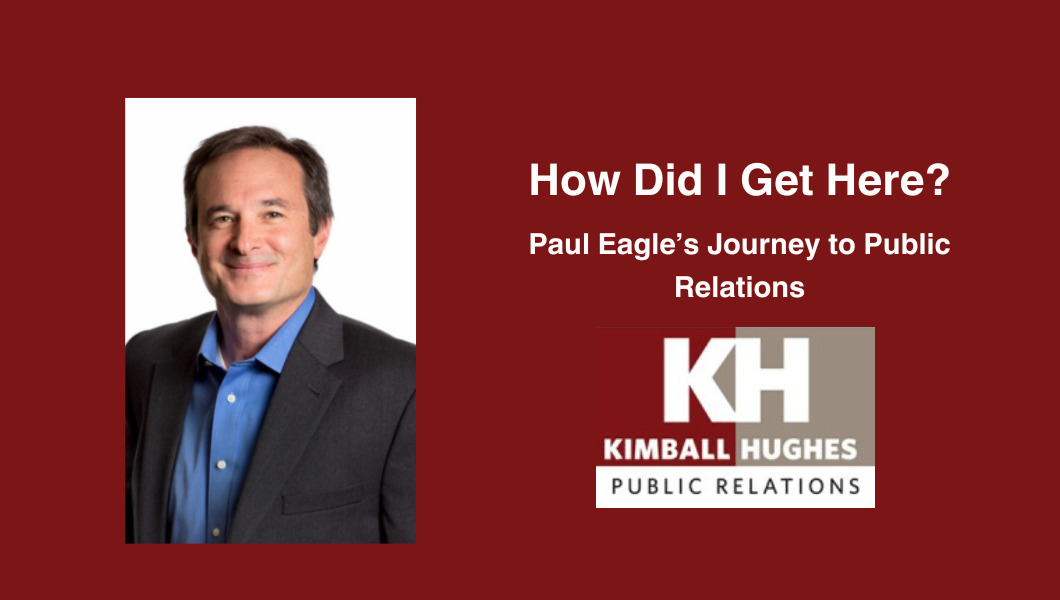
How I Got Here: Paul Eagle’s Journey to PR

Many career paths are unplanned. As specialists in insurance communications, we hear from insurance professionals all the time who found their way to their professions through unplanned or unexpected means. The same can be true of public relations. Whether it’s journalism, marketing or human resources—the PR field is uniquely suited to diverse backgrounds. That is why we are sharing this blog series breaking down how our team members came to find their current PR roles. For any new grads trying to figure out what they want to do, or even established professionals looking to make a change, we hope this series can shed some light on the PR field. 

What did you go to school for?

I started out as a psychology major. During my studies I discovered college radio, where I became a broadcaster and got totally hooked on communications. I later did an internship at a newspaper and changed my major to communications with an emphasis on public relations.  

What did you envision your job would be? 

There’s a great meme on social media about what my mom thinks I do versus what I actually do. It shows Mom thinks I’m behind a bank off microphones and cameras all day, but what I really do is sit behind a computer typing all day. It took me a while to realize that to be successful it takes long hours behind a computer doing research, cultivating relationships and writing really well to make one a good public relations practitioner.

What was your first job out of college? 

The Peace Corps. I served in Liberia West Africa, where I lived in a village with no power or water and ate lots of rice and jumping meat. One of my jobs was working at ELRV-Radio where I produced a weekly show about building fishponds in swamp rice farms for protein sources in rural villages.

How did you end up in your current role?

I spent 15 years in agency life, which I loved. It’s nimble and interesting and there is so much action. Then I spent 12 years as a vice president of one of the largest humanitarian organizations in the world. That was a very moving and intense role—especially with all the traveling. Today, I combine the two worlds in my role as a consultant and it’s my favorite job of all. 

What has surprised you most about your career or yourself given your current role?

Even though I feel prepared and knowledgeable for this role, I still learn every day. Public relations is never boring and there is always something new to pick up.

What have you learned from your career journey?

Empathy. Listening. Flexibility. These are all keys to success in public relations. And, of course, the improv theory of yes, and… . Spend your time adding value and making your colleagues’ ideas, products and services better, rather than tearing them down. 

What lesson or myth-busting idea would you want to share with someone thinking about a career in public relations?

In the early years we fought for credibility among leadership. Now we are side-by-side with leadership working through problems and solutions. The C-Suite understands the value of strong communications and often relies on their public relations team in good times and bad.