Are Automated Posts the Best Solution for Your Social Media Efforts?

Many companies and the marketing and communications agencies that represent them use social media management tools such as SproutSocial, Hootsuite or Radian6 to manage their social media accounts.

Many social media professionals love the scheduling features of these tools. Often scheduling tweets and Facebook posts in advance is done to save time, but is this having a negative effect on your engagement?


keiyac / Foter / Creative Commons Attribution 2.0 Generic (CC BY 2.0)

1. Don’t be a robot. If your company’s tweets are posted everyday at 10 am, noon and 2 pm, followers will notice that. It will seem like you are simply tweeting three times a day because that’s what you’re expected to do, not because you have genuinely useful or relevant information to share. Also, it seems robotic, like a real person didn’t take the time to craft the tweet him or herself.

2. Interaction goes both ways. If your posts are all scheduled, you will be missing opportunities to interact with your followers. Say someone asks a question on Facebook. Ideally you would respond to their question in a timely fashion. One way to be sure you catch notifications quickly is to have your social media management tool up in the background of your computer, so that while still working on other projects, you can occasionally check to make sure you haven’t missed anything.

3. Stay up to date on the news. If your posts for the day are all already scheduled, you may not be taking into account breaking news and events that come up that affect your industry or company. When these things happen it is important that you respond as soon as possible, so as not to get lost in the crowd. Simply taking a half hour during the day to go through your news feed as well as search the news for any relevant industry updates, is a great way to share or retweet the timely news your audience wants to know.

There is absolutely a place for scheduling automated posts, such as if you want to share company news or a link to your newest blog post. However, scheduled posts have to be mixed with live posts in order to most effectively communicate with your audience.
Socially Irresponsible

Some small business owners don’t believe in using experts for social media engagement and content development. They see the practice as novel and unproven – until it isn’t.

Such is the case of The Union Street Guest House in Hudson, N.Y. This picturesque small town inn quickly discovered the demonstrative impact of social media when comments about a fines-for-reviews policy hit the inn’s Facebook page and Yelp, the popular online review site.

According to an ABC News story resulting from the social media dust-up, the inn claims its “policy” was posted to its website as a tongue-in-cheek response to a wedding from years ago and should have been taken down. The policy in essence stated bridal parties would be fined $500, taken from deposit monies, for each negative review the inn might receive connected to a particular wedding or event.

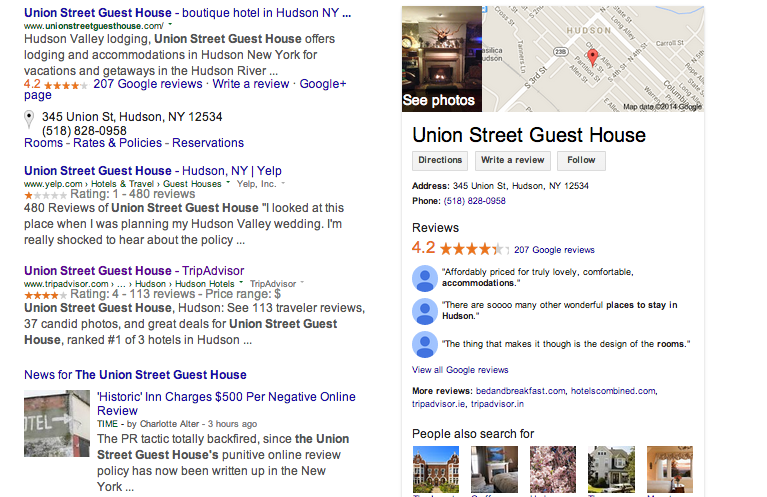
A Google search for the inn's name brings with it a wealth of negative online content that will impact the business' bottom line.

A Google search for the inn’s name brings with it a wealth of negative online content that will impact the business’ bottom line.

Unfortunately, a simple Google search of the inn’s name now produces both a link to the inn’s website, as well as countless social media and news articles referencing this not-so-amusing policy.

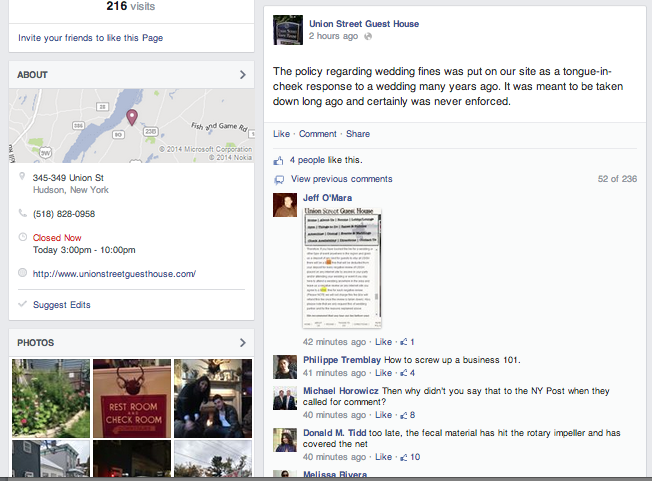
The result is a Search Engine Optimization nightmare for the inn coupled with a runaway train of negative comments on its Facebook page (more than 200 at this writing; although it appears the inn may now be deleting posts from its Facebook page).

Since this firestorm hit mainstream media, the inn's Facebook page has been inundated with negative posts.

Since this firestorm hit mainstream media, the inn’s Facebook page has been inundated with negative posts.

The news coverage and social media firestorm – with only a half-hearted response from management that appears to have since been deleted  – have created a massive public relations problem to overcome. This isn’t the type of crisis you wait out. And without a strategy for responding to and recovering from this communications nightmare, The Union Street Guest House is likely to see a steep decline in business, assuming it has the wherewithal to survive at all.

Small businesses are successful because they do what they do well. Where they often fail is when they try to do something outside of their expertise.

By consulting with a social media professional or brand content specialist, small businesses can avoid errors – even tongue-in-cheek responses – that might not seem substantial at the time, but with an extra set of trained eyes, can be seen for the potential disasters they are and thus avoided. Alternatively, bringing in the professionals after a crisis has erupted is not optimal, but it can mean the difference between staying in business or going under.

Most freelancers or public relations agencies can find equitable arrangements with small businesses that won’t break the bank, and can avoid or attempt to correct business-ending mistakes.

For a free consultation on how working with a public relations agency can help protect and promote your business, please contact me at rhughes@kimballpr.com.

Employee Travel: Preparing for Summer Travel

For Kimball Communications, summer is packed with conferences, workshops and events. Our employees attend conferences across the U.S., and since we cannot physically be together each day it’s important to have a plan before traveling. You, too, can keep everything running smoothly by following this simple, yet effective strategy.


Eelke de Blouw / Foter / Creative Commons Attribution-NonCommercial 2.0 Generic (CC BY-NC 2.0)
  • Prepare ahead of time. Have an internal meeting to go over everyone’s travel plans. Be sure you know when and where everyone will be throughout the summer. Keep a calendar of employee’s travel arrangements and daily schedules.
  • Stay connected. Technology is key. Skype, voice call, text and email will keep everyone informed.
  • Be aware of time zones. Remember, there’s a good chance you will not be on the same time zone. Schedule calls with each other appropriately.
  • Delegate tasks. Make sure all your bases are covered. Assign timely tasks to colleagues. This will ensure deadlines are still met and will simplify things tremendously.
  • Reach out to clients. Ensure clients are aware when you’ll be out of the office. It’s important to let clients know there will always be someone they can reach out to if a problem or question arises.

How do you stay connected during travel? Follow #KPRontheroad to see where we’ve been, and where we’re going, this summer.

Photo credit: Eelke de Blouw / Foter / Creative Commons Attribution-NonCommercial 2.0 Generic (CC BY-NC 2.0)

Don’t be a phony: Wikipedia and PR

David Kracht / Foter / CC BY-NC-SA 2.0The PR industry extended an olive branch to Wikipedia this week.

Earlier this week a consortium of PR agencies released a joint statement on their intention to comply with Wikipedia’s terms of service. This may seem like an empty gesture, but it is considered a significant step towards resolving a conflict between the communications industry and Wikipedia’s vigilant volunteers.

If you are not familiar with this conflict, here’s the short of it: Edits to a Wikipedia entry by a paid representative of an individual or organization constitute a conflict of interest and violate Wikipedia’s terms of service and goals. However, PR pros and freelancers have been paid to edit entries for nearly as long as the online encyclopedia has been around. Read up on the 2011 dust up between a British PR firm and the online encyclopedia for a clearer picture of the relationship.

Though I generally disagree that someone involved with an organization is incapable of updating basic information about that company without falling susceptible to promotional urges, I understand Wikipedia’s policy. It helps keep entries honest, factual and balanced. But more importantly, I understand that it is a community with rules and guidelines; it doesn’t matter whether or not the PR industry likes them. We have to play by the rules or risk our clients’ reputations and exclusion from the community.

Plus, trying to control a conversation—whether through spin or ham-fisted encyclopedia edits—necessarily relies on subterfuge and dishonesty. That never ends well. Instead, PR pros need to make their clients a part of the conversation.

On Wikipedia, that means requesting an edit and making your case for it. There’s even a page full of resources for paid editors, including the proper channels for requesting a change. If you need to make a change to a client’s Wikipedia entry, start there.

For a bit more inside baseball on the relationship between Wikipedia and the communications industry, check out the entry on conflict-of-interest editing, WikiProject Cooperation and WikiProject Integrity. These—and the terms of service—are essential reading if you are considering editing a Wikipedia page for a client or employer.

To get a peek into how Wikipedia’s community of moderators and editors resolves perceived conflicts of interest, check out the talk section of the Cracker Barrel page.

There are as many opinions on this matter as there are Wikipedia pages. Where do you stand? Does editing Wikipedia entries for pay violate your professional ethics? Have you done it? Talk to us about it in the comments.

Get Heard With Fewer Words

As people get more and more news from blogs, Facebook posts and tweets, content is becoming shorter and shorter. In fact, new guidelines put out by the Associated Press request that stories be no more than 500 words. Simply put, people want to read something short, sweet and to the point.


Fletcher Prince / Foter / Creative Commons Attribution 2.0 Generic (CC BY 2.0)

The same is true with journalists and editors. They get hundreds of emails a day, so chances are they aren’t interested in reading a long, detailed pitch and press release from you. They want to know the important facts as quickly as possible.

If your story isn’t getting heard, try making brevity and succinctness your focus. Here are some ways to do that:

Media Pitches:

  • Have a strong, attention-getting and short subject line
  • Make the media pitch a short and intriguing summary of the story in the body of the email
  • Be sure to focus on the timeliness and the local connection of the story, if applicable
  • Encourage interaction by providing multiple ways for the journalist to contact you, should they want more information

Press Releases:

  • Write more like a journalist, focusing on the news aspect of the story
  • Include the Who, What, When, Where, Why, and How in the first couple paragraphs – that way if that’s the only thing they read they still get the gist of the story
  • Always limit press releases to one page
  • Save them as PDFs so they can be universally opened and send them as an attachment to your pitch email
  • Attach pictures if you have them that journalists can use to go with the story

Another suggestion is to use your media contact database to its full potential; at Kimball Communications our database tells us an editor’s preferred form of contact. Some prefer phone, email or Twitter, this is a good thing to use in order to follow up with them and gauge their interest in your story.

Consistency Matters on the Social Web

When it comes to managing social media platforms, consistency matters. From the content that is shared to the voice/tone, being consistent is vital. Below we explore a few ways to keep everything in sync.


mkhmarketing / Foter / Creative Commons Attribution 2.0 Generic (CC BY 2.0)

A few things to consider …

  • Frequency matters. Ensure content is shared regularly on platforms. Posting four to five times a week? Stick with that posting schedule that disperses your posts evenly across the week. Avoid disappearing on platforms for an extended period of time.
  • Avoid randomness. Stick with content related to the industry or your brand identity. It can be confusing when seemingly random content is shared especially if someone is visiting the page for the first time.
  • Voice consistency matters. Be sure the voice and tone is similar when posting, responding or engaging with others especially if a few people manage the account. This helps establish a friendly rapport.
  • Keep the company name consistent. Avoid confusion and stick with the same company name. For example, decide whether or not your will use your company or brand’s full name or acronym.
  • Keep the logos uniform across all platforms. If you have different versions of your logo, ensure you are using the same one across social accounts. This helps people find and recognize you across platforms.

Feel free to share any additional tips in the comments!

Photo credit: mkhmarketing / Foter / Creative Commons Attribution 2.0 Generic (CC BY 2.0)

TeenCentral.Net Educates Teens about Dating Violence

Online graphic novel educates teens about domestic violence, offers resources

Schnecksville, Pa. – One in three teens will experience some form of abuse from someone they are dating. To raise awareness of dating violence and help abused teens get help, TeenCentral.Net today announces the launch of ‘A Good Date Gone Bad.’

This online graphic novel – another in a series of themed sections on TeenCentral.Net – provides teenagers with information about domestic violence, including signs of dating violence, advice to handle an abusive date, and a safety plan to help teens avoid abuse.

“Although we hear about domestic violence in the news sometimes, dating violence among teens, which occurs with alarming frequency, is rarely discussed in public,” says Julius Licata, Ph.D., director of TeenCentral.Net. “Teens often don’t know what is normal or abnormal in a relationship. Because they may not recognize certain behaviors as abusive, ‘A Good Date Gone Bad’ offers insight and help for teens with concerns.”

‘A Good Date Gone Bad’ provides an interactive quiz to help teens identify if they are in an abusive relationship followed by steps on how get help. The steps include a list of certified websites and hotlines for victims to call. Another important section of the site is the safety plan, which encourages teens to have a plan in place that has been shared with trusted individuals to lower chances of being abused.

ABOUT TEENCENTRAL.NET
TeenCentral.Net is a unique prevention, intervention and aftercare website developed by KidsPeace, a national not-for-profit mental and behavioral healthcare charity headquartered in Lehigh Valley, Pa. TeenCentral.Net’s mission is to help teens safely and anonymously tell their stories and receive sound advice within 24 hours from specially trained volunteers and counselors. All postings by teens and volunteers are reviewed by Master’s level clinicians before appearing on the site. To learn more, visit TeenCentral.Net.

Shawn Yingling Takes the Helm at Glatfelter Healthcare Practice

York, Pa. — May 5, 2014 — Glatfelter Program Managers (GPM), a strategic business unit dedicated to Glatfelter Insurance Group’s program business, has appointed Shawn Yingling as president of Glatfelter Healthcare Practice, effective today. Yingling is currently president of Glatfelter Religious Practice (GRP) and will maintain this role.

Yingling is a 26-year veteran of insurance program business. In 1988, he joined Glatfelter as a commercial underwriting specialist for the VFIS program, and then joined the Claims Department as a liability claims representative. Later, he was promoted to regional marketing representative for Glatfelter’s Ambulance Insurance Services, served as a producer for VFIS and then was promoted to Pennsylvania marketing and sales manager. In 2012, he was hired to lead GRP.

Licensed in all states, Yingling’s insurance designations include: Associate in Underwriting (AU), Associate in Claims (AIC), Accredited Advisor of Insurance (AAI), Associate in Insurance Services (AIS), Associate in Customer Services (ACS) and Certified Professional Insurance Agent (CPIA). He is currently working toward the Chartered Property and Casualty Underwriter (CPCU) and Associate in Management (AIM) designations. Yingling holds a bachelors’ degree from the Pennsylvania State University.

Sue Federinko, who led GHP as a senior vice president since 2013, retains this title as she moves to a leadership role on GHP’s sales team and assumes responsibility for all relationships with the program’s “Most Valuable Producers (MVPs).” She will also oversee all GHP territory east of the Mississippi and is responsible for expanding GHP’s distribution.

About Glatfelter Program Managers (GPM)
GPM (www.glatfelters.com/specialty_insurance_programs.asp) is a strategic business unit dedicated to Glatfelter Insurance Group’s program business. Based in York, Pa., GPM is one of the premier managers and recognized specialists of niche markets in the country. GPM manages and markets several specialty programs, including VFIS for fire departments, ambulance and rescue squads, and 911 centers; Glatfelter Public Practice for educational institutions, municipalities, independent school bus contractors and water/sewer entities; Glatfelter Healthcare Practice for skilled care, assisted living, independent living, continuing care retirement communities (CCRCs), personal care and group homes, hospice, home health care agencies and other private homecare agencies; and Glatfelter Religious Practice for churches, synagogues, temples and other religious institutions.

Cohen Feeley Marks 20 Years With Scholarships for Best of the Best

BETHLEHEM, Pa., April 21, 2014 – On May 17 Cohen, Feeley, Altemose & Rambo will celebrate the 20th anniversary of its Annual Best of the Best Scholarships Program. The law firm will award scholarship assistance to 37 Lehigh Valley, Hunterdon and Warren County high school students at the Event Center at Blue in Bethlehem.

The Best of the Best Scholarship Program was established by Martye Cohen and Dennis Feeley in 1994 to recognize one outstanding high school student from each high school in the Lehigh Valley. The program added 10 high schools in Hunterdon and Warren counties in 2013.

“The kids receiving these scholarships are selected through a committee that considers their academic achievements, extracurricular activities and the challenges they have overcome to excel at school and in life,” explained Martin D. Cohen, founding partner of the personal injury and commercial litigation law firm. “They are, without question, the best of the best.”

In addition, one male and one female from the Lehigh Valley and Warren and Hunterdon Counties is selected from the 37 honorees to be named overall Best of the Best. Two other students from all the applicants are granted the Team Capital Bank Community Service Award.

“Martye and I started Best of the Best 20 years ago to help make a difference in people’s lives,” said Dennis Feeley, a partner at Cohen, Feeley, Altemose & Rambo. “In the past 20 years we’ve provided assistance to nearly 700 area high school students and helped improve their lives and their communities at the same time.”

In the spirit of the program’s efforts to give back, the law firm also makes charitable donations in the name of each award recipient to a charity of the student’s choice.

The scheduled keynote speaker for the May 17 breakfast ceremony will be Temple Law School Dean JoAnne A. Epps.

ABOUT COHEN FEELEY
Cohen Feeley, Altemose & Rambo is a personal injury and commercial litigation law firm serving the needs of those in the Lehigh Valley and beyond for more than 30 years. Cohen, Feeley Altemose & Rambo has offices in Bethlehem and Allentown, Pa. For more information, please visit www.cohenfeeley.com

NAPCO Report: Low Property Catastrophe Losses and New Capital Drive Down Pricing and Increase Competition Among Insurers

State of the Market Insights Report asks whether the continued increase in industry capital from non-traditional sources will force insurers to rethink products and pricing

Iselin, N.J. — April 8, 2014 — With low global insured catastrophe losses and added capacity from non-traditional market sources, insurers have become increasingly competitive and are reducing rates for most accounts. This is a key takeaway from State of the Market: NAPCO Property Catastrophe Insights report from NAPCO, a wholesale insurance broker with expertise in the property catastrophe market.

Drawing on broker and insurer insights, as well as industry wide statistics, this report analyzes property-catastrophe insurance industry performance in 2013, catastrophe losses and trends for 2014.

“While catastrophe model guidance and rating agency pressure continue to play an important role in pricing and evaluating risks, the continued increase in the industry’s capital – including new capital from non-traditional sources – is changing how pricing is done,” says David Pagoumian, CEO of NAPCO. “These developments may begin to disrupt old business models and force insurers to rethink products and pricing.”

According to Pagoumian, brokers who understand the marketplace have an opportunity to help clients figure out when to remarket programs and how to structure programs to provide better coverage and pricing.

Key report findings include:

  • At about $31 billion, 2013 global catastrophe losses were well below the 10-year average, with no one event proving capable of affecting pricing.
  • Insurers’ net income rose 55 percent to $43 billion, thanks to strong growth in premiums and low catastrophe losses.
  • New capital from non-traditional sources now totals $50 billion, and catastrophe bonds are being used to protect against a wider array of risks.
  • Low catastrophe losses plus competition from alternative markets are driving down the price of reinsurance, 10 to 25 percent on loss-free accounts.
  • The frame habitational and commercial flood insurance markets remain difficult.
  • After raising rates in 2012 following a CAT model release, insurers kept rates relatively stable throughout most of 2013; in 2014 expect a soft market where insurers offer lower prices and plenty of capacity.

Download the full Fall 2013 State of the Market report at http://bit.ly/SOTMSpring14 for a deeper analysis of these trends detailed placement considerations for brokers.

About NAPCO
NAPCO (www.napcollc.com) is a leading wholesale broker of commercial property insurance coverage, providing retail agents and brokers with an efficient, single-source independent marketing arm for difficult placements that have significant exposure. The company utilizes in-depth research and sophisticated risk modeling to implement coverage and cost-effective programs. Headquartered in Iselin, N.J., NAPCO provides access to the global insurance market, including major and specialty domestic carriers, excess and surplus lines markets, reinsurers and international providers.