The Lesson of 2023: Messaging Matters More Than Ever

From the explosive exploration and application of generative AI across society, to bank failures and financial upheaval, inflation and more, 2023 was the year that surprised no one and everyone at the same time while keeping us all wondering what might follow.

This was also a year where proper messaging, or the failure to provide proper messaging, played into the headlines at a level we hadn’t seen since the height of the pandemic.

Introducing:  AI

Across the calendar, 2023 was the year where everyone wanted to talk about technology, specifically artificial intelligence. From an ill-considered public discussion about using AI to advance diversity at Levi’s to the very public spectacle that was the firing and rehiring of Sam Altman at OpenAI — and all manner of speculation of how AI would improve nearly every business — poor messaging drove headlines and cost their brands.

In March, Levi’s announced plans to use AI-generated clothing models to allow customers to see clothes on models who looked more like them. The initiative was met with backlash for failing to include in their messaging the platforms to find the AI models or information on how to customize the models, as well as what the change would mean for human models. The company was forced to issue a follow-up statement clarifying the initiatives and explaining, among other things, that it was not meant to substitute real action on diversity, equity and inclusion at the company.

Of course, the messaging around Sam Altman’s firing and rehiring at OpenAI made our list of messaging gone wrong in 2023. First, the board of directors of OpenAI fired Altman with a public announcement claiming he was “not consistently candid in his communications with the board,” and that the board “had no confidence in his ability to exercise his responsibilities.” After Microsoft swooped in to try to pick up Altman and his colleagues, pressure from employees and investors mounted, prompting OpenAI to post on X that Altman would be returning as CEO.

It seemed not a day passed this year when the public square did not feature a discussion about the digital world. And, regardless of your technological interest or acumen, few can honestly say they were not aware of or participating in the buzz around AI.

Failing Fabulously

Meanwhile, the financial sector was rocked when a few banks formerly ranked as among the 30 largest in the US imploded despite reassurances from business and government officials. In fact, one of the failed banks committed financial suicide due largely to poor messaging. Silicon Valley Bank, in the wake of rising inflation and interest rates, issued a statement in March that made no mention of its financial strength and instead focused exclusively on losses, manifesting an old-fashioned bank run that effectively killed the institution.

Additionally, theories and speculation on inflation and a potential recession offered real-world consequences for the global economy. Notes from a March meeting of the US Federal Reserve didn’t mince the words of Fed economists, noting bank failures were likely to cause “… a mild recession later this year.” This set off a chain of events that saw Silicon Valley leaders like Google, Meta and others publicly trim headcounts while other industries took a long, wait-and-see approach to spending in 2023.

The Value of Words

In short, buzz and speculation that included the active participation of brands and businesses through their messaging not only influenced public perception, but that messaging also drove consumer decision-making.

In a world increasingly attuned and sensitive to business and industry messaging, 2023 offered a bevy of examples too numerous to mention here that reinforce the adage, words matter. One of the key takeaways from this as we look to 2024 and beyond is that minds, as well as markets, can move more dramatically than ever based on how messaging is conceived and delivered. Brands and nonprofits will do well to apply this lesson to their new year planning. And, of course, Kimball Hughes PR is always here to help craft as well as pressure-test the words and content that shape the perceptions of those audience(s) most important to your organization.

A Holiday Message from Kimball Hughes Public Relations

This month the world will observe 11 faith-centric holidays and several more seasonal observances. For millions, every December offers a buffet of celebrations, time spent with friends and loved ones as well as moments of great delight, remembrance and, in some instances, challenge and struggle.

To our remarkable clients who greet us in partnership and invite us to apply our skills and talents to help navigate the successes and obstacles of their work, we offer our sincere appreciation. We endeavor to bring our best selves and thinking to each engagement, and we hope doing so further contributes to the qualities we believe distinguish our agency from our competitors.

Each day we are fortunate to work with remarkable professionals within the agency who all check their egos at the door and work – genuinely – as a team toward the mutual benefit of our clients, one another and the agency. Rare is the work environment where apprehension is absent, constructive collaboration is abundant and good humor and appreciation is ample and appreciated. This reality exists because each individual on our team chooses to manifest it daily.

Of course, without our families and loved ones, we would lack the emotional, mental, and frankly, the actual physical space to excel at our craft. Thank you is both an inadequate response to all you do to help make our good work viable and joyful, as well as the best and most concise articulation of how important you are to our personal and professional lives. So, thank you.

Whatever holiday you might observe, whether your December is spent in joy or somber remembrance, the team at Kimball Hughes PR wishes you peace, good will and success now, in 2024 and beyond.

KHPR Reflections: Top Moments of 2023

It’s been an exciting and fast-moving year for the team at Kimball Hughes Public Relations, full of special personal moments, career wins and of course, challenges. As the year rapidly comes to a close, we wanted to take the time to look back and reflect on our favorite moments of 2023. What were some of yours?

Rod Hughes: Perhaps my favorite moment from 2023 – among many – was an April trip to Carmel, California. I’ve been there before, but this trip was special because I played tour guide to my partner, David, who also fell in love with Carmel. After a busy few years focused on growing the agency, this Carmel trip was a needed and welcome respite where so many great memories were made.

Eileen Coyne: In the spring of 2023, my family took the trip of a lifetime. Navigating different languages, subway systems and coffee orders, we enjoyed whirlwind tours of London and Paris, travelled through the Alps, and completed our Griswald-like adventure in Italy.

James McKinsey: After getting married at the end of last year, my wife and I took a honeymoon to Glacier National Park. Seeing the bison and experiencing the mountains were an incredible place to celebrate the beginning of our lives together.

Hari Rajagopalan: This year, I took a trip down to Cancun to wrap up the summer. A nice week at the beach, relaxing and enjoying some beautiful weather and great food was exactly what I needed to recharge.

Cassidy Taylor: My favorite memory from 2023 has quickly become my favorite memory yet. This summer, I married my best friend and partner, Matt, in front of our closest friends and family. We had a beautiful ceremony followed by a memorable celebration with lots of dancing and laughter.

Kate Glaviano: While not just one moment, the best part of 2023 was making time with my friends to travel and spend time together. After years of huge life changes and a few moves to different states, it’s been grounding to reconnect, see new places and laugh hysterically with the people who know me best. 

Liz Rubino: One of my favorite memories from 2023 was when my grandson was born right before my birthday. Seeing his brother and our family enjoying the day was the best gift ever.  

Getting Festive: Four Ways to Celebrate the Holidays with Remote Teams

There was a time in business when office employees would get dressed up and gather with their coworkers for the office holiday party. As we know all too well, the pandemic changed everything – including those holiday parties.  

Office holiday parties used to be a significant aspect of a company’s culture where people would bond casually and build personal relationships. Not to mention, people looked forward to the celebrations with coworkers when business dialed down for the season.

Though traditional office parties may have fallen out of favor, we have a few ideas to help you mark a successful year and a happy holiday season with your teams near and far.

Tis’ the season for holiday fun

  1. Take a virtual city tour with the team. Consider marking the holidays with your remote team by taking a virtual city or region tour where they can explore tourist sites around the world with a guide local to those places. There are third-party companies that provide immersive tour experiences such Unexpected Virtual Tours and many of these companies will have a range of options to choose from like European virtual tours, South American holiday and more. To complement the tour, management may choose to send team members a special delicacy from that region to enjoy together while watching the virtual tour. Many of these tours have a strong educational component as well – but at minimum a tour could be a welcome virtual escape for team members geographically dispersed across the country.
  2. Encourage a gift exchange: A holiday gift exchange where team members send gifts to each other anonymously is a great way to engage employees with low pressure. Participants can create a wish list to help guide their coworkers buying for them in the right direction. Alternatively, the team could decide to make it humorous where team members compete to send the “most useless gift” or gift the “ugliest sweater.” If employees are interested in making the exchange more interactive, they can gather virtually to guess who sent which gift.
  3. Host a game or contest virtually: A little friendly competition offers employees a chance to work together and learn something new about each other, or good old fashioned bragging rights. Businesses could opt to use a third-party company for a game of trivia or a virtual escape room where employees work together to solve puzzles. To go a step further, leadership could organize a virtual baking or decorating competition where the team meets virtually to bake or decorate the best cookie, baked good, etc.
  4. Get together in January: Though virtual options have come a long way, nothing replaces in-person get togethers where employees gather outside of the business setting. If feasible, business leaders can consider postponing holiday celebrations to January when travel and accommodations can be more affordable and plan a get together in a convenient location. Holding a celebration in January also disconnects the celebration from a specific holiday, making it more inclusive to the entire team.

In planning any holiday fun, it’s always important to keep inclusivity in mind.Not everyone celebrates Christmas, and it is important that all team members feel comfortable and considered in holiday celebrations. Use terms like “happy holidays” and avoid the use of Santa Claus, or other holiday specific symbols in signage, cards and so on when planning for the season.

While the holiday office party may be a thing of the past for most businesses, employees are still interested in spreading some holiday cheer and deserve to celebrate their accomplishments from the year. While lavish holiday office parties may be a thing of the past, holiday celebrations with a valued team, shouldn’t be. Cheers to a festive and fun holiday season!

The Stories We Tell About Insurance Must Change

For years our agency founder, Gary Kimball, talked about how the insurance industry has an image problem. I continue to share that sentiment.

It’s akin to a plane crash. This time of year, millions of us climb into aluminum/composite tubes to be flung hundreds of miles per hour at 30,000 feet or more to visit family and friends. We do this, mostly, with confidence and not much concern about the airline industry until we learn of an incident of some kind. Suddenly, some are afraid to fly … because of one incident.

Whether it is capacity issues, carriers leaving certain states or regions, rising premiums, the talent crisis or denial of claims, these seemingly jolting situations are a mere fraction of the total contribution of one of the few industries that, without exaggeration, not only helps us in a time of need, but underpins every foundation of our society.

So, what is the solution?

Insurance leaders need to lean into what the industry, and individual companies, enable in the world. The messaging going forward needs to focus less on balance sheets, premium, products and capacity. Instead, a long-term image campaign is required. To do this successfully, a full-throated and relentless discourse is needed on the successes and enablement insurance provides across our society, in things large and small.

  • Businesses can expand – and create jobs – because they have insurance to protect them in the event of an “incident,” whatever that might mean to the business.
  • Technologies can be explored, developed and deployed because insurance exists to protect organizations and entrepreneurs from misapplications or hardware failures.
  • Each of us can invite friends and family to our homes, regardless of season, weather and other conditions, with the reassurance that if a guest trips or gets hurt, there is insurance to protect them and us from financial devastation.
  • Holiday gifts, as well as mission-critical medical equipment, can be shipped around the world without fear of loss or damage because these items are insured.
  • Life-saving treatments can be developed because the scientists and doctors doing the work are covered in case something goes wrong, ensuring the entire enterprise isn’t lost to the detriment of those who depend on these treatments.
  • Volunteers can support charitable events and serve on the boards of nonprofits doing social good because insurance shields them from junk lawsuits or legitimate, but not malicious, errors in action or judgement.
  • You can buy your $1,000 smartphone and rest assured two days later when you drop it that you have insurance to cover the repair or replacement without breaking the bank.
  • And those aluminum/composite tubes can help us get home to our families for the holidays because insurance protects them from complete disaster in even the most minor of errors, delays or missteps.

These and other messages are what consumers, potential industry recruits, business executives, homeowners, nonprofit leaders and others need to hear. In this moment, as we brace for a new year and all the challenges that come with it, we need to change the industry’s approach to its perpetual image problem.

I have spent a career reporting on, adjacent to and supporting the insurance industry. I am a convert. Despite the occasional bad press, there is so much the industry does that makes the world go round. We simply need to tell those stories, often, and starting now.

Attracting the Leaf Peepers: Tapping into PR to Leverage a Seasonal Rush

In today’s modern world driven by the 24-hour news cycle, social media buzz and influencers, organizations are constantly seeking ways to stand out and attract their target audiences. One powerful tool at their disposal is public relations (PR). However, PR is not just about creating buzz; it’s about utilizing an organization’s existing assets to build a stronger connection with its audiences and playing to your busy season.

This fall, we’ll look at fall foliage capital New England, its tourism bureaus, businesses and nonprofits. New England, with its historical sites and natural beauty, has learned to take advantage of its “it” season, autumn, to attract visitors and boost the region’s economy.

Leaves and Legacy

Renowned for its picturesque autumn foliage, New England attracts tourists and outdoor enthusiasts from around the world, aptly dubbed “leaf peepers,” by locals. Tourists chase the vibrant views up the coastline, swarming the northern states of Vermont, New Hampshire, Massachusetts, Rhode Island, Connecticut and Maine for a chance to snap a picture of the seasons changing. As they flood the northern states, opportunity awaits local businesses and nonprofits as they vie for the attention of paying customers to shop at local boutiques, stay in local hotels and dine in the region’s countless restaurants.

Some sites, such as Plymouth Rock, the Mark Twain House, the Paul Revere House and more draw millions of visitors year-round. Massachusetts and New England tourism groups leverage this reality each year to entice visitors to the area. For instance, one organization, Historic New England, is utilizing tourists’ interest in history to expand their profile. Through local news stories, the group is promoting its growing collection of some 125,000 historical objects in a sprawling cultural center around its headquarters in Haverhill, Massachusetts in the hopes that visitors will take advantage of the opportunity to see so much history in one spot.

Historic New England is not the only group utilizing PR and interest from tourists to boost their profile. Salem, Massachusetts, perhaps best known for its 1692 witch trials, is known to draw upwards of 1 million visitors each October. The town does not miss out on the opportunity to boast about their offerings. Every October, town leaders and their communications teams work to ensure they are included on lists featuring top spots to visit while leaf peeping in New England

Whether year round or seasonal, the historical destinations of New England have leaned into their natural appeal and the power of communications to make the most of their “most wonderful time of the year.”

Raking in the Customers

For those looking to leverage communication to make the most of their selling season, a good public relations strategy can complement promotional efforts to elevate your brand before this captive audience. Consider these tips:

  • Step up your social media efforts: A robust social media presence is critical to amplify your message during your “it” season. Business owners should ensure social channels are prominently promoted and accessible through their websites as well. By leaning into the inherent assets of the organization – a colorful personality in leadership, convenient or scenic location, practical benefits of their products or services – organizations can create a genuine connection with followers and build a reliable customer base beyond what existed before.
  • Get to know local media: Reaching out to local media when there is news that is of interest to the public is always a smart move. Businesses and non-profits must be careful, however, to avoid blatant self-promotional outreach to journalists. Offering sales or other obviously self-promoting information to the news media can have the opposite intended effect, damaging the organization’s reputation in the media and potentially black-listing it from future coverage.
  • Think outside of the box: Consider expanding your audience while the time is right. For example, while New England business’ primary consumers this fall may be folks on leisure excursions, tourism hot spots and hotels may want to consider reaching out to business and meeting publications to share the message of New England as a corporate travel destination if appropriate. Also, while traditional PR can be a powerful tool in cultivating an unbiased image of your destination or business, marketing promotions and sponsored content can complement those efforts helping business owners to capture an even larger audience.

In a world where organizations vie for attention and consumer loyalty, New England’s approach to soaking up the fall season serves as a powerful example. Know your organization’s time to shine and be ready to make the most of it with the right communication tools.

Trick or Treat: Recent Brand Wins and Fails

In the spirit of the Halloween season, we thought we would take a look at some tricks and treats in corporate communication efforts from the past several months that have made headlines. From widespread crises to clever spooky-time initiatives, brands and organizations around the world are experiencing tricks and treats impacting their brand.

Getting Tricky

Shein,a Chinese clothing company known for fast fashion, made headlines recently when they invited a group of influencers for an inside look at their factories. This trip came after several journalistic investigations last year revealed unsavory business practices including violations of labor laws and an environmentally unsustainable business model. The idea behind the trip was to have a positive image of the company presented by trusted influencers.

Unfortunately for Shein, this attempt to reclaim their brand image was not well received by the public since influencers only toured and commented on the company’s innovation center rather than multiple locations. Some accused influencers of taking part in a “propaganda stunt” as they shared reports with followers of clean factories and happy workers. After the backlash, some influencers ended their relationships with the company.

Shein’s experience is a key lesson in transparency and influencer marketing. While influencers are trusted by the public, they are not a surefire marketing tool and can present new risk exposure. A better approach from a communication perspective would have been for Shein to have a more honest and open conversation with the influencers, talk about prior news reports of poor conditions, point out discrepancies and note changes that were made to improve the work environment for employees.

In other news, the National Highway Transportation Safety Administration (NHTSA) recently pushed for a recall of about 52 million vehicles made with parts by a supplier, ARC Automotive, due to defective air bag inflators. General Motors (GM) manufactured approximately 20 million of those vehicles and recalled nearly one million in May for the same reason. The potential recall comes just two weeks after members of the United Auto Workers began to strike. GM made a statement in response to the NHTSA saying, they “believe the evidence and data presented by NHTSA at this time does not provide a basis for any recall,” per CNBC. “If GM concludes at any time that any unrecalled ARC inflators are unsafe, the company will take appropriate action in cooperation with NHTSA.”

GM has an obligation in the scenario to communicate a message regarding public safety. While vehicle manufacturers have come a long way in terms of safety standards over the last several decades, and the court of public opinion requires they tread carefully. Although GM’s concerns with the data presented could be valid, they could be seen as failing to prioritize customer safety. A good communicator will always encourage leadership to message with a sense of humanity, considering all sides of a situation and would have encouraged any messaging to include customer safety at the top.

Time for a Treat

It can be hard to gauge just how much candy to buy in preparation for trick or treaters.This year, Mars, the manufacturer of M&M’s, teamed up with delivery service GoPuff to create the M&M’s Halloween Rescue Squad. On Halloween after 3 p.m. ET, consumers can visit the M&M’s website to order free M&M’s in all locations GoPuff serves.

As one of the most popular candies in the U.S., M&M’s is taking a smart step to reinforce a positive brand image. Earlier this year, M&M’s was caught up in public controversy when they made changes to their “spokes candies” to remove gender norms from the characters. The controversy was thought to ignite a culture war that garnered the attention of national news outlets, political commentators and more. Less than a year later, the Halloween Rescue Squad is a way for media and the public to engage with M&M’s in a more positive, timely way.

Good communications can be a treat – or win – for your company, elevating your brand and bringing new customers to your door. But beware the trick of an ill-considered communications strategy. Partner with a public relations team who understands your business, your needs and can see the big picture.

Behind the Picket Lines: Communicating in Times of Employee Discord

Years ago, autumn was not just about pumpkin spice, leaf peeping, back to school and football. It was also celebrated as the end of summer’s re-runs with a new line-up of fresh television shows released each September. While those days are long gone with the advent of streaming platforms, this year looked a bit different. We were back to reruns.

The Writers Guild of America was on strike for more than five months, forcing a rapid halt to the production of new content for Hollywood. Then, its resolution in late September was followed with a strike by the Screen Actors Guild-American Federation of Television and Radio Artists, who have been behind the picket lines for more than 100 days now. Both unions were and are respectively pushing for long-term pay, control over artificial intelligence and employment consistency.

And it is not just Hollywood on strike these days. Roughly 46,000 workers with the United Auto Workers union in Kentucky, Michigan and Texas found themselves behind picket lines this fall demanding improved wages and benefits.

These strikes, coupled with employee push back on employer demands for a return to office point to the fact that today’s employees have a bigger voice, and their actions are forcing employers to listen. From a communications perspective, unhappy or disgruntled employees who take their complaints public can lead to a brand reputation problem. Fortunately, a smart, proactive plan for internal and external company communications can help diffuse situations and paint your company in the best light.

Best Practices for Communicating Amid Employee Issues

While a strike, social media backlash to a corporate return-to-work mandate, or round of layoffs may burden and inconvenience leadership with staffing shortages, overtime pay and/or mounting legal fees, the reputational damage could be the most destructive –  particularly if the press gets wind of it.

One of the best ways to get ahead of reputational issues related to employee discord is to work with a public relations team to build a comprehensive plan for internal and external communications. This way, leadership is better prepared and will have direction on how to maintain good communication with employees, vendors, stakeholders and the community. Among other best practices, leadership should consider the following in a time of employee discord:

  • Keep an open dialogue with employees.

Employees want to feel heard. With many employer return-to-work mandates, employees did not feel their needs were being considered.

Many employees like the cost savings and flexibility of remote work and feel they are more productive as a result. Employers who feel strongly about employees returning to work should communicate with employees rather than simply mandating a change. They should make the case for employees as to why a return to the office is necessary and even consider acknowledging the sacrifice employees made to work from home during the pandemic. After having that dialogue, leadership might determine that offering an incentive to bring employees back or a hybrid option could help maintain or improve employee morale and prevent discord.

  • Control emotions and cool tempers.

Communications between the U.A.W. and auto manufacturing plants have become heated with Stellantis issuing a press release that began with the fighting words, “we are outraged.”

Aside from pride, big dollars are at stake, causing emotions and tempers to run hot. But a good public relations professional can help a leadership team craft messaging that carries a human element and reflects a more considered approach. A public relations team would caution executives from letting anger show through, particularly in negotiation-related communications.

  • Keep your media team updated with all developments to avoid surprises.

Whether it is a salacious email leak connected to a member of the leadership team or a negative social media post gaining momentum, it is critical to keep your public relations team updated regarding developments during a time of employee discord.

You never know what will erupt into headlines and damage the reputation of your company. If your public relations team is made aware of the situation with time to spare, they can proactively prepare a plan and smart messaging to try to prevent a situation from spiraling out of control.

While a good public relations team may not be able to do anything about the employee discord forcing reruns upon us this fall, they can help company leadership better communicate – and recognize the value of open and frequent dialogue. Hopefully, we will see these workers and executives come to common ground soon, but until then, let us encourage a focus on good communication.

From Love Story to Bad Blood: The Pros and Cons of Influencer Campaigns in Public Relations

Influencer marketing can be a powerful tool for brands and public relations professionals looking to boost their reach and credibility. According to Influencer Marketing Hub, the influencer industry is set to grow to approximately $21.1 billion in 2023. However, despite many success stories, there are downsides. For example, according to Truelist, 63% of marketers and brands have been victims of influencer fraud. In addition, fake followers remain a top concern for 50% of marketers.

Perhaps no one understands the Jump Then Fall of the influencer world better than Taylor Swift. With more than 250 million followers on Instagram and more than 90 million followers on X (formerly Twitter), Swift can surely add the title “influencer” to her long list of accolades. Her recent relationship with Kansas City Chiefs’ Tight End, Travis Kelce, and her subsequent ties to the team serves as an outstanding example of both the pros and cons of utilizing influencers.

The Power of Influencer Campaigns

Influencer campaigns can be a dynamic component of public relations strategies, extending a brand’s message to a wider audience and enhancing credibility through association. While there is currently no formal influencer relationship between Swift and the Chiefs outside of her romantic relationship with Kelce, the team and the National Football League (NFL) are benefitting from the Invisible String that ties them together.

Wide Audience Reach: Swift’s immense popularity and influential status make her an ideal choice for brands looking to reach a diverse and massive audience. For instance, since her first appearance at a Chief’s game there has been a nearly 400% increase in Travis Kelce jersey sales. Brands who partner with certain influencers that connect with their audience and have a wide reach are sure to see similar results in their bottom line.

Authenticity and Trust: One of the primary reasons influencer marketing works is because it leverages the trust influencers have built with their followers. According to Marketing Dive, 69% of consumers trust influencers, then friends and then family before information from a brand.

Targeted Marketing: Since the first rumors of their relationship were released, interest in Travis Kelce has gone up by 25% and his favorability has gone up by 10%. Based on the many social media posts, a large portion of Kelce’s new fans are “Swifties,” otherwise known as Swift’s biggest fans. This is significant for both the Chiefs and for Kelce’s sponsors as 45% of these individuals are millennials and 52% are female. This is in contrast to the NFL’s typical fan, as 70% of the NFL’s fanbase is male and 65% are aged 25-39.

The Challenges of Influencer Campaigns

Despite the undeniable advantages, influencer campaigns come with challenges. Swift’s history with both the media and the public showcase just how quickly the tides can change.

High Costs: Hiring a superstar such as Swift, or even someone on a much smaller scale can be costly. While the average cost to hire a nano-influencer (1,000-10,000 followers) is only $10 to $100 per post, that cost can soar to $5,000 to $10,000 per post for macro-influencers (500,000-1 million followers), and organizations are paying the cost. In fact, 23% of respondents to Influencer Marketing Hub’s survey stated they plan to spend more than 40% of their budget on influencers this year, potentially taking vital resources away from other marketing efforts.

Loss of Control: When collaborating with influencers, brands must relinquish some control over their messaging. This can be risky if an influencer’s actions or statements do not align with the brand’s values or objectives.

Saturation and Authenticity Concerns: In the case of Swift’s relationship with Kelce and the NFL, many fans appear irritated, saying the NFL and the Chiefs are going overboard with mentions of Swift. Kelce seems to agree, saying, “They’re overdoing it a little bit, especially my situation.”

Influencer campaigns are valuable tools, offering a range of benefits such as broad reach, authenticity and targeted marketing. Nevertheless, they come with challenges like high costs, loss of control and concerns about authenticity. By carefully weighing the pros and cons and tailoring influencer campaigns to fit specific needs and circumstances, PR professionals and brands can leverage this powerful tool to enhance their public image and reach new audiences.

The Right Fit: The Benefits of Partnering with a Boutique PR Agency

Road Runner always outran Wile E. Coyote. The massive, formidable Death Star was no match for Luke Skywalker’s tiny x-wing fighter. And of course, we all know how David fared against Goliath. In each instance, the little guy triumphed, reminding us that bigger is not always better.

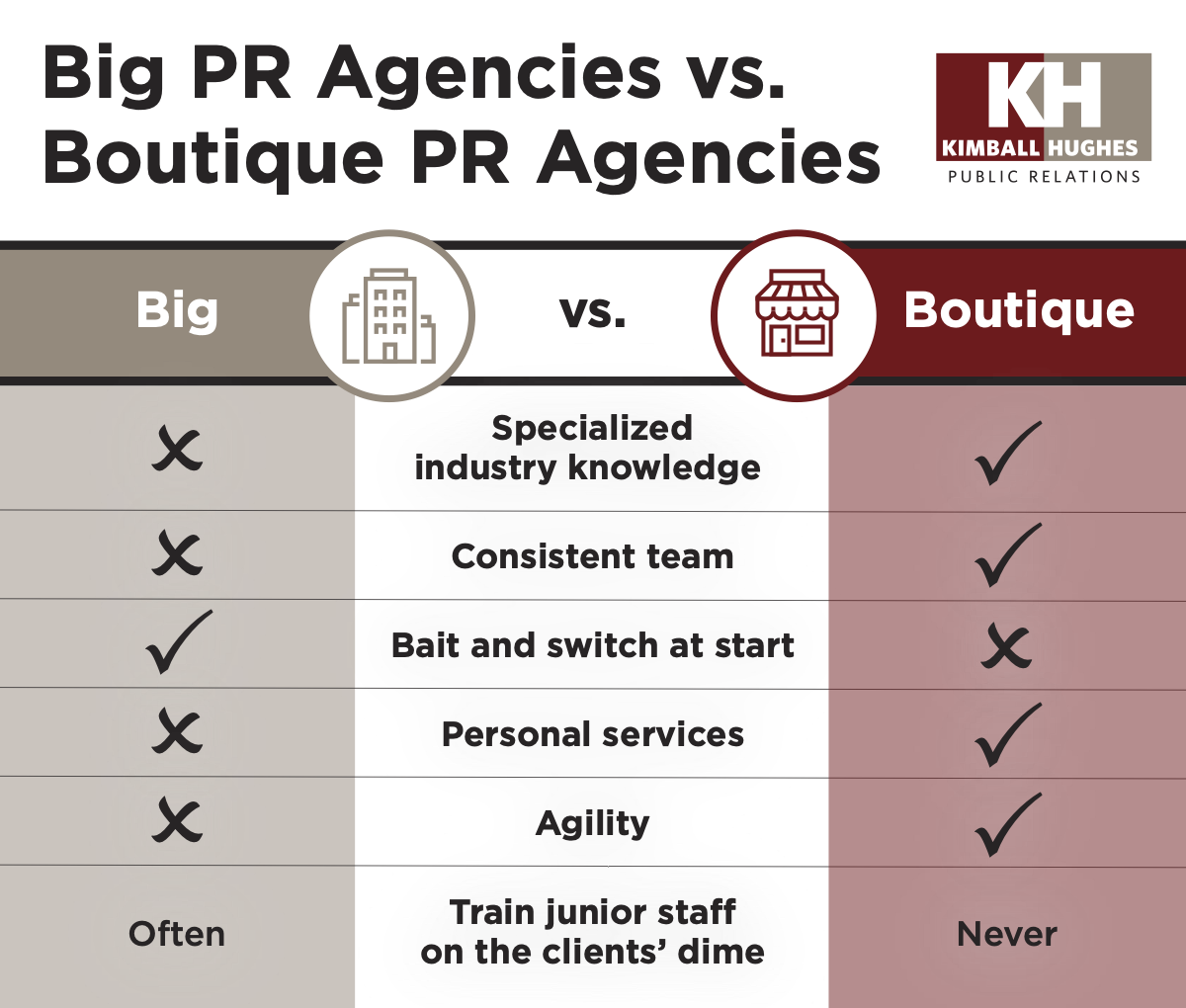
The same holds true when it comes to public relations agencies. Boutique-sized public relations agencies may not boast the large teams and vast service offerings that their larger counterparts do, but when it comes to specialized knowledge, nimbleness, and personal service, selecting the right boutique agency can provide unmatched success.

A Specialized Focus

Often a boutique agency will specialize in select industries where they have expertise. Their team will consist of seasoned employees who have worked within the industry itself or worked for years on accounts for companies in that industry. For example, at Kimball Hughes Public Relations, one of our specialties is insurance. Our team members have worked for numerous insurance clients from a PR agency perspective, have worked in-house for communications teams at insurance companies and even worked as reporters on the insurance beat. Moreover, boutique PR agencies pride themselves on employing experienced professionals to lead accounts; they simply cannot afford to risk their reputations by staffing client work with new or less experienced staff.

A boutique PR agency with a specialty will have knowledge of hot button issues and emerging trends. They will be able to do more than simply promote your brand or your executives, they will have the inside knowledge to be able to position your subject matter experts as thought leaders within the industry. They will know the conferences at which to be seen and secure media interviews that matter to your stakeholders. A specialized PR agency will have strong media contacts within the niche and help to position your leaders as go-to sources for future stories.

A Nimble Approach

Like Jerry the mouse, smaller agencies can be nimble – speedy too, like Road Runner. Without the red tape of a larger agency, a smaller agency can react to news more quickly and prepare a thoughtful response for your team to review and distribute in a timely manner.

A small PR firm will also be a nimble ally in a crisis. In those circumstances and others, you will have direct and prompt access to your agency account manager, someone you know and trust, who understands your organization and your industry who is also ready to help protect your company’s reputation anytime day or night.

That agility also comes in handy when a media strategy is not working. Valuing each and every client relationship as if it were the firm’s only relationship, a smaller agency will constantly be monitoring for results. When those results don’t manifest, they’ll recognize it immediately and pivot to a new strategy.

Personal Service

Finally, when you work with a boutique agency, your daily contact and team are likely to be people you met at the start of your relationship with the agency. The bait and switch is rare with boutique PR agencies. In fact, in many cases, you may know a number of people within the agency and they will know you and be familiar with your company’s needs. Small PR firms work closely with clients and staff to ensure  all team members are in the know so they can quickly spot-fill or act as an extra set of hands when necessary. Further, these folks will make an effort to get to know you and to understand your team’s marketing and communications goals to ensure your team is getting the results your c-suite wants to see.

For smaller PR agencies, clients are truly partners. We value relationships and want to deliver for our clients.  

So, smaller agencies may not wield a multi-story downtown headquarters the size of the Death Star. But they can be a powerful force. Give Kimball Hughes PR a call to talk to us about our specialized expertise, knowledgeable team and proven results.