I Hate to Tell You This: The Dos and Don’ts of Breaking Bad News

In business, we can’t escape bad news. Whether the topic is layoffs, poor earnings, a deal that fell through or any number of business or workplace challenges, communicating a negative outcome is sometimes as difficult as living with the outcome itself. There is no silver bullet to best communicate bad news, but it is the responsibility of business owners and spokespeople to manage the impact of that bad news on stakeholders and the business.

Communicating internally

When communicating bad news to your team, it is important to remember that for some, the news can be upsetting. Keep the following in mind when communicating bad news within your business.

Do: Be clear

A bad news announcement is stressful under the best of circumstances. A confusing announcement only makes the problem worse. When communicating, take extra steps to avoid generalities and include whatever specifics can be shared to ensure the news cannot be misinterpreted. For example, rather than saying “layoffs are expected,” consider “Due to economic conditions, we are planning to reduce the number of staff in our New York office by 15% by year end. The specific roles impacted by this decision are still being considered, and we expect to know and share more details by the end of the quarter.”

Do: Provide resources

After bad news breaks, team members will have questions. Consider putting together a FAQ or other fact sheet that managers and team members can turn to for more information. Also, consider giving your team members access to leaders who may be able to best answer common questions.

Don’t: Sugarcoat the news

Don’t belittle the intelligence and maturity of your team members by utilizing flowery language. The first instinct to soften the blow of bad news can be useful, and compassion has a part to play in delivering bad news. However, being overly sweet can come off as disingenuous.

Working with partners

Bad news will usually impact more than just your business. It often impacts the businesses and clients with which you work. For example, downsizing can reduce your capabilities, leading to partner concerns about being underserviced. When planning for bad news, consider the following as it relates to your partners.

Do: Be proactive

The people and businesses that work with your company expect they will be kept in the loop about news that impacts them. If a staff reduction is planned, they should hear it from your business first — not from news headlines or via the gossip mill.

Do: Plan

Communicating with partners involves more than just messaging. It involves timing. When preparing partner-related messaging, ensure all materials are developed before an announcement. Depending on the nature of the news, it may be beneficial to communicate with partners before sharing with the public. However, the time between the two announcements should not exceed 24 hours. Any longer risks a leak and losing control of the message.

Don’t: Overshare

While being proactive is important, it does not mean a business should share every detail of a bad news announcement. Businesses need to tailor partner messaging to only include information that pertains to the partner. If a partner has questions, schedule a time to speak with them one-on-one after the news breaks.

Talking to the public

Sharing bad news with the world can create opportunities for error, misinterpretation and even crisis if not handled correctly, especially in today’s world of instant digital communication. That said, when sharing bad news businesses should work through a medium like the news media or their website. When working with these mediums, keep the following in mind.

Do: Be Transparent

Generalities and vague comments create doubt. At worst such vagary provides opportunities for bad actors to take bad news and make it sound far worse than the reality. While being open about bad news can be painful, it is far better to keep control of the facts and remain transparent.

Do: Be Responsive

Public response to a bad news announcement could include anything from a reporter on a deadline or a social media post. Regardless of the source, responsiveness is critical for managing a negative announcement. Just like transparency can help reduce the chance of misinformation about a negative announcement, responsiveness can ensure facts and truth remain at the center of the conversation.

Don’t: Lie

You will be caught. It may not be immediately, but it will happen. Misstating facts and hiding critical information are sure ways to not only lose the trust of the public but create new problems as well. This goes for guessing or speculation, too. When announcing bad news, stick to the facts.

While these tips will help to better manage the impact of bad news on a business, they are all focused on mitigating the potential damage to the business and its reputation. There is no way to fully negate the impact of bad news. However, by following the above tips businesses can better survive delivering bad news, and work to grow in the long term.

Sorry Seems to Be the Hardest Word

Giving your public relations team a seat at the table early in a situation can mean the difference between successfully navigating a potential reputational crisis and falling victim to embarrassing, costly and ruinous public backlash against your brand via social media and the press. One just needs to look at the now nearly infamous Kyte Baby incident, where CEO Ying Liu delivered a cringe-worthy and awkward TikTok apology in January, to see how harmful it truly can be to fail to consider strategic counsel from a seasoned PR advisor. This was in response to the company’s termination of an employee’s request to work remotely while her adopted newborn was in a neonatal intensive care unit.

While the underlying issue at Kyte Baby seemed connected to parental leave policies, the decision was viewed by consumers as antithetical to the company’s mission and values. Under the title of Kyte Cares, the company’s website reads in part: “At Kyte Baby, we have dedicated our company to helping babies and families find comfort for more than a decade … we understand the importance of family and recognize parents’ vital role in nurturing and supporting their families.”

The controversary swirled as enthusiastic fans of Kyte Baby’s products learned of the employee’s termination and complained to the company and online. Ironically, it was Liu’s awkward and stilted apology that brought the company out of the shadows of social media and made headlines around the world.

A Failure of Consideration

It would be a mistake to discount Liu or her decision as ill-considered. She is a working mother and entrepreneur who also happens to hold a doctorate in economics. Also, the tone of her original video apology, where she asked the employee in question to forgive “how her parental leave policy was communicated and handled,” would imply she was advised on how to respond.

What happened was a failure of consideration. A failure to consider what the decision to terminate would say about the company, and a failure to consider how Liu’s response to public backlash would be presented and received by that public.

If there was a PR professional advising her to act as she did, that person should be fired. If there was no PR professional advising Liu alongside of the company’s attorneys, then the fault lies squarely with Liu and the company’s fundamental inability to live its mission in a way its loyal customers might expect.

My guess, and it is only a guess, is this matter was seen as a legal issue and addressed accordingly. What it lacked was someone in the room, steeped in the brand’s mission and reputation, who would have played devil’s advocate both on the decision to dismiss the employee as well as gaming out any potential blowback from the apology. Had a skilled PR professional been in the room from the start, Liu would have been advised on the optics of dismissing a new mom with a sick child from a company founded to help moms navigating health issues (skin conditions related to fabrics) among their young children. Further, had a skilled PR pro spoken to Liu when her original apology was scripted and planned for wide distribution on TikTok, Liu would have been strongly advised to take a different approach.

Instead, Liu made a decision that matched the company’s (then) policy on parental leave. Liu made a legally appropriate CEO decision to follow company policy but failed to be the empathetic mom who founded the company 10 years earlier to help other moms.

Why PR Needs a Seat at the Executive Table

Liu is only the latest example of organizational leaders – C-suite and others – who failed to look beyond policy or legalese. In the same month Kyte Baby made headlines, a former account executive for Cloudflare, an IT company, recorded and posted to social media a video of her termination over Zoom by two human resource professionals she had never met and who didn’t know her. That company’s CEO also went on a social media apology tour, calling the video “painful” to watch and noting the way the matter was handled was inappropriate.

Organizations large and small make mistakes. Having trusted counsel – both legal and others – consider and review decisions that can impact the brand is vital. Moreover, the rules governing the workplace have changed and continue to evolve. Not only are people making space for their work in their homes and having to integrate that work into their lives beyond 9-to-5, but we are also in an era where the aggrieved can turn to social media and expose former employers who act in bad faith – real or perceived – to a firestorm of negative publicity. And, frankly, a lot of organizational leaders are getting it wrong.

Having a communications professional as part of the decision matrix can help. Whether in-house or an outside consultant or agency, these are trained professionals whose jobs are to consider every decision, message, social media post and internal memo through the lens of the organization’s reputation. It’s an invaluable service when you consider the alternative: Kyte Baby is navigating an ongoing boycott while trying to share positive news about their new parental leave policies. Cloudflare blew up on social media for the wrong reasons and may struggle with recruitment of vital talent as a result.

Lawyers are excellent advisors. They protect their clients in the court of law. Public relations professionals focus on reputational threats and protect clients in the court of public opinion, which is where consumers tend to decide where and how to spend their money. Both must be in the room where decisions are made.

The Lesson of 2023: Messaging Matters More Than Ever

From the explosive exploration and application of generative AI across society, to bank failures and financial upheaval, inflation and more, 2023 was the year that surprised no one and everyone at the same time while keeping us all wondering what might follow.

This was also a year where proper messaging, or the failure to provide proper messaging, played into the headlines at a level we hadn’t seen since the height of the pandemic.

Introducing:  AI

Across the calendar, 2023 was the year where everyone wanted to talk about technology, specifically artificial intelligence. From an ill-considered public discussion about using AI to advance diversity at Levi’s to the very public spectacle that was the firing and rehiring of Sam Altman at OpenAI — and all manner of speculation of how AI would improve nearly every business — poor messaging drove headlines and cost their brands.

In March, Levi’s announced plans to use AI-generated clothing models to allow customers to see clothes on models who looked more like them. The initiative was met with backlash for failing to include in their messaging the platforms to find the AI models or information on how to customize the models, as well as what the change would mean for human models. The company was forced to issue a follow-up statement clarifying the initiatives and explaining, among other things, that it was not meant to substitute real action on diversity, equity and inclusion at the company.

Of course, the messaging around Sam Altman’s firing and rehiring at OpenAI made our list of messaging gone wrong in 2023. First, the board of directors of OpenAI fired Altman with a public announcement claiming he was “not consistently candid in his communications with the board,” and that the board “had no confidence in his ability to exercise his responsibilities.” After Microsoft swooped in to try to pick up Altman and his colleagues, pressure from employees and investors mounted, prompting OpenAI to post on X that Altman would be returning as CEO.

It seemed not a day passed this year when the public square did not feature a discussion about the digital world. And, regardless of your technological interest or acumen, few can honestly say they were not aware of or participating in the buzz around AI.

Failing Fabulously

Meanwhile, the financial sector was rocked when a few banks formerly ranked as among the 30 largest in the US imploded despite reassurances from business and government officials. In fact, one of the failed banks committed financial suicide due largely to poor messaging. Silicon Valley Bank, in the wake of rising inflation and interest rates, issued a statement in March that made no mention of its financial strength and instead focused exclusively on losses, manifesting an old-fashioned bank run that effectively killed the institution.

Additionally, theories and speculation on inflation and a potential recession offered real-world consequences for the global economy. Notes from a March meeting of the US Federal Reserve didn’t mince the words of Fed economists, noting bank failures were likely to cause “… a mild recession later this year.” This set off a chain of events that saw Silicon Valley leaders like Google, Meta and others publicly trim headcounts while other industries took a long, wait-and-see approach to spending in 2023.

The Value of Words

In short, buzz and speculation that included the active participation of brands and businesses through their messaging not only influenced public perception, but that messaging also drove consumer decision-making.

In a world increasingly attuned and sensitive to business and industry messaging, 2023 offered a bevy of examples too numerous to mention here that reinforce the adage, words matter. One of the key takeaways from this as we look to 2024 and beyond is that minds, as well as markets, can move more dramatically than ever based on how messaging is conceived and delivered. Brands and nonprofits will do well to apply this lesson to their new year planning. And, of course, Kimball Hughes PR is always here to help craft as well as pressure-test the words and content that shape the perceptions of those audience(s) most important to your organization.

Trick or Treat: Recent Brand Wins and Fails

In the spirit of the Halloween season, we thought we would take a look at some tricks and treats in corporate communication efforts from the past several months that have made headlines. From widespread crises to clever spooky-time initiatives, brands and organizations around the world are experiencing tricks and treats impacting their brand.

Getting Tricky

Shein,a Chinese clothing company known for fast fashion, made headlines recently when they invited a group of influencers for an inside look at their factories. This trip came after several journalistic investigations last year revealed unsavory business practices including violations of labor laws and an environmentally unsustainable business model. The idea behind the trip was to have a positive image of the company presented by trusted influencers.

Unfortunately for Shein, this attempt to reclaim their brand image was not well received by the public since influencers only toured and commented on the company’s innovation center rather than multiple locations. Some accused influencers of taking part in a “propaganda stunt” as they shared reports with followers of clean factories and happy workers. After the backlash, some influencers ended their relationships with the company.

Shein’s experience is a key lesson in transparency and influencer marketing. While influencers are trusted by the public, they are not a surefire marketing tool and can present new risk exposure. A better approach from a communication perspective would have been for Shein to have a more honest and open conversation with the influencers, talk about prior news reports of poor conditions, point out discrepancies and note changes that were made to improve the work environment for employees.

In other news, the National Highway Transportation Safety Administration (NHTSA) recently pushed for a recall of about 52 million vehicles made with parts by a supplier, ARC Automotive, due to defective air bag inflators. General Motors (GM) manufactured approximately 20 million of those vehicles and recalled nearly one million in May for the same reason. The potential recall comes just two weeks after members of the United Auto Workers began to strike. GM made a statement in response to the NHTSA saying, they “believe the evidence and data presented by NHTSA at this time does not provide a basis for any recall,” per CNBC. “If GM concludes at any time that any unrecalled ARC inflators are unsafe, the company will take appropriate action in cooperation with NHTSA.”

GM has an obligation in the scenario to communicate a message regarding public safety. While vehicle manufacturers have come a long way in terms of safety standards over the last several decades, and the court of public opinion requires they tread carefully. Although GM’s concerns with the data presented could be valid, they could be seen as failing to prioritize customer safety. A good communicator will always encourage leadership to message with a sense of humanity, considering all sides of a situation and would have encouraged any messaging to include customer safety at the top.

Time for a Treat

It can be hard to gauge just how much candy to buy in preparation for trick or treaters.This year, Mars, the manufacturer of M&M’s, teamed up with delivery service GoPuff to create the M&M’s Halloween Rescue Squad. On Halloween after 3 p.m. ET, consumers can visit the M&M’s website to order free M&M’s in all locations GoPuff serves.

As one of the most popular candies in the U.S., M&M’s is taking a smart step to reinforce a positive brand image. Earlier this year, M&M’s was caught up in public controversy when they made changes to their “spokes candies” to remove gender norms from the characters. The controversy was thought to ignite a culture war that garnered the attention of national news outlets, political commentators and more. Less than a year later, the Halloween Rescue Squad is a way for media and the public to engage with M&M’s in a more positive, timely way.

Good communications can be a treat – or win – for your company, elevating your brand and bringing new customers to your door. But beware the trick of an ill-considered communications strategy. Partner with a public relations team who understands your business, your needs and can see the big picture.

How to integrate social media in crisis communications


ePublicist / Foter / CC BY-ND

A crisis is a time of uncertainty that requires the careful management of information. If you don’t move quickly to present the facts and explain your position, then others will do it for you – and that puts the accuracy of the words and images they use beyond your control.

The words and images you use can either spell success and strengthen your future or damage your company’s reputation for years to come. The impact of social media on the crisis communications process has been significant.

Today information flows faster is more complex and independent. It is spread through multiple channels, and as a result, is often less reliable and more difficult to control. You often have just a few hours or minutes to communicate.

Social media must be fully integrated in your crisis communications plan. That means, your social networks are of equal import as other audiences and your community manager should be an effective communicator, as well as a media-savvy professional with appropriate technical skills.

Messaging must be also consistent with other channels, but appropriate for social networks. Candor is expected and an authentic voice is critical.  And, as crisis communications is a two-way process, listening through your social networks can inform your communications with many different audiences.

Above all, you need to consider and plan for all contingencies. Each type of crisis should be considered. Social media will play a critical role in communicating during and after natural disasters, terrorist attacks, cyber breaches and, of course, crises created by social media. But also consider its role in financial crises, human resources issues and (in the insurance world) claims and service issues.

Join me on Thursday, Feb. 12, 2015 at 11 a.m. EST for the IMCA webcast, “Integrating Social Media in Crisis Communications,” where I’ll explore these issues in more detail.

Socially Irresponsible

Some small business owners don’t believe in using experts for social media engagement and content development. They see the practice as novel and unproven – until it isn’t.

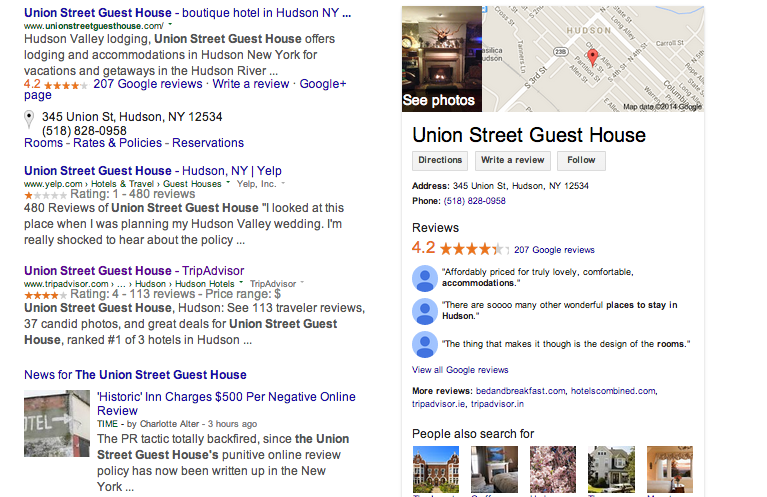
Such is the case of The Union Street Guest House in Hudson, N.Y. This picturesque small town inn quickly discovered the demonstrative impact of social media when comments about a fines-for-reviews policy hit the inn’s Facebook page and Yelp, the popular online review site.

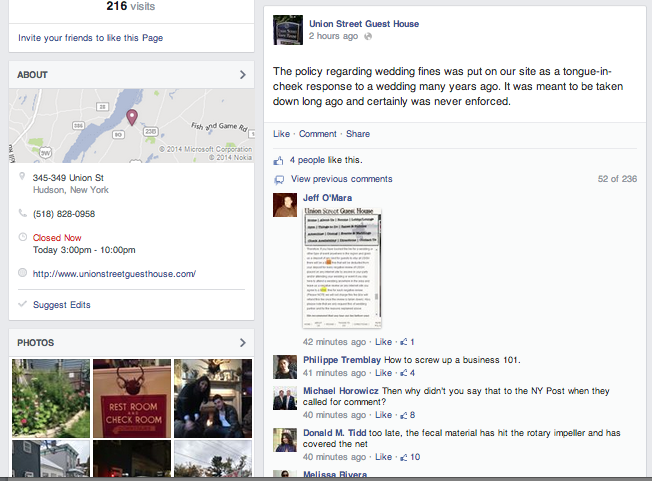
According to an ABC News story resulting from the social media dust-up, the inn claims its “policy” was posted to its website as a tongue-in-cheek response to a wedding from years ago and should have been taken down. The policy in essence stated bridal parties would be fined $500, taken from deposit monies, for each negative review the inn might receive connected to a particular wedding or event.

A Google search for the inn's name brings with it a wealth of negative online content that will impact the business' bottom line.

A Google search for the inn’s name brings with it a wealth of negative online content that will impact the business’ bottom line.

Unfortunately, a simple Google search of the inn’s name now produces both a link to the inn’s website, as well as countless social media and news articles referencing this not-so-amusing policy.

The result is a Search Engine Optimization nightmare for the inn coupled with a runaway train of negative comments on its Facebook page (more than 200 at this writing; although it appears the inn may now be deleting posts from its Facebook page).

Since this firestorm hit mainstream media, the inn's Facebook page has been inundated with negative posts.

Since this firestorm hit mainstream media, the inn’s Facebook page has been inundated with negative posts.

The news coverage and social media firestorm – with only a half-hearted response from management that appears to have since been deleted  – have created a massive public relations problem to overcome. This isn’t the type of crisis you wait out. And without a strategy for responding to and recovering from this communications nightmare, The Union Street Guest House is likely to see a steep decline in business, assuming it has the wherewithal to survive at all.

Small businesses are successful because they do what they do well. Where they often fail is when they try to do something outside of their expertise.

By consulting with a social media professional or brand content specialist, small businesses can avoid errors – even tongue-in-cheek responses – that might not seem substantial at the time, but with an extra set of trained eyes, can be seen for the potential disasters they are and thus avoided. Alternatively, bringing in the professionals after a crisis has erupted is not optimal, but it can mean the difference between staying in business or going under.

Most freelancers or public relations agencies can find equitable arrangements with small businesses that won’t break the bank, and can avoid or attempt to correct business-ending mistakes.

For a free consultation on how working with a public relations agency can help protect and promote your business, please contact me at rhughes@kimballpr.com.

Hack of a Whopper

On Feb. 18, 2013, Burger King's Twitter account was hacked garnering national media coverage and the ire of brand followers.

On Feb. 18, 2013, Burger King’s Twitter account was hacked garnering national media coverage and the ire of brand followers.

Crisis happens. When the crisis involves social media, it can have one heck of an impact on brand.

When Burger King’s Twitter handle was hacked today, the brand’s logo was changed to that of McDonald’s. The hackers also posted crude language, @ messages to questionable accounts, and video and photographs that had little to do with the brand and no doubt annoyed followers. Oddly, they boosted Burger King’s followers by more than 20,000 before the account was suspended.

Twitter followers noticed, as did CNN, ABC News and Fast Company’s Teressa Lezzi who published stories about the hacking within minutes.

If you manage a Twitter account for a brand and that account is hacked, what steps should your crisis plan include?

At the first indication of trouble, immediately log in and change the password. If you are able to log in and change the password, go into your settings and review all of the third-party apps connected to your account. Revoke access to all third-party apps until you can better assess the situation. (Be sure to revisit these apps once the situation is under control to ensure all brand account functionality.)

If you are not able to access the account and change the password, go to the Support Request section of Twitter and under Account Access select the “Hacked account” option. This will give Twitter the necessary “heads up” to suspend your account and avoid endless amounts of spam being sent to your followers. It will also allow you to reset your password.

While you work to regain control of your Twitter account, post a notification to your brand’s blog, website and other social platforms. This notification should simply state:

  • Your Twitter account has been compromised
  • You are working to remedy the situation, and
  • Your Followers should not click on any posted links until otherwise notified.

Such action lets your followers know you are aware of the situation. It can even foster good will among followers irritated by the hacking event.

As a precaution, make sure you use a secure password including letters, numbers and capitalization that cannot be easily determined. This password – especially if multiple people have access to the account – should be changed regularly.

Using dashboards like SproutSocial or HootSuite can also help minimize risk. We also suggest you follow @Safety or @Spam to stay alert to the latest spammer activity or malware.

Some crises can’t be avoided. But they can be mitigated through close monitoring, training and ensuring a workable plan is in place.

Interested in training your team to handle a social media crisis? Email us at info@kimballpr.com for information.

Sandy, Superstorm, Frankenstorm—How Agencies Should Handle Any Storm

Solitude / Foter / CC BY-SA

Like many fellow communications professionals, hearing the words “Frankenstorm” didn’t scare us away from our workdays this week. Some of us may have faced the effects of Hurricane Sandy head-on like one Philadelphia editor, but, for many of us, we could sit at home and work right from our smartphones and laptops without having to feel a raindrop (hopefully.)

So, when the business world is taking a “hurricane day,” what do you do? The answer to this is something agencies hopefully had prepared yesterday.

PR agencies can’t put a “Closed” sign on their email accounts or turn off their smartphones just because they can’t drive to work. Unless major wires are destructed or phones lose the last of their battery life, PR agencies can remain open for business.

Employees need to be prepared to deliver to their clients, communicate effectively with one another and, most importantly, protect themselves, whether a record-breaking hurricane hits or the power just happens to blow out on a perfectly sunny day.

The Quiet Before the Storm

Just as you would prepare for a client—prepare your own crisis communications plan before the event of a crisis. The news and National Weather Service prepared us for a worst case scenario for this #Superstorm, so agencies should be just as ready for their clients and themselves.

As Entrepreneur.com suggests, assess any possible risks your company may face, including weather events and property damage. Moreover, consider what to do if key employees are absent or unavailable; keep contact lists and passwords in a safe, accessible place.

Make the communications plan known to employees throughout the year so your team can navigate as smoothly as possible through a workday with turbulent weather.

On the Big Day

Just like any regular morning meeting, the first step in tackling a storm is to set up a virtual team meeting and prioritize. Over a conference line or chat room, discuss top deliverables that must be completed.

Next to consider is your clients. Alert your clients via email, Twitter—any channel necessary to inform them that you are available to fulfill their needs.

Throughout the day of a disaster, keep your co-workers and clients continually updated on work progress, as well as your safety, and follow these tips from PR News to work from home most successfully.

Finally, keep yourself safe and pass work onto others if you begin lose access to forms of communication. And, if you find yourself sitting in the dark, pull out your nearest candle, take out the old ereader—I mean book—and just wait until the storm passes.

Photo credit: Solitude / Foter / CC BY-SA

Where I am in June

It’s June and that means I start my annual trek crisscrossing the United States for our long-time client AMSkier Insurance. AMSkier insures children’s camps (in fact, they are the largest direct insurer of camps in the country). Company president Henry Skier came up with a novel idea a couple decades ago – offer a 24-hour crisis management services to the camps they insure. And that’s where I come in, handling crises when they arise at camps in the summer months. But that’s not why I travel in June.

Several years ago, Henry asked me to fill in and do some of the staff safety training during orientation. Hmm… other than war stories from the crises I’ve managed, what did I know about training staff? Not much. But with the lure of trips to places like Malibu and Carmel Valley, and training by my colleague and friend Norm Friedman, I reluctantly agreed. I found myself in front of hundreds of counselors discussing sexual abuse and other tough topics. Frankly, I was terrified. But I was well received and reluctantly agreed to do a few other camps the next year.

Then something happened. As I discussed how to handle disclosures of abuse to a group of counselors in Chattanooga, a young woman stood up and told her fellow counselors that this very advice I had given the year before had helped her help a little girl who had been abused at home. That was the epiphany. Sure, this was not my specialty and certainly not my comfort zone. But these workshops were helping keep kids safe.

So now I’m 30,000 feet in the air en route to Texas, followed by California, Palm Desert, Wisconsin, West Virginia, Georgia, North Carolina and more. I’m still not in my comfort zone, still terrified and still hate flying. But each year I agree. I just can’t get that image from Chattanooga out of my mind.