Earlier this month, we shared a blog about remote work and travel. Here, PR Manager Hari Rajagopalan shares some photos of some of the interesting food and sights he saw while working in India this year.
A stuffed, pesto marinated paneer steak with onions and spices on a bed of roasted potatoes and arrabbiata sauce.
A view of a restaurant center in Bengaluru, India.
An Indian take on a deep-dish pizza with veggies and a burrata bomb on top.
A view of nearby buildings and nature in Bengaluru, India.
A quattro formaggi pizza with an Indian twist, with a range of spices included.
Sweaty palms and a microphone in hand, you are called to the stage for your presentation in front of hundreds of your colleagues. You wrote your speech word for word and studied it diligently but as your nervousness grows, those words you meticulously studied begin to vanish. Panic. Anxiety. Is there more you could have done? As in all things, preparation is key.
Power in preparation
A successful speaking engagement is rooted in the right kind of preparation. While writing a speech is an important part of the process, simply putting words on paper could leave a public speaker high and dry on stage. The reality is a memorized speech is full of recollection and verbal landmines, stumbling and missed content. When preparing for your next speaking engagement, consider the following:
Focus on key messages: Rather than memorizing a speech, consider the key messages or the main points the speech conveys. Talking points serve as a speaker’s safety net and help pull them back to their main points when stumbling occurs or they veer off on a tangent. Key messages should include the main idea of the speech, how it relates to the speaker and their organization, as well as the audience and high-level content points.
Follow a formula: Be sure to make your point, provide reasoning or statistics that support your point and consider offering an example to help the audience visualize what you are saying. Telling a story is often easier for a speaker to recall compared to memorizing theories, data or intellectual arguments. Finally, be sure to drive the point home again at the conclusion of your remarks.
Practice makes perfect: Reading your speech ahead of time can be helpful, but nothing compares to giving the speech on camera or in front of colleagues, friends or family. Avoid speaking in front of the mirror as it only serves to distract. Speaking before a friendly audience helps with both familiarity with the topic as well as speed of delivery, your body language, your intonation, articulation and more. Play the recording back afterward to self-evaluate and ask for honest feedback and direction from those who are invested in you making a great impression up on the big stage.
Engage with your audience: Audience engagementis crucial to a speaker’s success, but it rarely ever just happens. Speakers must prepare for what some call crowd work; engaging the audience as part of their presentation and considering potential outcomes. In addition to the fact that audiences do not want to sit through a lecture, engaging with the audience can help them remember your key points. Storytelling, adding a little humor, polling the audience or low-pressure activities can be great ways to garner audience attention and prime them to listen attentively.
Have a backup plan: When all else fails, speakers should be prepared with a backup plan. Comedian Jo Koy saw firsthand what happens when you do not have a plan at the 2024 Golden Globes when his monologue fell flat. His jokes about Barbie and Taylor Swift left him in hot water and his only fallback was to blame the writers. While the Golden Globes is a much larger stage than your average business conference, all speakers should be prepared to pivot. Consider how an audience could respond to all aspects of your speech and have a plan to pivot to a safer topic should you lose the audience.
Public speaking is among the most common societal phobias, but it can be overcome in many cases, with effective practice and preparation. Comprehensive preparation can instill the confidence a speaker needs to be successful on stage. Speakers are selected for the insights they offer. Come prepared for the stage with key messages and a solid plan of action to make sure your messages are conveyed in way that engages the audience and leaves them wanting to learn more.
My discussions around paid content, for many years, typically went something like this:
Client:Hi. Amazing Media just emailed saying they want to feature our CEO as the best business influencer of [fill in month or year]. Is this legit? I’ve never heard of this outlet. Would you check it out for us?
Me:Sure. I suspect this is a pay-for-play opportunity, and it can come with a big price tag. Also, because you’re unfamiliar with this outlet, I suspect it won’t hit the target audience most important to your company. We’ll check it out and get back to you with a recommendation.
My colleagues and I would investigate and, with varying degrees of obfuscating from the outlets at issue, we would find it was a pay-for-play opportunity and often recommend to our clients to steer clear.
Sometimes these were paid broadcast interviews with fading celebrity hosts. Often these interviews would air at 3 a.m. on Sundays on some wildly obscure television station or streaming platform no one I have ever met would admit to watching. At other times, they involved free publications (meaning no one asked for them) so broad in nature that the concept of a specific target audience was practically a joke. In some limited circumstances, these paid opportunities were with good outlets, however, they were often still slightly off-target and, therefore, not worth the investment. In my 20 years in public relations, I have seen these types of unsolicited opportunities range from $2,500 to more than $80,000 for a one-shot deal.
So, of course, for many years I scoffed at these outlets and felt a duty to protect my clients from being taken advantage of.
However, the landscape of journalism is changing and, increasingly, we see paid-content opportunities with legitimate media outlets of value to some of our clients. With shrinking newsrooms and ongoing media consolidation requiring more revenue growth, some of these opportunities are – with a limited few industry trades – becoming de rigueur.
The question, of course, is, are they worth the investment? My evolved answer is, it depends. If the audience aligns with your target audience specifically, not generally, then maybe. The costs should also not exceed 2 to 5% of your total marcom budget for the year. If it’s more, it likely isn’t worth it for a single opportunity. Finally, you want to maintain control over the content for which you are paying. Don’t accept the default writer assigned to you from the outlet. I have seen this go very badly and at great, nonrefundable cost to the clients involved. Insist on your own, vetted and knowledgeable writer and maintain final veto authority on the content and the art that might accompany it.
Paid content, in this dynamic information age, is no longer something to be immediately scoffed at or ignored. Increasingly, this type of content should be built into your marcomm strategy, but carefully.
For years our agency founder, Gary Kimball, talked about how the insurance industry has an image problem. I continue to share that sentiment.
It’s akin to a plane crash. This time of year, millions of us climb into aluminum/composite tubes to be flung hundreds of miles per hour at 30,000 feet or more to visit family and friends. We do this, mostly, with confidence and not much concern about the airline industry until we learn of an incident of some kind. Suddenly, some are afraid to fly … because of one incident.
Whether it is capacity issues, carriers leaving certain states or regions, rising premiums, the talent crisis or denial of claims, these seemingly jolting situations are a mere fraction of the total contribution of one of the few industries that, without exaggeration, not only helps us in a time of need, but underpins every foundation of our society.
So, what is the solution?
Insurance leaders need to lean into what the industry, and individual companies, enable in the world. The messaging going forward needs to focus less on balance sheets, premium, products and capacity. Instead, a long-term image campaign is required. To do this successfully, a full-throated and relentless discourse is needed on the successes and enablement insurance provides across our society, in things large and small.
Businesses can expand – and create jobs – because they have insurance to protect them in the event of an “incident,” whatever that might mean to the business.
Technologies can be explored, developed and deployed because insurance exists to protect organizations and entrepreneurs from misapplications or hardware failures.
Each of us can invite friends and family to our homes, regardless of season, weather and other conditions, with the reassurance that if a guest trips or gets hurt, there is insurance to protect them and us from financial devastation.
Holiday gifts, as well as mission-critical medical equipment, can be shipped around the world without fear of loss or damage because these items are insured.
Life-saving treatments can be developed because the scientists and doctors doing the work are covered in case something goes wrong, ensuring the entire enterprise isn’t lost to the detriment of those who depend on these treatments.
Volunteers can support charitable events and serve on the boards of nonprofits doing social good because insurance shields them from junk lawsuits or legitimate, but not malicious, errors in action or judgement.
You can buy your $1,000 smartphone and rest assured two days later when you drop it that you have insurance to cover the repair or replacement without breaking the bank.
And those aluminum/composite tubes can help us get home to our families for the holidays because insurance protects them from complete disaster in even the most minor of errors, delays or missteps.
These and other messages are what consumers, potential industry recruits, business executives, homeowners, nonprofit leaders and others need to hear. In this moment, as we brace for a new year and all the challenges that come with it, we need to change the industry’s approach to its perpetual image problem.
I have spent a career reporting on, adjacent to and supporting the insurance industry. I am a convert. Despite the occasional bad press, there is so much the industry does that makes the world go round. We simply need to tell those stories, often, and starting now.
In today’s modern world driven by the 24-hour news cycle, social media buzz and influencers, organizations are constantly seeking ways to stand out and attract their target audiences. One powerful tool at their disposal is public relations (PR). However, PR is not just about creating buzz; it’s about utilizing an organization’s existing assets to build a stronger connection with its audiences and playing to your busy season.
This fall, we’ll look at fall foliage capital New England, its tourism bureaus, businesses and nonprofits. New England, with its historical sites and natural beauty, has learned to take advantage of its “it” season, autumn, to attract visitors and boost the region’s economy.
Leaves and Legacy
Renowned for its picturesque autumn foliage, New England attracts tourists and outdoor enthusiasts from around the world, aptly dubbed “leaf peepers,” by locals. Tourists chase the vibrant views up the coastline, swarming the northern states of Vermont, New Hampshire, Massachusetts, Rhode Island, Connecticut and Maine for a chance to snap a picture of the seasons changing. As they flood the northern states, opportunity awaits local businesses and nonprofits as they vie for the attention of paying customers to shop at local boutiques, stay in local hotels and dine in the region’s countless restaurants.
Some sites, such as Plymouth Rock, the Mark Twain House, the Paul Revere House and more draw millions of visitors year-round. Massachusetts and New England tourism groups leverage this reality each year to entice visitors to the area. For instance, one organization, Historic New England, is utilizing tourists’ interest in history to expand their profile. Through local news stories, the group is promoting its growing collection of some 125,000 historical objects in a sprawling cultural center around its headquarters in Haverhill, Massachusetts in the hopes that visitors will take advantage of the opportunity to see so much history in one spot.
Historic New England is not the only group utilizing PR and interest from tourists to boost their profile. Salem, Massachusetts, perhaps best known for its 1692 witch trials, is known to draw upwards of 1 million visitors each October. The town does not miss out on the opportunity to boast about their offerings. Every October, town leaders and their communications teams work to ensure they are included on lists featuring top spots to visit while leaf peeping in New England
Whether year round or seasonal, the historical destinations of New England have leaned into their natural appeal and the power of communications to make the most of their “most wonderful time of the year.”
Raking in the Customers
For those looking to leverage communication to make the most of their selling season, a good public relations strategy can complement promotional efforts to elevate your brand before this captive audience. Consider these tips:
Step up your social media efforts: A robust social media presence is critical to amplify your message during your “it” season. Business owners should ensure social channels are prominently promoted and accessible through their websites as well. By leaning into the inherent assets of the organization – a colorful personality in leadership, convenient or scenic location, practical benefits of their products or services – organizations can create a genuine connection with followers and build a reliable customer base beyond what existed before.
Get to know local media: Reaching out to local media when there is news that is of interest to the public is always a smart move. Businesses and non-profits must be careful, however, to avoid blatant self-promotional outreach to journalists. Offering sales or other obviously self-promoting information to the news media can have the opposite intended effect, damaging the organization’s reputation in the media and potentially black-listing it from future coverage.
Think outside of the box: Consider expanding your audience while the time is right. For example, while New England business’ primary consumers this fall may be folks on leisure excursions, tourism hot spots and hotels may want to consider reaching out to business and meeting publications to share the message of New England as a corporate travel destination if appropriate. Also, while traditional PR can be a powerful tool in cultivating an unbiased image of your destination or business, marketing promotions and sponsored content can complement those efforts helping business owners to capture an even larger audience.
In a world where organizations vie for attention and consumer loyalty, New England’s approach to soaking up the fall season serves as a powerful example. Know your organization’s time to shine and be ready to make the most of it with the right communication tools.
Road Runner always outran Wile E. Coyote. The massive, formidable Death Star was no match for Luke Skywalker’s tiny x-wing fighter. And of course, we all know how David fared against Goliath. In each instance, the little guy triumphed, reminding us that bigger is not always better.
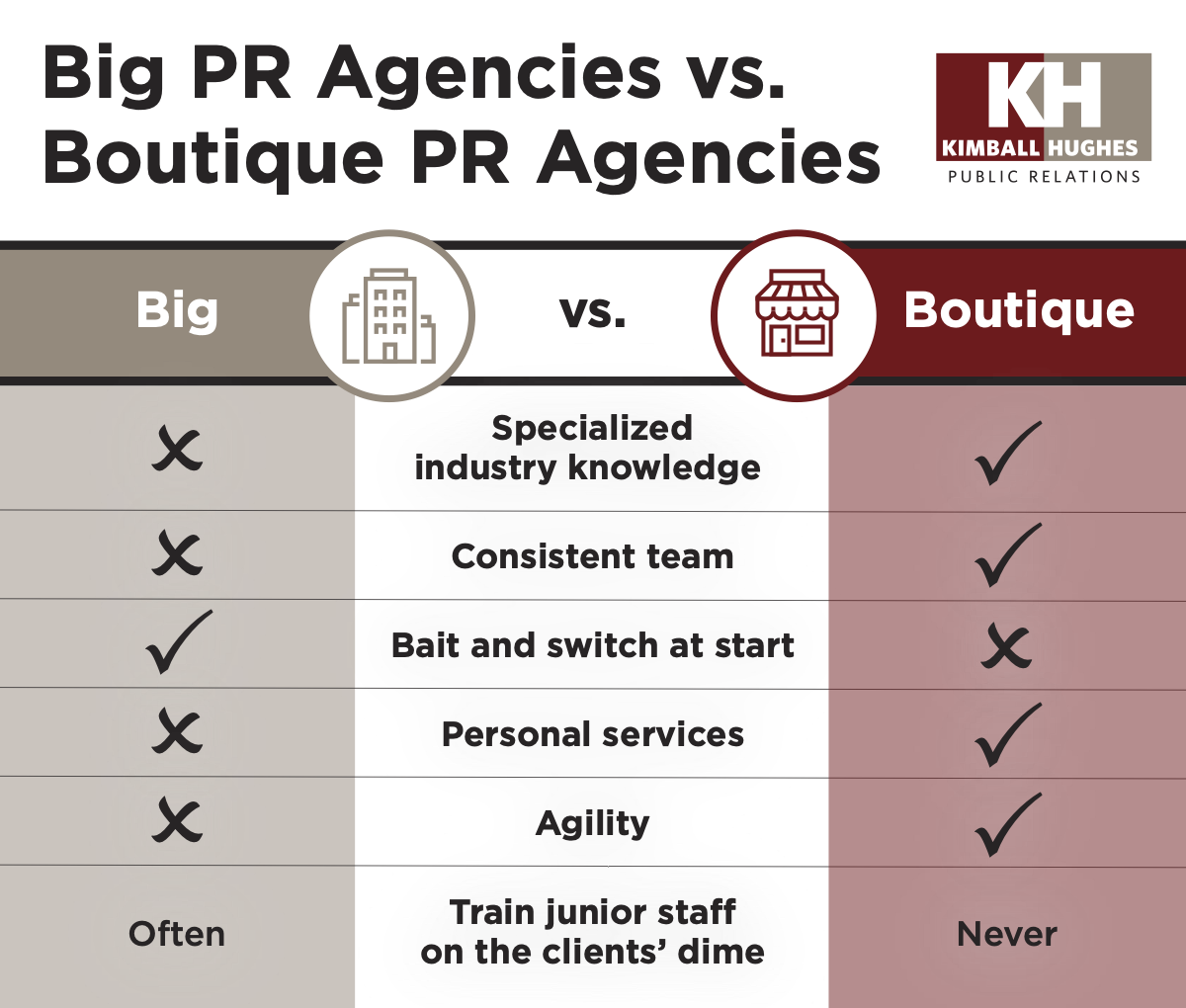
The same holds true when it comes to public relations agencies. Boutique-sized public relations agencies may not boast the large teams and vast service offerings that their larger counterparts do, but when it comes to specialized knowledge, nimbleness, and personal service, selecting the right boutique agency can provide unmatched success.
A Specialized Focus
Often a boutique agency will specialize in select industries where they have expertise. Their team will consist of seasoned employees who have worked within the industry itself or worked for years on accounts for companies in that industry. For example, at Kimball Hughes Public Relations, one of our specialties is insurance. Our team members have worked for numerous insurance clients from a PR agency perspective, have worked in-house for communications teams at insurance companies and even worked as reporters on the insurance beat. Moreover, boutique PR agencies pride themselves on employing experienced professionals to lead accounts; they simply cannot afford to risk their reputations by staffing client work with new or less experienced staff.
A boutique PR agency with a specialty will have knowledge of hot button issues and emerging trends. They will be able to do more than simply promote your brand or your executives, they will have the inside knowledge to be able to position your subject matter experts as thought leaders within the industry. They will know the conferences at which to be seen and secure media interviews that matter to your stakeholders. A specialized PR agency will have strong media contacts within the niche and help to position your leaders as go-to sources for future stories.
A Nimble Approach
Like Jerry the mouse, smaller agencies can be nimble – speedy too, like Road Runner. Without the red tape of a larger agency, a smaller agency can react to news more quickly and prepare a thoughtful response for your team to review and distribute in a timely manner.
A small PR firm will also be a nimble ally in a crisis. In those circumstances and others, you will have direct and prompt access to your agency account manager, someone you know and trust, who understands your organization and your industry who is also ready to help protect your company’s reputation anytime day or night.
That agility also comes in handy when a media strategy is not working. Valuing each and every client relationship as if it were the firm’s only relationship, a smaller agency will constantly be monitoring for results. When those results don’t manifest, they’ll recognize it immediately and pivot to a new strategy.
Personal Service
Finally, when you work with a boutique agency, your daily contact and team are likely to be people you met at the start of your relationship with the agency. The bait and switch is rare with boutique PR agencies. In fact, in many cases, you may know a number of people within the agency and they will know you and be familiar with your company’s needs. Small PR firms work closely with clients and staff to ensure all team members are in the know so they can quickly spot-fill or act as an extra set of hands when necessary. Further, these folks will make an effort to get to know you and to understand your team’s marketing and communications goals to ensure your team is getting the results your c-suite wants to see.
For smaller PR agencies, clients are truly partners. We value relationships and want to deliver for our clients.
So, smaller agencies may not wield a multi-story downtown headquarters the size of the Death Star. But they can be a powerful force. Give Kimball Hughes PR a call to talk to us about our specialized expertise, knowledgeable team and proven results.
Many say that planning a wedding is akin to having a full-time job. This is a reality I learned planning my own wedding. I got married this past July.
As I was wrapping up work in preparation for the wedding, I was struck by the similarities between planning a wedding and preparing a public relations strategy. While one focuses on florals and outfit coordination and the other on messaging tactics, media placements and KPIs, both are tied to reality by timelines, budgets, audience expectations and the seasoned professionals who know the marketplace.
Defining Your Happily Ever After
When planning any program, strategy or event, it is important to have a vision of what your end outcome will be. For example, most marriers aim to have a beautiful wedding, where all guests enjoy themselves and the couple has a long and harmonious happily ever after.
To position their wedding for success, couples often identify a theme. Some aspire to have a grand, black-tie gala while others want a more laid back, yet festive beach affair. Personally, I planned for a casual, yet sophisticated garden party.
When launching a public relations campaign, the strategy can be similar. Consider what your business ultimately wants to gain from this strategy. Similar to the couple-to-be’s goal of happy guests, your goal may be to have a roster of eager prospects. Or you may be looking to bring more awareness to your company, introduce a new product or line of business or change the way your organization’s reputation is perceived. Each goal requires a different approach, making it important to select and focus on one before the work begins.
Engaging the Right Partners
Once your vision has been clearly defined and you have a better understanding of what is needed to accomplish your goal, look for the tools and resources that will help you succeed.
In the wedding world, little can be accomplished without the support of key specialists. The venue, caterer, photographer, florist and DJ will all come together to create your vision of the perfect day.
Putting together and successfully implementing a public relations strategy does not and should not have to be a one-person job. Consider seeking out a partner with expertise to meet your needs. Just as the wedding vendors can connect you with recommended business partners who they know and trust, PR professionals can connect you with media that will reach your target audience. In the case of my wedding, my vendors all came highly recommended by my venue, meaning they knew exactly what equipment to come prepared with and had worked together before, helping the day go off without a hitch.
There are a multitude of resources to help accomplish your public relations goals. A full-service public relations agency can help you throughout the entire process, from defining your goals and audience to setting tactics, implementing a plan and measuring success.
Additionally, the right partners will be flexible. A good wedding vendor will do what they can to meet your changing needs. For instance, my photographer’s original quote was out of budget, but they worked with us and added in the extra benefit of an engagement shoot for free. Similarly, when my venue told me the ice cream truck I had my heart set on was unavailable, they were able to lean into their relationships to source a different one.
Similarly, a good media team will also know how to pivot to best meet your needs. They will recognize when a change in approach or messaging is needed to adjust to breaking news or current trends.
Catering to Your Audience
While a wedding is ultimately put together to celebrate the couple, it is important to take the rest of the guests into consideration. Certain accommodations are arranged with guests in mind, such as transportation, lodging and the menu. For instance, my guests who were vegetarian or vegan were provided with separate meals.
Similarly, your PR strategy must cater to your audience. Just like a steak dinner won’t work for a mostly vegan guest list, a trendy influencer partnership on TikTok is unlikely to help an insurance organization meet their goal of reaching more brokers and agents. When building a public relations strategy, it is critical to identify your audience and understand what they are reading and viewing.
Taking an audience-first approach will help ensure the vision you are trying to achieve will have the intended effect on the right people whether it’s a ballroom full of happy, stuffed, dancing wedding guests or a list of prospective clients now interested in inquiring about your products and services.
While seemingly worlds apart, wedding and public relations planning share similarities. Building a rock-solid foundation with a clear vision, the right partners and an audience-first approach will make ironing out the details, whether they be dress fittings and menu selections or pitching and coordinating media interviews more successful in the long run.
A few years ago, I quit my job as a chef in Chicago to pursue a career in public relations. Not surprisingly, it prompted many conversations about why I was making this change. Then, in June of 2022 the emergence of FX’s hit show The Bear prompted a newfound interest and respect for kitchen professionals and their skillset, and the questions began again.
While The Bear is a television show dramatizing work in restaurants, it has been recognized as one of the most realistic portrayals of kitchen culture. This fresh portrayal of kitchens provides the perfect backdrop for an idea I have personally struggled to explain: Many kitchen skills and experiences are transferable to public relations work. From finding inspiration in an environment of chaos, to pushing through pressure to get a dish out (or meet a deadline) and fielding every mishap, small burn and burst pipe along the way, I’ve found these two vastly different careers have many similarities.
Here are just a few of the ways public relations and kitchen life are not all that different:
Understanding the Value of Good Communications
In a kitchen, you will often hear “corner” when someone is going around a corner, “sharp” when someone is holding a knife and walking or “heard” to convey something is understood. To some, this may seem like over-communicating, but these short, succinct communications often hold the responsibility of safety and/or clarity in a kitchen.
In public relations, we must be acutely aware of the power of words and consider how those words will be received to support a goal. We must also work to determine the best way to communicate a message. We need to find the best way to get the audience’s attention just like the chef needs to find the best way to get the attention of their staff. This can mean finding a target audience where they want to be met and often understanding less is more. We may not use one simple word to communicate like “corner,” but we try to deliver tight, compelling messages that speak to our client’s services or thinking, while providing value to the reader.
Keeping Your Cool Under Pressure
The Bear does a great job of passing on to the viewer the feeling of immense pressure that looms over a kitchen. Whether its managing ticket times, difficulties with cooks who are out of unison or struggles with finances threatening the future of a restaurant, handling pressure is a prerequisite of the restaurant industry.
Public relations professionals are no strangers to pressure either. For one, communications professionals are depended upon for unbiased, clear-minded insight to position their clients in the best light. Whether it be in a crisis where we must move quickly while working to manage particularly sensitive situations or in daily work with deadlines looming and new opportunities arising, it’s a delicate balancing act. While these scenarios are much different than the never-ending demand of a ticket machine (see The Bear, season 1, ep 7), they require an ability to listen, prioritize, strategize, plan ahead and, of course, take a deep breath and have confidence and trust in you and your teams’ abilities to best support your client.
Wearing Many Hats
Multi-tasking is not a nice-to-have skill in a kitchen; it’s a must. There may be days when two people have to be the line cooks, dishwashers, expeditors and food runners.
Public relations professionals must also master the art of multi-tasking. A public relations professional, especially in the agency environment, must have a finger on the pulse of various industries while also managing client work, maintaining relationships with clients and media, fostering new business, writing content, coordinating interviews and more. Like chefs, most public relations professionals thrive on a fast-moving pace.
Finding Joy in the Presentation
A good chef can prepare a simple dish and elevate it to a remarkable meal. A good chef takes pride in their creations and finds joy and inspiration in seeing people enjoy them.
In public relations, we also take great pride in what we present to our clients – the call back from the Wall Street Journal, the resulting placements from thoughtful pitching, increased share of voice, etc. Our goal in public relations is to highlight the expertise of our clients and find the best places to do so. We strive to get our clients in front of the audiences that are valuable to them and enjoy that same thrill as the chef in seeing their satisfaction in the end. Much like a kitchen, public relations requires you to manage various ups and downs. And when it all comes together, it is incredibly gratifying.
The shift from kitchens to public relations to some may seem like an odd transition, but what you learn in a kitchen is all about communication, balance, productivity, management and doing your best to please the customer. These are invaluable skills that can transfer to any industry. They certainly have in mine.
Throughout my 20 years in public relations, I – and my colleagues – have found ourselves frequently playing clean-up after another public relations agency has failed to deliver what was promised to a client.
When I talk with organizations that have worked with PR agencies in the past, typically six out of 10 tell me the relationship ended badly. The reasons tend to fall into a few familiar categories:
Poor communication between the agency and the client
Frequent agency staff turnover
Meeting senior agency leaders at the pitch meeting, but only interacting with less-experienced agency personnel after the contracts are signed
Lack of alignment either on strategy, content, writing quality, values and personalities
Like any professional or personal relationship, there is likely a bit of blame to be had on both sides when an investment by both parties in achieving a successful public relations partnership fails.
However, in my experience, often these agency hiring misfires could have been avoided if the right questions had been asked in the agency screening process. Understanding who you are hiring and establishing shared expectations from the start can help ensure the relationship starts off as strongly as possible. To do so, there are five key questions I recommend asking your potential public relations agency during the screening process, including:
What distinguishes your agency from your competition?
Will you include former clients in your list of references that we can contact?
Who will serve as the account manager, and can we meet him or her before signing the agreement?
If the plan you create for us isn’t working out, what is your pivot strategy to ensure success?
Please describe your ideal working relationship with clients so we can level-set expectations both from our perspective and among the agency team.
Additional questions you should consider asking any public relations agency you might be looking to hire should include:
What kind of response time can I expect from your team to my emails, texts or phone calls?
If the account manager isn’t a member of senior leadership, what role will leadership play in the development and execution of our public relations plan?
What is your process for learning about our organization, and how long should we expect that process to take?
How will you help us prepare for any media interviews you might secure on our behalf?
Can we see samples of your writing relevant to our industry or organization type?
What kind of time commitment should we expect to make to ensure our work with the agency is a success?
Please describe the frequency and type of ongoing communication you expect to have with our organization throughout the engagement.
Asking the right questions will help you get a better sense of the agency you are potentially hiring as well as how they intend to engage with you.
Too many business and nonprofit leaders ask questions of public relations agencies that either cannot be answered in the initial pitch meeting or demonstrate a lack of understanding of how public relations works. In our next blog, we’ll cover questions you shouldn’t ask in these initial meetings if you want to be taken seriously while also making the most of the time you do have to evaluate if the agency at the table or on a video call is a good fit.
Remember, public relations is more than an investment of money. It’s one of time, effort and trust. Knowing what to ask will help ensure those you ultimately hire are worthy of that investment.
Public relations is all about relationships—the people behind the stories. That’s why we’re offering this blog series all about our team members. This isn’t about our professional accomplishments but who we are as people. We hope you have as much fun reading along as we do interviewing each other.
1. What got you interested in public relations?
My love of public relations spun off from a combination of my early journalism career, a deep love for American history, and my love of good storytelling. After a short but intense stint covering politics on Capitol Hill at CNN and working local news in a few regional Virginia markets and my hometown in Western Canada, I realized I wanted to do communications differently than I had previously. I learned that I was really excited by taking on the challenges of shaping messaging, crafting narratives, and helping organizations navigate the media world, crisis communications, and engaging the public in mission-focused communications. Working in the non-profit world was an easy jump after graduate school. And that road ultimately led me to here – a new and exciting way to keep telling great stories and engaging clients in new and innovative ways.
2. Tell us about your favorite movie and what appeals most to you about it?
Anyone that knows me knows that this is a multi-hour discussion. However, because I’ve got a word limit, I’ll grudgingly choose one; and that is The Lord of the Rings: The Fellowship of The Ring. This movie never fails to give me chills to this day – and as a young kid, this movie blew my mind. The movie score, the cinematography, the acting, the scale and scope of what was built and created gave life to Tolkien’s masterpiece. I truly believe there’s never been a movie like it… and short of the new Dune movies, there may never be again.
3. What was the last, best book you read and what about it spoke to you?
The last book I read was a guilty pleasure: World War Z by Max Brooks. Totally just an entertaining and thrilling book, written in the form of a pseudo-documentary about a global war against zombies. The movie wasn’t great, but the book is fantastic. The last book that I read that inspired me and spoke to me was probably Washington: A Life by Ron Chernow. The life of George Washington is truly something that people need to read to believe. There’s something very inspiring about a person whose singular commitment to honor and duty shaped the way that we view civic virtue and our system of government to this day. Not without his flaws, the book also does a wonderful job exploring how deeply complicated and conflicted Washington was with his own family, his career, and his view of the revolution he helped fight. How that book and the story of George Washington hasn’t been given a proper treatment or at least translated into an HBO mini-series a-la John Adams or Chernobyl, is beyond me.
4. Tell us about a meaningful hobby or outside of work commitment that is important to you.
I am really into winter sports, which makes living in Florida an interesting place for someone who grew up playing ice hockey and snowboarding. But any time I can manage to get to the mountains I feel completely refreshed. There’s nothing quite like the total peace and quiet at the top of a mountain. It is a great place to clear your head and decompress.
5. Share a fun fact about you.
I am an avid cook and am constantly trying out new recipes for my wife and me. Not all of them are winners, but we’ve stumbled across some absolutely great ones that have become staples in our house. To quote the great classic, Ratatouille: “You must try things that may not work. Anyone can cook; but only the fearless can be great.”













 PR Matters