Read the Room: Preparing for your next speaking engagement

Sweaty palms and a microphone in hand, you are called to the stage for your presentation in front of hundreds of your colleagues. You wrote your speech word for word and studied it diligently but as your nervousness grows, those words you meticulously studied begin to vanish. Panic. Anxiety. Is there more you could have done? As in all things, preparation is key.

Power in preparation

A successful speaking engagement is rooted in the right kind of preparation. While writing a speech is an important part of the process, simply putting words on paper could leave a public speaker high and dry on stage. The reality is a memorized speech is full of recollection and verbal landmines, stumbling and missed content. When preparing for your next speaking engagement, consider the following:

  • Focus on key messages: Rather than memorizing a speech, consider the key messages or the main points the speech conveys. Talking points serve as a speaker’s safety net and help pull them back to their main points when stumbling occurs or they veer off on a tangent. Key messages should include the main idea of the speech, how it relates to the speaker and their organization, as well as the audience and high-level content points.
  • Follow a formula: Be sure to make your point, provide reasoning or statistics that support your point and consider offering an example to help the audience visualize what you are saying. Telling a story is often easier for a speaker to recall compared to memorizing theories, data or intellectual arguments. Finally, be sure to drive the point home again at the conclusion of your remarks.
  • Practice makes perfect: Reading your speech ahead of time can be helpful, but nothing compares to giving the speech on camera or in front of colleagues, friends or family. Avoid speaking in front of the mirror as it only serves to distract. Speaking before a friendly audience helps with both familiarity with the topic as well as speed of delivery, your body language, your intonation, articulation and more. Play the recording back afterward to self-evaluate and ask for honest feedback and direction from those who are invested in you making a great impression up on the big stage.
  • Engage with your audience: Audience engagementis crucial to a speaker’s success, but it rarely ever just happens. Speakers must prepare for what some call crowd work; engaging the audience as part of their presentation and considering potential outcomes. In addition to the fact that audiences do not want to sit through a lecture, engaging with the audience can help them remember your key points. Storytelling, adding a little humor, polling the audience or low-pressure activities can be great ways to garner audience attention and prime them to listen attentively.
  • Have a backup plan: When all else fails, speakers should be prepared with a backup plan. Comedian Jo Koy saw firsthand what happens when you do not have a plan at the 2024 Golden Globes when his monologue fell flat. His jokes about Barbie and Taylor Swift left him in hot water and his only fallback was to blame the writers. While the Golden Globes is a much larger stage than your average business conference, all speakers should be prepared to pivot. Consider how an audience could respond to all aspects of your speech and have a plan to pivot to a safer topic should you lose the audience.

Public speaking is among the most common societal phobias, but it can be overcome in many cases, with effective practice and preparation. Comprehensive preparation can instill the confidence a speaker needs to be successful on stage. Speakers are selected for the insights they offer. Come prepared for the stage with key messages and a solid plan of action to make sure your messages are conveyed in way that engages the audience and leaves them wanting to learn more.

Over the River and through the Woods: Takeaways from November Travels

November kicks off the busy holiday travel season and a month of travel it certainly was for the Kimball Hughes Public Relations team. Our colleagues visited Las Vegas, Chicago, Hollywood Beach, Fla., and more. We enjoyed spending time supporting our clients, speaking at events, attending insightful sessions, catching up with our colleagues in the media and making new connections.  

Below are a few takeaways from our November on the road.

Las Vegas

This month, Account Managers James McKinsey and Hari Rajagopalan had the opportunity to join our client at Insurtech Connect Vegas (ITC) 2023, a three-day conference dedicated to discussing the future of insurance and innovation.

One of the industry’s biggest of the year, artificial intelligence (AI) fueled much of the conference discussion. Insurtech and insurance leaders are still attempting to figure out the role of AI in the industry and whether it will truly serve as a disruptor. In fact, one of the most widespread opinions shared throughout the event was that everyone has their own definition of AI, but no one truly knows what it is. We expect AI to be a valuable supplemental tool to insurance businesses, but the industry still is not quite sure of how and where to best utilize this growing technology.

ITC Vegas 2023 also presented a great opportunity to connect with the industry trade press. Reporters from leading insurance organizations including Insurance Journal, National Underwriter, The Insurer, Risk Management, Rough Notes, Digital Insurance and The Institutes were on hand. In our conversations with the media and with various podcasters, we learned there is continued interest in hearing from sources on topics such as the future of work, innovation, AI, climate change and cyber.

Hollywood Beach, FL

Agency President Rod Hughes visited the Sunshine State to speak about crisis communications at the annual meeting of one of our franchise organization clients, as well as to lead two roundtable discussions on the power of public relations to promote new business openings.

As all entrepreneurs know, there are always war stories shared on crises large and small when gathering at these types of events that create teachable moments for others in the audience. A recurring area of concern was online reviews, their impact on the business and the various platform processes and guidelines that can work in a business owner’s favor – when used appropriately – to remove fake, slanderous or otherwise untrue reviews of a business.

Franchisees face myriad demands on their time and attention. Understanding how small things can quickly become big crises, what to look for and how to best manage an existing or potential crisis was information many of these attendees welcomed.

Chicago

This month, Eileen Coyne, agency vice president, had the opportunity to attend the Digital Insurance Women in Insurance Leadership Conference. After enjoying time with the Digital Insurance staff and meeting women leaders from across the industry, she provided two valuable takeaways from speakers related to the challenges that career and homelife present.

  • Break out of Your Comfort Zone. Joan Woodward, executive of public policy for Travelers and president of the Travelers Institute, captured the room with inspiring and amusing stories from her impressive career journey during the evening awards dinner. She encouraged the audience to embrace the unfamiliar, touching on milestones in her extraordinary career on Capitol Hill, at Goldman Sachs, Travelers and more. She urged the crowd to be bold and willing to try new things.
  • Expect and Embrace Flexibility. “I have one life and one calendar,” Kathy Krantz, vice president and chief financial officer at Pinnacol, told the women assembled for a panel on decoding leadership DNA. She said, she incorporates all of her work and parent to-dos on one calendar. She explained that many employers are more understanding now about work-life challenges. No longer should we feel a need to hide work-life challenges from the office as we struggle to navigate the multifaceted demands of life and work.

New York City

No itinerary would be complete without a stop in the Big Apple. Eileen Coyne and Hari Rajagopalan had the opportunity to join the Insurance Industry Charitable Foundation at the IICF Northeast Annual Benefit Event in New York City where the nonprofit celebrated another year of giving and volunteerism – a year that saw more than $1 billion in giving industry-wide. IICF gathered leaders from across the insurance industry to celebrate the industry’s efforts, while raising funds for nonprofit grantees in the Northeast region.

It was a wonderful opportunity to cap off and toast an incredible year in charitable giving and volunteerism for the industry that fueled a fun evening of catching up with friends in the insurance media, within the industry, and introduced another chance to make new connections.

With the year nearly wrapped, the team at Kimball Hughes PR would like to express an appreciation for the re-emerging opportunities we have all enjoyed this year enabling us to get together once again in person with colleagues and industry peers. We look forward to seeing many of you on the road again in 2024!

Paid Content: Is It Worth It?

My discussions around paid content, for many years, typically went something like this:

Client: Hi. Amazing Media just emailed saying they want to feature our CEO as the best business influencer of [fill in month or year]. Is this legit? I’ve never heard of this outlet. Would you check it out for us?

Me: Sure. I suspect this is a pay-for-play opportunity, and it can come with a big price tag. Also, because you’re unfamiliar with this outlet, I suspect it won’t hit the target audience most important to your company. We’ll check it out and get back to you with a recommendation.

My colleagues and I would investigate and, with varying degrees of obfuscating from the outlets at issue, we would find it was a pay-for-play opportunity and often recommend to our clients to steer clear.

Sometimes these were paid broadcast interviews with fading celebrity hosts. Often these interviews would air at 3 a.m. on Sundays on some wildly obscure television station or streaming platform no one I have ever met would admit to watching. At other times, they involved free publications (meaning no one asked for them) so broad in nature that the concept of a specific target audience was practically a joke. In some limited circumstances, these paid opportunities were with good outlets, however, they were often still slightly off-target and, therefore, not worth the investment. In my 20 years in public relations, I have seen these types of unsolicited opportunities range from $2,500 to more than $80,000 for a one-shot deal.

So, of course, for many years I scoffed at these outlets and felt a duty to protect my clients from being taken advantage of.

However, the landscape of journalism is changing and, increasingly, we see paid-content opportunities with legitimate media outlets of value to some of our clients. With shrinking newsrooms and ongoing media consolidation requiring more revenue growth, some of these opportunities are – with a limited few industry trades – becoming de rigueur.

The question, of course, is, are they worth the investment? My evolved answer is, it depends. If the audience aligns with your target audience specifically, not generally, then maybe. The costs should also not exceed 2 to 5% of your total marcom budget for the year. If it’s more, it likely isn’t worth it for a single opportunity. Finally, you want to maintain control over the content for which you are paying. Don’t accept the default writer assigned to you from the outlet. I have seen this go very badly and at great, nonrefundable cost to the clients involved. Insist on your own, vetted and knowledgeable writer and maintain final veto authority on the content and the art that might accompany it.

Paid content, in this dynamic information age, is no longer something to be immediately scoffed at or ignored. Increasingly, this type of content should be built into your marcomm strategy, but carefully.

The Stories We Tell About Insurance Must Change

For years our agency founder, Gary Kimball, talked about how the insurance industry has an image problem. I continue to share that sentiment.

It’s akin to a plane crash. This time of year, millions of us climb into aluminum/composite tubes to be flung hundreds of miles per hour at 30,000 feet or more to visit family and friends. We do this, mostly, with confidence and not much concern about the airline industry until we learn of an incident of some kind. Suddenly, some are afraid to fly … because of one incident.

Whether it is capacity issues, carriers leaving certain states or regions, rising premiums, the talent crisis or denial of claims, these seemingly jolting situations are a mere fraction of the total contribution of one of the few industries that, without exaggeration, not only helps us in a time of need, but underpins every foundation of our society.

So, what is the solution?

Insurance leaders need to lean into what the industry, and individual companies, enable in the world. The messaging going forward needs to focus less on balance sheets, premium, products and capacity. Instead, a long-term image campaign is required. To do this successfully, a full-throated and relentless discourse is needed on the successes and enablement insurance provides across our society, in things large and small.

  • Businesses can expand – and create jobs – because they have insurance to protect them in the event of an “incident,” whatever that might mean to the business.
  • Technologies can be explored, developed and deployed because insurance exists to protect organizations and entrepreneurs from misapplications or hardware failures.
  • Each of us can invite friends and family to our homes, regardless of season, weather and other conditions, with the reassurance that if a guest trips or gets hurt, there is insurance to protect them and us from financial devastation.
  • Holiday gifts, as well as mission-critical medical equipment, can be shipped around the world without fear of loss or damage because these items are insured.
  • Life-saving treatments can be developed because the scientists and doctors doing the work are covered in case something goes wrong, ensuring the entire enterprise isn’t lost to the detriment of those who depend on these treatments.
  • Volunteers can support charitable events and serve on the boards of nonprofits doing social good because insurance shields them from junk lawsuits or legitimate, but not malicious, errors in action or judgement.
  • You can buy your $1,000 smartphone and rest assured two days later when you drop it that you have insurance to cover the repair or replacement without breaking the bank.
  • And those aluminum/composite tubes can help us get home to our families for the holidays because insurance protects them from complete disaster in even the most minor of errors, delays or missteps.

These and other messages are what consumers, potential industry recruits, business executives, homeowners, nonprofit leaders and others need to hear. In this moment, as we brace for a new year and all the challenges that come with it, we need to change the industry’s approach to its perpetual image problem.

I have spent a career reporting on, adjacent to and supporting the insurance industry. I am a convert. Despite the occasional bad press, there is so much the industry does that makes the world go round. We simply need to tell those stories, often, and starting now.

Attracting the Leaf Peepers: Tapping into PR to Leverage a Seasonal Rush

In today’s modern world driven by the 24-hour news cycle, social media buzz and influencers, organizations are constantly seeking ways to stand out and attract their target audiences. One powerful tool at their disposal is public relations (PR). However, PR is not just about creating buzz; it’s about utilizing an organization’s existing assets to build a stronger connection with its audiences and playing to your busy season.

This fall, we’ll look at fall foliage capital New England, its tourism bureaus, businesses and nonprofits. New England, with its historical sites and natural beauty, has learned to take advantage of its “it” season, autumn, to attract visitors and boost the region’s economy.

Leaves and Legacy

Renowned for its picturesque autumn foliage, New England attracts tourists and outdoor enthusiasts from around the world, aptly dubbed “leaf peepers,” by locals. Tourists chase the vibrant views up the coastline, swarming the northern states of Vermont, New Hampshire, Massachusetts, Rhode Island, Connecticut and Maine for a chance to snap a picture of the seasons changing. As they flood the northern states, opportunity awaits local businesses and nonprofits as they vie for the attention of paying customers to shop at local boutiques, stay in local hotels and dine in the region’s countless restaurants.

Some sites, such as Plymouth Rock, the Mark Twain House, the Paul Revere House and more draw millions of visitors year-round. Massachusetts and New England tourism groups leverage this reality each year to entice visitors to the area. For instance, one organization, Historic New England, is utilizing tourists’ interest in history to expand their profile. Through local news stories, the group is promoting its growing collection of some 125,000 historical objects in a sprawling cultural center around its headquarters in Haverhill, Massachusetts in the hopes that visitors will take advantage of the opportunity to see so much history in one spot.

Historic New England is not the only group utilizing PR and interest from tourists to boost their profile. Salem, Massachusetts, perhaps best known for its 1692 witch trials, is known to draw upwards of 1 million visitors each October. The town does not miss out on the opportunity to boast about their offerings. Every October, town leaders and their communications teams work to ensure they are included on lists featuring top spots to visit while leaf peeping in New England

Whether year round or seasonal, the historical destinations of New England have leaned into their natural appeal and the power of communications to make the most of their “most wonderful time of the year.”

Raking in the Customers

For those looking to leverage communication to make the most of their selling season, a good public relations strategy can complement promotional efforts to elevate your brand before this captive audience. Consider these tips:

  • Step up your social media efforts: A robust social media presence is critical to amplify your message during your “it” season. Business owners should ensure social channels are prominently promoted and accessible through their websites as well. By leaning into the inherent assets of the organization – a colorful personality in leadership, convenient or scenic location, practical benefits of their products or services – organizations can create a genuine connection with followers and build a reliable customer base beyond what existed before.
  • Get to know local media: Reaching out to local media when there is news that is of interest to the public is always a smart move. Businesses and non-profits must be careful, however, to avoid blatant self-promotional outreach to journalists. Offering sales or other obviously self-promoting information to the news media can have the opposite intended effect, damaging the organization’s reputation in the media and potentially black-listing it from future coverage.
  • Think outside of the box: Consider expanding your audience while the time is right. For example, while New England business’ primary consumers this fall may be folks on leisure excursions, tourism hot spots and hotels may want to consider reaching out to business and meeting publications to share the message of New England as a corporate travel destination if appropriate. Also, while traditional PR can be a powerful tool in cultivating an unbiased image of your destination or business, marketing promotions and sponsored content can complement those efforts helping business owners to capture an even larger audience.

In a world where organizations vie for attention and consumer loyalty, New England’s approach to soaking up the fall season serves as a powerful example. Know your organization’s time to shine and be ready to make the most of it with the right communication tools.

Trick or Treat: Recent Brand Wins and Fails

In the spirit of the Halloween season, we thought we would take a look at some tricks and treats in corporate communication efforts from the past several months that have made headlines. From widespread crises to clever spooky-time initiatives, brands and organizations around the world are experiencing tricks and treats impacting their brand.

Getting Tricky

Shein,a Chinese clothing company known for fast fashion, made headlines recently when they invited a group of influencers for an inside look at their factories. This trip came after several journalistic investigations last year revealed unsavory business practices including violations of labor laws and an environmentally unsustainable business model. The idea behind the trip was to have a positive image of the company presented by trusted influencers.

Unfortunately for Shein, this attempt to reclaim their brand image was not well received by the public since influencers only toured and commented on the company’s innovation center rather than multiple locations. Some accused influencers of taking part in a “propaganda stunt” as they shared reports with followers of clean factories and happy workers. After the backlash, some influencers ended their relationships with the company.

Shein’s experience is a key lesson in transparency and influencer marketing. While influencers are trusted by the public, they are not a surefire marketing tool and can present new risk exposure. A better approach from a communication perspective would have been for Shein to have a more honest and open conversation with the influencers, talk about prior news reports of poor conditions, point out discrepancies and note changes that were made to improve the work environment for employees.

In other news, the National Highway Transportation Safety Administration (NHTSA) recently pushed for a recall of about 52 million vehicles made with parts by a supplier, ARC Automotive, due to defective air bag inflators. General Motors (GM) manufactured approximately 20 million of those vehicles and recalled nearly one million in May for the same reason. The potential recall comes just two weeks after members of the United Auto Workers began to strike. GM made a statement in response to the NHTSA saying, they “believe the evidence and data presented by NHTSA at this time does not provide a basis for any recall,” per CNBC. “If GM concludes at any time that any unrecalled ARC inflators are unsafe, the company will take appropriate action in cooperation with NHTSA.”

GM has an obligation in the scenario to communicate a message regarding public safety. While vehicle manufacturers have come a long way in terms of safety standards over the last several decades, and the court of public opinion requires they tread carefully. Although GM’s concerns with the data presented could be valid, they could be seen as failing to prioritize customer safety. A good communicator will always encourage leadership to message with a sense of humanity, considering all sides of a situation and would have encouraged any messaging to include customer safety at the top.

Time for a Treat

It can be hard to gauge just how much candy to buy in preparation for trick or treaters.This year, Mars, the manufacturer of M&M’s, teamed up with delivery service GoPuff to create the M&M’s Halloween Rescue Squad. On Halloween after 3 p.m. ET, consumers can visit the M&M’s website to order free M&M’s in all locations GoPuff serves.

As one of the most popular candies in the U.S., M&M’s is taking a smart step to reinforce a positive brand image. Earlier this year, M&M’s was caught up in public controversy when they made changes to their “spokes candies” to remove gender norms from the characters. The controversy was thought to ignite a culture war that garnered the attention of national news outlets, political commentators and more. Less than a year later, the Halloween Rescue Squad is a way for media and the public to engage with M&M’s in a more positive, timely way.

Good communications can be a treat – or win – for your company, elevating your brand and bringing new customers to your door. But beware the trick of an ill-considered communications strategy. Partner with a public relations team who understands your business, your needs and can see the big picture.

Behind the Picket Lines: Communicating in Times of Employee Discord

Years ago, autumn was not just about pumpkin spice, leaf peeping, back to school and football. It was also celebrated as the end of summer’s re-runs with a new line-up of fresh television shows released each September. While those days are long gone with the advent of streaming platforms, this year looked a bit different. We were back to reruns.

The Writers Guild of America was on strike for more than five months, forcing a rapid halt to the production of new content for Hollywood. Then, its resolution in late September was followed with a strike by the Screen Actors Guild-American Federation of Television and Radio Artists, who have been behind the picket lines for more than 100 days now. Both unions were and are respectively pushing for long-term pay, control over artificial intelligence and employment consistency.

And it is not just Hollywood on strike these days. Roughly 46,000 workers with the United Auto Workers union in Kentucky, Michigan and Texas found themselves behind picket lines this fall demanding improved wages and benefits.

These strikes, coupled with employee push back on employer demands for a return to office point to the fact that today’s employees have a bigger voice, and their actions are forcing employers to listen. From a communications perspective, unhappy or disgruntled employees who take their complaints public can lead to a brand reputation problem. Fortunately, a smart, proactive plan for internal and external company communications can help diffuse situations and paint your company in the best light.

Best Practices for Communicating Amid Employee Issues

While a strike, social media backlash to a corporate return-to-work mandate, or round of layoffs may burden and inconvenience leadership with staffing shortages, overtime pay and/or mounting legal fees, the reputational damage could be the most destructive –  particularly if the press gets wind of it.

One of the best ways to get ahead of reputational issues related to employee discord is to work with a public relations team to build a comprehensive plan for internal and external communications. This way, leadership is better prepared and will have direction on how to maintain good communication with employees, vendors, stakeholders and the community. Among other best practices, leadership should consider the following in a time of employee discord:

  • Keep an open dialogue with employees.

Employees want to feel heard. With many employer return-to-work mandates, employees did not feel their needs were being considered.

Many employees like the cost savings and flexibility of remote work and feel they are more productive as a result. Employers who feel strongly about employees returning to work should communicate with employees rather than simply mandating a change. They should make the case for employees as to why a return to the office is necessary and even consider acknowledging the sacrifice employees made to work from home during the pandemic. After having that dialogue, leadership might determine that offering an incentive to bring employees back or a hybrid option could help maintain or improve employee morale and prevent discord.

  • Control emotions and cool tempers.

Communications between the U.A.W. and auto manufacturing plants have become heated with Stellantis issuing a press release that began with the fighting words, “we are outraged.”

Aside from pride, big dollars are at stake, causing emotions and tempers to run hot. But a good public relations professional can help a leadership team craft messaging that carries a human element and reflects a more considered approach. A public relations team would caution executives from letting anger show through, particularly in negotiation-related communications.

  • Keep your media team updated with all developments to avoid surprises.

Whether it is a salacious email leak connected to a member of the leadership team or a negative social media post gaining momentum, it is critical to keep your public relations team updated regarding developments during a time of employee discord.

You never know what will erupt into headlines and damage the reputation of your company. If your public relations team is made aware of the situation with time to spare, they can proactively prepare a plan and smart messaging to try to prevent a situation from spiraling out of control.

While a good public relations team may not be able to do anything about the employee discord forcing reruns upon us this fall, they can help company leadership better communicate – and recognize the value of open and frequent dialogue. Hopefully, we will see these workers and executives come to common ground soon, but until then, let us encourage a focus on good communication.

From Love Story to Bad Blood: The Pros and Cons of Influencer Campaigns in Public Relations

Influencer marketing can be a powerful tool for brands and public relations professionals looking to boost their reach and credibility. According to Influencer Marketing Hub, the influencer industry is set to grow to approximately $21.1 billion in 2023. However, despite many success stories, there are downsides. For example, according to Truelist, 63% of marketers and brands have been victims of influencer fraud. In addition, fake followers remain a top concern for 50% of marketers.

Perhaps no one understands the Jump Then Fall of the influencer world better than Taylor Swift. With more than 250 million followers on Instagram and more than 90 million followers on X (formerly Twitter), Swift can surely add the title “influencer” to her long list of accolades. Her recent relationship with Kansas City Chiefs’ Tight End, Travis Kelce, and her subsequent ties to the team serves as an outstanding example of both the pros and cons of utilizing influencers.

The Power of Influencer Campaigns

Influencer campaigns can be a dynamic component of public relations strategies, extending a brand’s message to a wider audience and enhancing credibility through association. While there is currently no formal influencer relationship between Swift and the Chiefs outside of her romantic relationship with Kelce, the team and the National Football League (NFL) are benefitting from the Invisible String that ties them together.

Wide Audience Reach: Swift’s immense popularity and influential status make her an ideal choice for brands looking to reach a diverse and massive audience. For instance, since her first appearance at a Chief’s game there has been a nearly 400% increase in Travis Kelce jersey sales. Brands who partner with certain influencers that connect with their audience and have a wide reach are sure to see similar results in their bottom line.

Authenticity and Trust: One of the primary reasons influencer marketing works is because it leverages the trust influencers have built with their followers. According to Marketing Dive, 69% of consumers trust influencers, then friends and then family before information from a brand.

Targeted Marketing: Since the first rumors of their relationship were released, interest in Travis Kelce has gone up by 25% and his favorability has gone up by 10%. Based on the many social media posts, a large portion of Kelce’s new fans are “Swifties,” otherwise known as Swift’s biggest fans. This is significant for both the Chiefs and for Kelce’s sponsors as 45% of these individuals are millennials and 52% are female. This is in contrast to the NFL’s typical fan, as 70% of the NFL’s fanbase is male and 65% are aged 25-39.

The Challenges of Influencer Campaigns

Despite the undeniable advantages, influencer campaigns come with challenges. Swift’s history with both the media and the public showcase just how quickly the tides can change.

High Costs: Hiring a superstar such as Swift, or even someone on a much smaller scale can be costly. While the average cost to hire a nano-influencer (1,000-10,000 followers) is only $10 to $100 per post, that cost can soar to $5,000 to $10,000 per post for macro-influencers (500,000-1 million followers), and organizations are paying the cost. In fact, 23% of respondents to Influencer Marketing Hub’s survey stated they plan to spend more than 40% of their budget on influencers this year, potentially taking vital resources away from other marketing efforts.

Loss of Control: When collaborating with influencers, brands must relinquish some control over their messaging. This can be risky if an influencer’s actions or statements do not align with the brand’s values or objectives.

Saturation and Authenticity Concerns: In the case of Swift’s relationship with Kelce and the NFL, many fans appear irritated, saying the NFL and the Chiefs are going overboard with mentions of Swift. Kelce seems to agree, saying, “They’re overdoing it a little bit, especially my situation.”

Influencer campaigns are valuable tools, offering a range of benefits such as broad reach, authenticity and targeted marketing. Nevertheless, they come with challenges like high costs, loss of control and concerns about authenticity. By carefully weighing the pros and cons and tailoring influencer campaigns to fit specific needs and circumstances, PR professionals and brands can leverage this powerful tool to enhance their public image and reach new audiences.

The Right Fit: The Benefits of Partnering with a Boutique PR Agency

Road Runner always outran Wile E. Coyote. The massive, formidable Death Star was no match for Luke Skywalker’s tiny x-wing fighter. And of course, we all know how David fared against Goliath. In each instance, the little guy triumphed, reminding us that bigger is not always better.

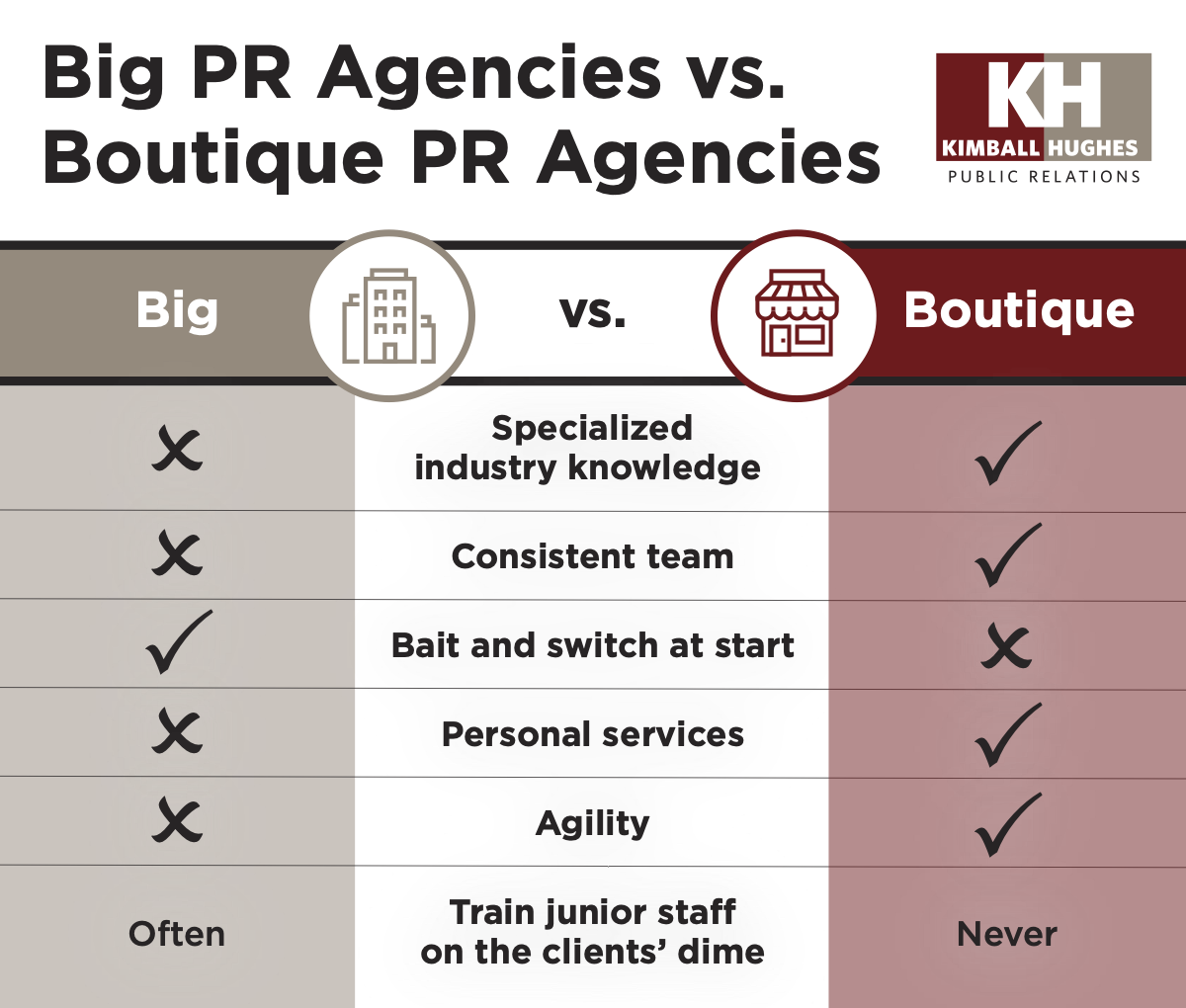
The same holds true when it comes to public relations agencies. Boutique-sized public relations agencies may not boast the large teams and vast service offerings that their larger counterparts do, but when it comes to specialized knowledge, nimbleness, and personal service, selecting the right boutique agency can provide unmatched success.

A Specialized Focus

Often a boutique agency will specialize in select industries where they have expertise. Their team will consist of seasoned employees who have worked within the industry itself or worked for years on accounts for companies in that industry. For example, at Kimball Hughes Public Relations, one of our specialties is insurance. Our team members have worked for numerous insurance clients from a PR agency perspective, have worked in-house for communications teams at insurance companies and even worked as reporters on the insurance beat. Moreover, boutique PR agencies pride themselves on employing experienced professionals to lead accounts; they simply cannot afford to risk their reputations by staffing client work with new or less experienced staff.

A boutique PR agency with a specialty will have knowledge of hot button issues and emerging trends. They will be able to do more than simply promote your brand or your executives, they will have the inside knowledge to be able to position your subject matter experts as thought leaders within the industry. They will know the conferences at which to be seen and secure media interviews that matter to your stakeholders. A specialized PR agency will have strong media contacts within the niche and help to position your leaders as go-to sources for future stories.

A Nimble Approach

Like Jerry the mouse, smaller agencies can be nimble – speedy too, like Road Runner. Without the red tape of a larger agency, a smaller agency can react to news more quickly and prepare a thoughtful response for your team to review and distribute in a timely manner.

A small PR firm will also be a nimble ally in a crisis. In those circumstances and others, you will have direct and prompt access to your agency account manager, someone you know and trust, who understands your organization and your industry who is also ready to help protect your company’s reputation anytime day or night.

That agility also comes in handy when a media strategy is not working. Valuing each and every client relationship as if it were the firm’s only relationship, a smaller agency will constantly be monitoring for results. When those results don’t manifest, they’ll recognize it immediately and pivot to a new strategy.

Personal Service

Finally, when you work with a boutique agency, your daily contact and team are likely to be people you met at the start of your relationship with the agency. The bait and switch is rare with boutique PR agencies. In fact, in many cases, you may know a number of people within the agency and they will know you and be familiar with your company’s needs. Small PR firms work closely with clients and staff to ensure  all team members are in the know so they can quickly spot-fill or act as an extra set of hands when necessary. Further, these folks will make an effort to get to know you and to understand your team’s marketing and communications goals to ensure your team is getting the results your c-suite wants to see.

For smaller PR agencies, clients are truly partners. We value relationships and want to deliver for our clients.  

So, smaller agencies may not wield a multi-story downtown headquarters the size of the Death Star. But they can be a powerful force. Give Kimball Hughes PR a call to talk to us about our specialized expertise, knowledgeable team and proven results.

Lifting the Veil: Parallels Between Building a PR Strategy and Planning a Wedding

Many say that planning a wedding is akin to having a full-time job. This is a reality I learned planning my own wedding. I got married this past July.

As I was wrapping up work in preparation for the wedding, I was struck by the similarities between planning a wedding and preparing a public relations strategy. While one focuses on florals and outfit coordination and the other on messaging tactics, media placements and KPIs, both are tied to reality by timelines, budgets, audience expectations and the seasoned professionals who know the marketplace.

Defining Your Happily Ever After

When planning any program, strategy or event, it is important to have a vision of what your end outcome will be. For example, most marriers aim to have a beautiful wedding, where all guests enjoy themselves and the couple has a long and harmonious happily ever after.

To position their wedding for success, couples often identify a theme. Some aspire to have a grand, black-tie gala while others want a more laid back, yet festive beach affair. Personally, I planned for a casual, yet sophisticated garden party.

When launching a public relations campaign, the strategy can be similar. Consider what your business ultimately wants to gain from this strategy. Similar to the couple-to-be’s goal of happy guests, your goal may be to have a roster of eager prospects. Or you may be looking to bring more awareness to your company, introduce a new product or line of business or change the way your organization’s reputation is perceived. Each goal requires a different approach, making it important to select and focus on one before the work begins.

Engaging the Right Partners

Once your vision has been clearly defined and you have a better understanding of what is needed to accomplish your goal, look for the tools and resources that will help you succeed.

In the wedding world, little can be accomplished without the support of key specialists. The venue, caterer, photographer, florist and DJ will all come together to create your vision of the perfect day.

Putting together and successfully implementing a public relations strategy does not and should not have to be a one-person job. Consider seeking out a partner with expertise to meet your needs. Just as the wedding vendors can connect you with recommended business partners who they know and trust, PR professionals can connect you with media that will reach your target audience. In the case of my wedding, my vendors all came highly recommended by my venue, meaning they knew exactly what equipment to come prepared with and had worked together before, helping the day go off without a hitch.

There are a multitude of resources to help accomplish your public relations goals. A full-service public relations agency can help you throughout the entire process, from defining your goals and audience to setting tactics, implementing a plan and measuring success.

Additionally, the right partners will be flexible. A good wedding vendor will do what they can to meet your changing needs. For instance, my photographer’s original quote was out of budget, but they worked with us and added in the extra benefit of an engagement shoot for free. Similarly, when my venue told me the ice cream truck I had my heart set on was unavailable, they were able to lean into their relationships to source a different one.

Similarly, a good media team will also know how to pivot to best meet your needs. They will recognize when a change in approach or messaging is needed to adjust to breaking news or current trends.

Catering to Your Audience

While a wedding is ultimately put together to celebrate the couple, it is important to take the rest of the guests into consideration. Certain accommodations are arranged with guests in mind, such as transportation, lodging and the menu. For instance, my guests who were vegetarian or vegan were provided with separate meals.

Similarly, your PR strategy must cater to your audience. Just like a steak dinner won’t work for a mostly vegan guest list, a trendy influencer partnership on TikTok is unlikely to help an insurance organization meet their goal of reaching more brokers and agents. When building a public relations strategy, it is critical to identify your audience and understand what they are reading and viewing.

Taking an audience-first approach will help ensure the vision you are trying to achieve will have the intended effect on the right people whether it’s a ballroom full of happy, stuffed, dancing wedding guests or a list of prospective clients now interested in inquiring about your products and services.

While seemingly worlds apart, wedding and public relations planning share similarities. Building a rock-solid foundation with a clear vision, the right partners and an audience-first approach will make ironing out the details, whether they be dress fittings and menu selections or pitching and coordinating media interviews more successful in the long run.