Takeaways from Yellowstone: Getting the Biggest Bang Out of Your Content Buck

Atop his horse, gazing across the horizon of the Yellowstone Dutton family ranch, John Dutton explains to his ranch manager, Rip Wheeler, “The brand isn’t somethin you earn, it’s somethin you live up to.”

Whether you are promoting the Yellowstone brand – be it the ranch or the television series – or your company brand, Dutton’s words ring true: the content you produce for your for- or non-profit organization has to live up to your brand promise to deliver meaningful value.

Whether you like Yellowstone creator Taylor Sheridan’s style or not, there is no question he is a master when it comes to churning out content that leaves viewers wanting more, and those of us responsible for “living up to” the brand through content could take a few lessons from him.

As public relations professionals, we strive to produce non-promotional engaging content on behalf of our clients that drives their audiences to connect with a brand. Cowboy hats and boots aside, good PR practitioners tend to subscribe to some of the same tenets of content creation and promotion as Sheridan. We’ll call these the bunk house rules for good PR:

  • Find what works and stick with it. Sheridan found a successful formula in the Yellowstone brand and he invested further. What was so successful about Yellowstone? A New York Times writer seemed to sum it up with his brothers words, “It romances the Wild West in a modern related way.” Variety said the Yellowstone finale attracted a whopping 16.5 million viewers. A few years back when Yellowstone began gaining in popularity, Sheridan and his producers saw they had content gold. Sheridan went on to produce two prequels banking on the story of the Dutton family. PR pros subscribe to a similar philosophy. When they find messaging or content that connects with a target audience, they continue to build on those concepts. For example, a client came to us struggling to gain media attention. We recognized the client was struggling because they were chasing their audience with their value proposition rather than backing into the value proposition through relatable story-telling and education. We flipped their script and focused on drawing parallels between the eclectic hobbies of their founder to the industry trends, issues and solutions that mattered most to the audiences they needed to reach most. When we saw success and audience engagement, we told the story on different platforms to broaden our reach.
  • Commit to producing a steady stream of original fresh content. In just the past 9 years, Sheridan has written and produced almost a dozen shows, according to Esquire. He understands what his star actor, Kevin Costner, who played John Dutton on Yellowstone, heard from Shoeless Joe Jackson so many years ago in Field of Dreams, “If you build it, they will come.” The same holds true in the world of PR. One piece of static content will not keep audiences engaged or customers coming in the door. Companies need a bank of fresh content that educates and speaks to topics and trends that interest readers. Often in PR it is said, what we do can’t be turned off and on like a spigot. A company needs to have a continued presence in the eyes of the media and its audience. This can be established through steady media outreach and thought leadership, as well as by posting original content on a company’s owned media channels regularly.
  • Don’t be afraid to put yourself out there. Sheridan is not afraid to stir up a little controversy. In the most recent season, Sheridan gave himself a good amount of screentime, cast a model for his on-screen girlfriend, and showed off his brawny physique in a strip poker scene, which USA Today said, viewers saw as “a bit self-indulgent.” And, following Sheridan’s approach, one of the secrets to better engaging with key audiences in 2025 and beyond is for those at the top – CEOs in particular – to step in front of the camera to shape their brand story; on podcasts, company-branded YouTube channels, streaming services and more. Regardless of what viewers thought Sheridan’s time in front of the cameras for the finale season of Yellowstone, he continues to build his brand and make a name for himself. He continues to write new shows, invest in new stories, test his own acting skills and remain visible. It’s a successful formula when you’ve got great ideas to share. A good PR practitioner will help you raise awareness for your brand if you’re not afraid to put yourself out there. They can help you understand what your audience wants to talk about and how the audience wants to be met, as well as how your company can best position its subject matter experts to comment on these matters in a way that puts the brand in a positive light. Again, it’s not always about your company’s value proposition; it’s about what audiences can learn from you to bring them to your brand.

Taylor Sheridan has a lot to say, and viewers are eating it up. Likely, your company does too. Find a good PR partner to help you build original content and make the most of it. After all, brands that fail to keep their audiences engaged could be headed for the train station.

Navigating Conference Season: Take-aways from a Philly Cyber Risk Summit

It’s conference season and this week I was fortunate to attend an industry event with a global draw – without hopping on a plane or train – in my hometown of Philadelphia. Insurance carriers, brokers, cyber risk assessment, breach recovery experts, legal, security, privacy professionals and more traveled to the City of Brotherly Love for three days of discussions on cyber risk hosted by NetDiligence®. For me, the event provided a valuable opportunity to learn about trends and challenges in the ever-evolving cyber space, to connect with clients, make new connections and of course check in with and coordinate meetings with trade reporters and editors on site.

As a public relations professional who has spent years working closely with the insurance industry, I know enough about cyber risk and cyber insurance to be dangerous. However, the speakers at the conference offered eye-opening insights on challenges in the cyber risk space, emerging risks including artificial intelligence, new technology and best practices for risk mitigation. Now, I know enough to keep me up at night.

For example, top cyber scams noted by Experian Head of Global Data Breach Resolution Michael Bruemmer included those related to fake news (particularly bad during election season), natural disasters, charities, sextortion (which can even include a photo of the recipient or their house) and QR codes. What I learned about QR codes maybe should have been obvious – it’s nearly impossible to tell the difference between a legitimate and illegitimate QR code with the naked eye.

For businesses, the top risk, according to NetDiligence, remains business email compromise. As to why the risk remains so high despite corporate teams working diligently to implement safety measures and train teams to spot these emails, Bruemmer said it’s the smart pitches from the criminals that appeal to human weakness. They just keep getting more creative.

Outside the sessions, I spent time roaming the exhibit hall and making new connections. Representatives were on site to talk about their cyber risk technology, mitigation services, cyber data mining services, e-discovery and more. While the usual water bottles, pens, mints and cozies adorned the tables, a robot, like a modern version of Rosey from the old Jetsons’ cartoon, roamed the floor proffering champagne from exhibitor KYND for attendees.

Additionally, I had the opportunity to connect a few clients with attending media for background conversations. At Kimball Hughes PR, we encourage our clients to leverage their attendance at conferences like this for potential media introductions or onsite interviews. Not only can conferences bring value in terms of continuing education credit, new business meetings and client relationship building, meeting with media members, who are often on-site at these events, can pay dividends in establishing you as a trusted source for future articles or even in a conference wrap-up piece.

We often suggest our clients bring us along to conferences where media is attending for boots-on-the-ground support. This way, we can coordinate additional on-site meetings, assist in fielding questions, assist in bringing trending conference topics to the conversation and seek out opportunities to comment on articles currently in the works.

While I’ll be happy to trade my dress shoes for sneakers in the days ahead, this industry conference, like so many others, was a fantastic opportunity to learn, further relationships and build new connections.

Stay tuned for more conference round-ups as members of the Kimball Hughes PR team continue to round the conference circuit throughout the month.

What’s in an Address? Good PR Doesn’t Always Mean Big City Agencies, Hefty Price Tags

There was a time when American businesses leaders could do no wrong if the consultants or vendors they hired were marquee names with storied addresses on K-Street in Washington, D.C., Madison Avenue in New York or were located among the scenic vistas of Silicon Valley. That time is over. Management has tired of paying for the geographic mark-up of posh addresses. New York City and Silicon Valley may have been known as go-to hot beds for finance and tech expertise, but cities in Texas, less recognized for offering that same level of expertise without the swanky digs, are quickly transforming the Lone Star State into a tech and financial hub.

Goldman Sachs, Wells Fargo, Charles Schwab and Deloitte are expanding their presence in Dallas, lightly dubbed Y’all Street, according to The Wall Street Journal. At the same time, tech companies like Hewlett Packard Enterprise, Oracle and Tesla have moved sizeable operations to Texas as well, noting a friendlier regulatory and tax environment and robust talent pool.

These companies do not want to spend Silicon Valley or New York City dollars to get the same-or-better quality and service they can get elsewhere. This thinking has long been a too well-kept secret in public relations. While business leaders may have previously assumed a large New York City PR firm was the only means of garnering impressive results, current trends are pointing to star PR talent in Texas, and elsewhere outside the high-rent districts of Manhattan.

Good PR does not have to cost $30k, $20k or even $10k a month. While some of the country’s most well-known global PR firms may have former presidential candidates to tout on their rosters, many boutique agencies have tenured professionals who not only know PR, but know your industry… and best of all, who will take the time to listen and get to know you because they value – and need – your business.

In fact, we often hear from clients who have come to us from large, global agencies. They tell us they were shocked by the both the price of admission to these goliath agencies, as well as the lack of access to senior talent at those agencies. Too often with larger firms, clients find themselves the victims of bait-and-switch routines with a junior staffer managing their account after an initial meeting with executives where they signed on as new clients. Or they find out that press releases or thought leadership writing are all additional costs outside the retainer agreement. Just as many tech and financial services companies have recognized, good expertise does not always come from the most expensive source.

That said, we are all also too familiar with the phrase “you get what you pay for.” Fantastic PR firms offering services at a fraction of the price of their larger counterparts are out there, but business leaders and their marketing and communications teams seeking support will have to do their homework to find a valued partner they can trust.

Contemplate the following dos and don’ts when considering a PR firm:

  • Don’t be fooled by a name or size. Simply because they have a celebrity on their roster or they are the biggest, does not mean they are the right fit for your company’s needs. Often, business owners can get more bang for their buck when it comes to PR by selecting a smaller agency with specialized expertise to fit their needs.
  • Don’t assume PR is expensive. PR does not have to be expensive. Campaigns can be tailored to fit your budget – within reason. A smaller, targeted campaign by a team who really understands how to reach a specific audience and what they are looking for can produce more results for less compared to an overly broad, national campaign.
  • Don’t let your company be nickeled and dimed. A good PR firm will not busy themselves with counting your hours and billing for every single. They will work with you. They will offer inclusive services, and not bill separately for press releases or writing services. (And on writing, ensure the agency you are considering has proven writers on staff.) Often, the best PR firms employ former journalists, who not only know what reporters are looking for, but know how to write like them to ensure the best possible reception among the journalists most important to you and the audiences you need to reach.
  • Do ask who will be working on your account to ensure the leadership team you spoke with at first doesn’t ghost you for the newest assistant.
  • Do consider a PR agency’s specialties and expertise in your industry.
  • Do look to references. Clients, and particularly former clients, can give you an honest opinion on whether an agency met or exceeded expectations, as well as their experience working with the team.

Most importantly, keep an open mind. Just as good tech solutions no longer come only from Silicon Valley, good PR is not provided exclusively by big city agencies for tens of thousands of dollars a month. Smart, committed and results-driven teams drive PR success and increasingly those folks can be found at boutique PR agencies that offer more manageable retainers.

The Secret Sauce: How Video Can Spice Up Your PR Strategy

The dog days of August are here, accompanied by late summer vacations, back to school and, if you’re lucky, quieter workdays. This precious, less-demanding time of year when customers, clients and colleagues enjoy some much-deserved time off could be the ideal opportunity to explore ways to freshen up your public relations strategy for the final stretch of the year.

So, what do we see as the secret sauce to spice up your PR efforts before we close out the year?

Video.

HubSpot laid out the reasons why video is the future for marketing in a recent report. We’ll include PR under that umbrella for these purposes. The HubSpot research found 63% of customers surveyed in 2024 watched video content to learn about a product. They ascertained that 89% of consumers want to see more videos from the companies trying to reach them.

And video is not just valuable because people see it and digest it; brands love it because consumers pass it on. HubSpot found that people surveyed were 52% more likely to share video content than other types of content.

It’s not just brands that are noticing this growing consumer interest in video. Social media platforms recognize this too. Just this summer, LinkedIn beta tested a new video tab to piggyback on the popularity of TikTok and Instagram scrollable reels of video content. After testing out the new feature earlier this summer, digital transformation consultant and social media selling expert Ema Roloff wrote, “I can confidently say it will become the most used part of the LinkedIn mobile app. Just like Reels on Instagram, or Shorts on YouTube, the video tab is the spot to get your dopamine hit.”

She went on to explain the new feature will enhance user engagement and community building as users spend more time watching video, connecting with it and are presented with more opportunities to interact. Further, the easy-to-scroll set up encourages users to stay on the platform scrolling through videos and hopefully, sharing those videos.

Working It In

In the world of PR, video can be used to complement and enliven nearly any PR tactics. Consider the following:

  • Press releases and product announcements embody traditional PR. While a press release may still be needed for convenient text containing the who, what, when, why and where for reporters, why not make the news a bit more exciting for the consumer? Video can do just that and help to make a more memorable connection with your customer related to your announcement.
  • Thought leadership prepared as text can also be recycled into video to further the writer’s point either through animation or a casual short video on the topic. It can help to highlight the main points and draw viewers in to want to take a deeper diver and learn more. As much of what we do in PR is based on telling a compelling story for our clients, video can help achieve this goal as it can help to evoke emotion and more deeply engage the viewer.
  • Issue statements, a tool used by PR pros to get a leader’s expertise out to the media on a certain topic making headlines or breaking news, can also be supported with a video message. A recorded video message by the thought leader could not only be valuable to catch a reporter’s eye, but also for reporters to insert into segments, or to demonstrate the individual is TV-ready.
  • Social media posts can get a bit stale if a company is always posting the same types of content, whether its graphics, photos or even original articles. Short, original video can help to break up this content and keep the viewer engaged.
  • Interactive events like LinkedIn or Facebook Lives seem to be the modern press conference. These platforms allow users to host live webinar-like events that can be more easily found among your connections, shareable, cost-effective and a fantastic way to encourage user interaction and promote engagement.

Dos and Don’ts

So, you’re ready to tackle video for your company. What should you keep in mind?

  • Don’t worry about producing highly polished content. Do produce “relatable and authentic” content. HubSpot found 63% of viewers prefer this.
  • Don’t publish a full-on made-for-TV mini-series. Do create a brief, thoughtful video. HubSpot found 83% of marketers believe video should be no longer than 60 seconds in length.
  • Don’t commit yourself to one channel. Do explore and take advantage of the channels your key audience frequents, whether they include LinkedIn, YouTube, Instagram or Facebook.
  • Don’t assume you can do it all. Do consult a PR professional or agency. While video for these purposes should appear “authentic”, it should not appear sloppy or amateur. Work with PR pros who can help you, at minimum, with talking points, speech prep, with recording and conducting light edits on the video.

Video will play a key role in the future of PR and marketing. Freshen up your approach to PR with the latest channels to share your key messages and connect with your audience to help ensure your brand is meeting your customers where they are.  

Envisioning a Clearer Line from PR to Sales

How do you measure the return on investment (ROI) on your public relations (PR) services? It’s a question asked of every public relations professional by clients and prospects frequently.

It’s also a question we wish we could answer with detailed rows of figures, colorful line graphs and a direct line to sales, but even in 2024, it’s not that easy.

Though we can — and do — give clients comprehensive measurement reports listing the circulation, readership, viewership or listenership of media outlets where they’ve been featured, as well as share-of-voice (SOV) reports, Google Analytics, and more, the industry is yet to develop that perfect algorithm or tool that demonstrates a direct line from PR to sales.

By no means does this mean our work is not generating sales and/or leads. In fact, experienced PR pros have clients say, time and time again, “We had a call come in from a prospect who said they were inquiring about our services after reading our contributed article in XYZ publication.”

For those in our profession, a statement like this is the ultimate compliment. We know, and the client knows, we not only positioned them in front of their target audience through a thoughtfully designed PR strategy, we helped bring, through our work, a prospect to their door.

So, how do you know your PR strategy is working?

A good PR partner will start with obtainable goals and consider a variety of factors to measure their progress. Key measures should include:

Comprehensive Metrics: These are critical in measuring PR success, but once again, you likely will not find an accurate direct link to sales. But there are plenty of metrics your PR team can examine to measure the success of a campaign.

For example, they should carefully review and measure unique monthly visitors to the host site, share of voice, tone, sentiment, reach, key word ranking, social media traffic and more. That information should be shared with you on a monthly basis with a media mentions report of articles, podcasts or other media where your company was featured during that month.

At the same time, to boost those metrics, your PR team should be working to secure backlinks in your media coverage where possible. Though some publications will not allow this, when permitted, a backlink can be quite valuable. Backlinks denote authority and raise the search engine optimization (SEO) of your website, as well as the authority of your content. If the publication’s own domain authority or SEO is considerable, that lends greater credibility from Google’s perspective. With backlinks and your website’s Google Analytics, your PR team can benchmark and track progress as to how the PR work is impacting web traffic to your site.

While ad value equivalency and media impressions were once the holy grail of PR measurement, these two metrics have since largely fallen out of favor. They are a “holdover over from print” and no longer accurate, according to PRWeek. Though impressions can tell you how many viewed and an article from a circulation perspective it fails to tell you how many times a physical article was passed around, how an article has been featured and circulated on social media, how long a viewer stays on an article and more.

Share of Voice: Share of voice, which should be included in the comprehensive metrics above, deserves a shout out of its own here as a key measure as it can offer a company critical insight into their own media footprint as it compares to their competitors.

The term share of voice denotes a measurement that encompasses a company’s print, radio, broadcast and podcast presence, as well as its online mentions and website traffic, among other factors. Share of voice is measured with a calculation of a company’s mentions divided by total market measures.

At Kimball Hughes PR, we’ve seen tremendous success for our clients in terms of growing share of voice via a strategic PR campaign. In fact, after one year of a PR engagement with our team, one of our clients saw their share of voice increase from just under 10% to more than 75% compared to their competitors. In addition to posting thoughtful press releases in tandem with the client, we accomplished this by leveraging insight from the client’s leadership team, by telling stories about relatable personal interests, tapping into industry trends and more to get in front of their key audiences in print, online, via broadcast and streaming platforms, via podcasts, blogs and more. Further, once these pieces of content were published, we provided recommendations and suggested messaging to amplify the article’s reach through social media.

New Business Origination and Leads: While these tools are helpful, as mentioned at the top, one of the best ways to measure PR success, is through a client’s new business wins after the prospect has read their insight in earned media coordinated by your PR team. There, you see PR’s direct link to sales.

No doubt, new tools will be introduced in the months and years to come to better measure PR success. In the meantime, be patient and open to considering multiple metrics in evaluating the success of your PR campaign.

Jargon Madness Wrap Up: Top Overused Business Jargon and How to Block It Out

Well, once again to the dismay of my three teenage sons, I won the family March Madness NCAA basketball bracket. We’ll just say I do not follow college basketball like they do, but please know that I didn’t pick solely on uniform colors or schools I’ve visited.

One topic I do have a better handle on than my boys is business jargon. This year, Kimball Hughes Public Relations thought it might be fun to explore some of the more over-used business jargon and build a bracket of sorts in the spirit of March Madness. The former journalists and word wizards on our team sure had fun with it.  Afterall, as professional communicators, these are words we’d like to see used minimally, if not completely boxed out from content.

Confusing the Point

According to the Harvard Business Review, jargon exists in workplaces because it can reinforce a shared identity, assist in fast and accurate communications among particular groups, as well as to quench an individual’s desire for professional status.

Prospects and clients want to understand what your company does. They do not want to be frustrated by jargon and buzz words strung together. Afterall, doesn’t your company do more than create integrated solutions that optimize efficiencies, drive alignment and build synergies with an omnichannel approach, all while connecting with ecosystems that align with core competencies?

Placing phrases on an About Us page, on a press release or in another piece of content peppered with heavy jargon could lead the client or prospect to leave the page out of frustration, misunderstand your products and services or decide to completely disengage with your company.

Geoff Keast, VP of Sales and INSTANDA, raised an interesting point in a recent interview on insurance jargon with PropertyCasualty360. He noted that when agents or insurers use jargon, the average insurance policyholder does not understand, they run the danger of leaving clients and prospects feeling as though they are being deliberately tricked. In other words, the overuse of jargon can lead to distrust.

Further, Keast noted that in the world of insurance, certain jargon could be doing the industry a disservice. For example, he pointed out that the often-used insurance term “premium” could leave one to interpret that they’ll be paying a higher-than-normal price for the product or services, when a premium in insurance is simply an insurance payment.

Writing Slam Dunk Messaging

At Kimball Hughes PR, our final four business jargon terms included core competency, integrated solutions, North Star and synergy, with my vote to position integrated solutions atop that list.  The term integrated solutions can certainly sound impressive, but if the content doesn’t explain the type of solutions a company provides and how they can benefit me or my business, what value do those business buzz words really hold?

Other words that made our list are terms we all easily recognize including: alignment, bandwidth, ecosystem, efficiencies, engagement, KPI, leverage, omni channel, psychographics, optimize, scale and viral.

Don’t get me wrong, these terms are essential for business communications. We simply used this amusing exercise to have a little fun and point out this fact: allowing your messaging to get lost in jargon can lead to an airball for your team, missing your key target audience.

Business jargon can and should be used in business communications, but it should not be your only play. For a winning communications strategy, consider:

  • Reviewing your copy for jargon and ensuring that what you are trying to say can be clearly understood by any member of your target audience.
  • Rereading any jargon to ensure it will not mislead readers or be misinterpreted.
  • Sharing the copy with an outsider and asking them to explain what is written.
  • Flagging identified overuse of jargon and exploring alternative ways to convey the same thought. (Finding fresh ways to explain what you do or to share key messages can help set you apart from the competition.)
  • Defining jargon terms that could confuse readers upon first reference on the word.

Finally, to ensure your communication fits your audience and conveys your key messages clearly and accurately, consider talking to a communications specialist or engaging a PR agency – preferably one staffed by former journalists or a proven team of writers. Good communicators will find the right words to tell your story in a way that resonates with your audience and delivers results.

The Press Release: “In” or “Out” in 2024?

As a journalism major in college, I studied the inverted pyramid. It states that the most important details permeate the widest part of the pyramid, supporting details follow in the middle and supplemental information completes the tip of the upside-down pyramid. As a public relations professional, I know a well-written press release should follow a similar format — but I also know no press release, no matter how well written, should stand on its own.

So, what’s the scoop on press releases for 2024? Those that follow the inverted pyramid format as part of a strategic public relations campaign are still very much “in,” but, if released in a vacuum or poorly written, the press release is most definitely “out.”

This should not come as a surprise in 2024. The demise of the press release has been predicted, incorrectly, for years. Once a powerful, singular tool in the world of PR, the press release has become simply one of countless tools available to the profession. Deployed strategically and creatively, a well-written press release can still help to raise brand awareness.

The Press Release Myth

For many, the idea of public relations often begins and ends with a press release. It’s not that simple anymore. Most reporters receive hundreds of press releases daily and could easily overlook yours even if you pay big bucks to have the best-known PR agency around draft and distribute it.

The truth is you need a continuous effort with the media to build credibility and a reputation as a valued resource among reporters and your audience at large. Journalists are in the business of reporting on news and taking deep dives into important trends; not promoting your company. To select you or your organization as a credible source, first journalists need to know your name. Secondly, they need to know you aren’t merely going to try to promote your product or service. The way journalists come to know these things is through continuous, relevant and topical outreach on subjects they cover and care about. This is the primary reason most PR professionals advise clients not to treat PR like a spigot, turning it off and on at will.

To accomplish all of this, you may use a press release here and there. But it should never be your default tactic, and it should only be used if you have genuine news or insight to announce. Instead, consider the press release as one useful tool in a communication strategy.

Maximizing the Press Release

So, how can a business owner get the most from a press release?

Press releases can offer value when announcing a business launch, new product, merger or acquisition, personnel change, etc. It should be relevant to the audiences you hope to reach and tell the reader the facts of what is happening with your business and leave the promotional language for the marketing and advertising folks. If the goal is establishing credibility among your audience, any hint of self-promotion will steer journalists — and increasingly more savvy news consumers — in the other direction.

Ultimately, business owners should not expect a press release alone to garner media attention. You need a broader campaign where reporters and other key audiences are receiving a steady stream of content on your brand whether through pitches to the media related to industry trends or current events, through content on company blogs, the company website or social media posts. Only with consistency will you build credibility and confidence in your leaders and your brand. Consider consulting with a PR agency to understand what approach might be best for your brand.

Best Practices

When a press release is determined to be a useful component of a broader communications strategy, it must be well-written to demonstrate that credibility. By taking care in your messaging and presentation, you are conveying that you take care in your product or service.

Consider these tips in drafting a good press release:

  • Think like a journalist — keep the inverted pyramid in mind, stick to the facts, and avoid promotion.
  • Announce your “news” up top.
  • Try to find a news hook or element of timeliness.
  • Keep the copy clean and tight.
  • Craft a compelling headline that sums up your news.
  • Consider partnering with a PR agency with former journalists on staff.

Issuing a press release as part of a comprehensive PR strategy can have several benefits including:

  • Boosting company search engine optimization, particularly if the release is picked up by multiple media outlets.
  • Serving as good introductory or reference material for reporters.
  • Providing useful fodder for marketing and other owned content sources.
  • Helping to build credibility and name recognition with a steady drumbeat of newsworthy and relevant releases, combined with other PR initiatives.

While the media landscape continues to change, the press release remains “in” and will continue to be a useful tool — for now. However, business owners should understand a press release, on its own, does not guarantee media coverage. When written well and thoughtfully distributed, it can be an effective component of a comprehensive PR strategy that can build brand trust and elevate your company in the eyes of reporters and customers.

Reflections on a Day of Service: The Value in Communicating the Good You Do

We have all heard charitable giving and volunteerism are good for the community and good for business. Although our central purpose in giving back is hopefully to produce better outcomes for others, wildlife, the environment or countless worthy causes, that business benefit should not be overlooked.

After taking part in this year’s Martin Luther King Jr. Day of Service, we thought we would explore the benefits – beyond the self-satisfaction found in helping others – available to companies that give back through kindness.

These are benefits that can inspire and encourage others to get involved and feel a part of something, while also enhancing the company’s reputation and, potentially, its bottom line.

More specifically, spreading the word, in the right way, of a company’s philanthropic initiatives can:

  • Enhance company culture. Today’s employees want to know they are working for companies that care and take action toward social responsibility. They want to see the company’s principles and support for employees, the community and the environment communicated. It can engender them a sense of pride toward their employer. Further, providing employees with time to volunteer with their team can promote comradery and build a corporate culture where employees feel more fulfilled, challenged and want to stay and grow.
  • Assist in recruiting top talent. Millennials and Gen Z want to give back in meaningful ways and they are increasingly looking to employers to not only support, but enable, these social good contributions. They are looking to join companies that provide opportunities to volunteer, to take part in fundraising initiatives and to support the causes that matter to them.
  • Raise awareness of your company among your target audience. It is not only employees who are interested in socially minded employers; customers want to patronize companies that support causes important to them.

By sharing news and updates of charitable donations and volunteering efforts via articles, photos and videos shared via eblasts, social media channels and newsletters, leadership can ensure prospective and existing customers, job candidates, and current employees see their commitment to giving back and realize this is an organization worthy of their time, attention and money. To help ensure this, consider these best practices for communicating charitable endeavors on social media:

  • Craft your post with care for clarity, tone and importantly, brevity, as well as spelling and grammar.
  • Include photos and short video clips where possible.
  • Tag the nonprofits you supported. They may repost to their networks.
  • Call out employees where appropriate for their volunteer efforts and tag them on posts.
  • Encourage employees to like and share on their social media channels as well.

Finally, a good public relations partner can define a clear strategy communicating the social good works of the company and its employees. Having a strategy is important, not only for promotional purposes, but also to ensure you and your employees communicate thoughtfully, consistently and respectfully while focusing on the best channels and language to best support the efforts of the company and its employees. Not every fundraising initiative is worthy of a press release. Again, a PR professional can help you determine the best communications channel for sharing messaging.

For our part, team members at Kimball Hughes PR had an amazing time volunteering in their local communities on MLK Day. They organized dog and cat food at the Connecticut Humane Society, made cards for veterans with the Lexington Day of Service and packaged emergency relief and disaster kits with Jersey Cares for victims of recent storms and natural disasters. At Kimball Hughes PR, we encourage a culture of giving back by providing paid time off to volunteer for MLK Day as well as during the Insurance Industry Charitable Foundation’s Week of Giving. We seek team input on all company charitable initiatives, whether through our pro bono client work or our annual charitable gift made to a nonprofit cause important to our team on behalf of our clients.

From paid-time-off to volunteer to matching employee charitable donations, organizational leaders should not only be sure to create opportunities to give back, but also to communicate their efforts and those of their employees. While not every charitable effort is newsworthy, a photo on social media of an employee helping to clean a beach or assist in a food kitchen can go a long way in advancing your reputation as a company that cares and one that is worth the investment and support of employees, customers and others.

Behind the Picket Lines: Communicating in Times of Employee Discord

Years ago, autumn was not just about pumpkin spice, leaf peeping, back to school and football. It was also celebrated as the end of summer’s re-runs with a new line-up of fresh television shows released each September. While those days are long gone with the advent of streaming platforms, this year looked a bit different. We were back to reruns.

The Writers Guild of America was on strike for more than five months, forcing a rapid halt to the production of new content for Hollywood. Then, its resolution in late September was followed with a strike by the Screen Actors Guild-American Federation of Television and Radio Artists, who have been behind the picket lines for more than 100 days now. Both unions were and are respectively pushing for long-term pay, control over artificial intelligence and employment consistency.

And it is not just Hollywood on strike these days. Roughly 46,000 workers with the United Auto Workers union in Kentucky, Michigan and Texas found themselves behind picket lines this fall demanding improved wages and benefits.

These strikes, coupled with employee push back on employer demands for a return to office point to the fact that today’s employees have a bigger voice, and their actions are forcing employers to listen. From a communications perspective, unhappy or disgruntled employees who take their complaints public can lead to a brand reputation problem. Fortunately, a smart, proactive plan for internal and external company communications can help diffuse situations and paint your company in the best light.

Best Practices for Communicating Amid Employee Issues

While a strike, social media backlash to a corporate return-to-work mandate, or round of layoffs may burden and inconvenience leadership with staffing shortages, overtime pay and/or mounting legal fees, the reputational damage could be the most destructive –  particularly if the press gets wind of it.

One of the best ways to get ahead of reputational issues related to employee discord is to work with a public relations team to build a comprehensive plan for internal and external communications. This way, leadership is better prepared and will have direction on how to maintain good communication with employees, vendors, stakeholders and the community. Among other best practices, leadership should consider the following in a time of employee discord:

  • Keep an open dialogue with employees.

Employees want to feel heard. With many employer return-to-work mandates, employees did not feel their needs were being considered.

Many employees like the cost savings and flexibility of remote work and feel they are more productive as a result. Employers who feel strongly about employees returning to work should communicate with employees rather than simply mandating a change. They should make the case for employees as to why a return to the office is necessary and even consider acknowledging the sacrifice employees made to work from home during the pandemic. After having that dialogue, leadership might determine that offering an incentive to bring employees back or a hybrid option could help maintain or improve employee morale and prevent discord.

  • Control emotions and cool tempers.

Communications between the U.A.W. and auto manufacturing plants have become heated with Stellantis issuing a press release that began with the fighting words, “we are outraged.”

Aside from pride, big dollars are at stake, causing emotions and tempers to run hot. But a good public relations professional can help a leadership team craft messaging that carries a human element and reflects a more considered approach. A public relations team would caution executives from letting anger show through, particularly in negotiation-related communications.

  • Keep your media team updated with all developments to avoid surprises.

Whether it is a salacious email leak connected to a member of the leadership team or a negative social media post gaining momentum, it is critical to keep your public relations team updated regarding developments during a time of employee discord.

You never know what will erupt into headlines and damage the reputation of your company. If your public relations team is made aware of the situation with time to spare, they can proactively prepare a plan and smart messaging to try to prevent a situation from spiraling out of control.

While a good public relations team may not be able to do anything about the employee discord forcing reruns upon us this fall, they can help company leadership better communicate – and recognize the value of open and frequent dialogue. Hopefully, we will see these workers and executives come to common ground soon, but until then, let us encourage a focus on good communication.

The Right Fit: The Benefits of Partnering with a Boutique PR Agency

Road Runner always outran Wile E. Coyote. The massive, formidable Death Star was no match for Luke Skywalker’s tiny x-wing fighter. And of course, we all know how David fared against Goliath. In each instance, the little guy triumphed, reminding us that bigger is not always better.

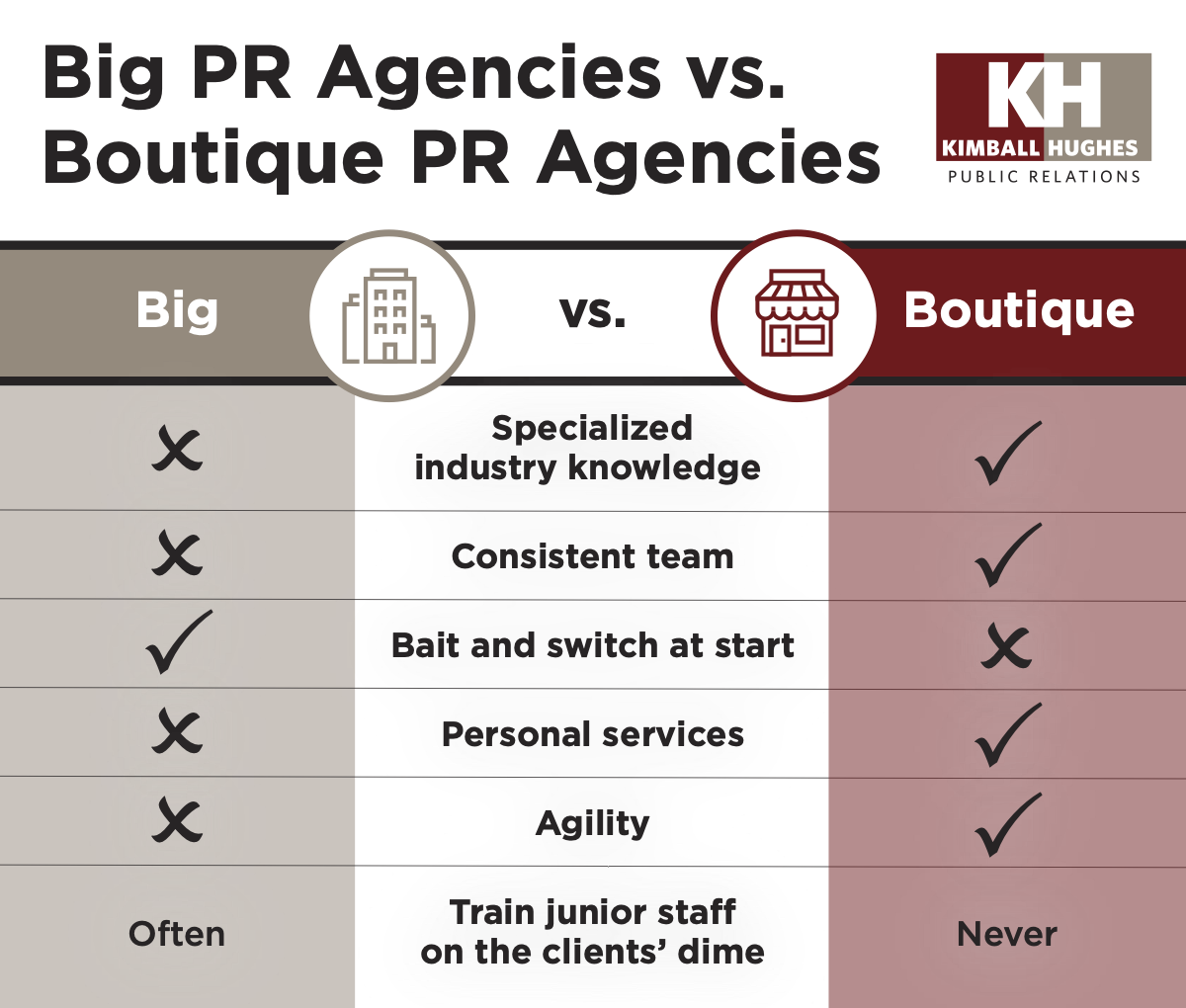
The same holds true when it comes to public relations agencies. Boutique-sized public relations agencies may not boast the large teams and vast service offerings that their larger counterparts do, but when it comes to specialized knowledge, nimbleness, and personal service, selecting the right boutique agency can provide unmatched success.

A Specialized Focus

Often a boutique agency will specialize in select industries where they have expertise. Their team will consist of seasoned employees who have worked within the industry itself or worked for years on accounts for companies in that industry. For example, at Kimball Hughes Public Relations, one of our specialties is insurance. Our team members have worked for numerous insurance clients from a PR agency perspective, have worked in-house for communications teams at insurance companies and even worked as reporters on the insurance beat. Moreover, boutique PR agencies pride themselves on employing experienced professionals to lead accounts; they simply cannot afford to risk their reputations by staffing client work with new or less experienced staff.

A boutique PR agency with a specialty will have knowledge of hot button issues and emerging trends. They will be able to do more than simply promote your brand or your executives, they will have the inside knowledge to be able to position your subject matter experts as thought leaders within the industry. They will know the conferences at which to be seen and secure media interviews that matter to your stakeholders. A specialized PR agency will have strong media contacts within the niche and help to position your leaders as go-to sources for future stories.

A Nimble Approach

Like Jerry the mouse, smaller agencies can be nimble – speedy too, like Road Runner. Without the red tape of a larger agency, a smaller agency can react to news more quickly and prepare a thoughtful response for your team to review and distribute in a timely manner.

A small PR firm will also be a nimble ally in a crisis. In those circumstances and others, you will have direct and prompt access to your agency account manager, someone you know and trust, who understands your organization and your industry who is also ready to help protect your company’s reputation anytime day or night.

That agility also comes in handy when a media strategy is not working. Valuing each and every client relationship as if it were the firm’s only relationship, a smaller agency will constantly be monitoring for results. When those results don’t manifest, they’ll recognize it immediately and pivot to a new strategy.

Personal Service

Finally, when you work with a boutique agency, your daily contact and team are likely to be people you met at the start of your relationship with the agency. The bait and switch is rare with boutique PR agencies. In fact, in many cases, you may know a number of people within the agency and they will know you and be familiar with your company’s needs. Small PR firms work closely with clients and staff to ensure  all team members are in the know so they can quickly spot-fill or act as an extra set of hands when necessary. Further, these folks will make an effort to get to know you and to understand your team’s marketing and communications goals to ensure your team is getting the results your c-suite wants to see.

For smaller PR agencies, clients are truly partners. We value relationships and want to deliver for our clients.  

So, smaller agencies may not wield a multi-story downtown headquarters the size of the Death Star. But they can be a powerful force. Give Kimball Hughes PR a call to talk to us about our specialized expertise, knowledgeable team and proven results.