Keeping Up Earth Month’s Momentum: Leveraging Sustainability Communications

While the beginning of May marks the end of Earth Month, sustainability should be a year-round endeavor. Fortunately, there are plenty of opportunities throughout the year for businesses of all sizes to support their communities and maintain and build on the momentum highlighted each Earth Month. With the right communication strategies, sustainability-focused initiatives can benefit not only the planet and the greater good, but your business as well.

Practicing a thoughtful approach

A business that cares for and invests in the environment can offer employees, consumers, prospects and other stakeholders a positive perspective. However, leaders must tread carefully to avoid an adverse impact down the line. Consider posing the following questions when building a sustainability plan:

  • Are your goals clear? Your sustainability initiative plan should clearly outline what your organization is trying to achieve and/or contribute. For example, if your cause is to support forestry, a goal might be to plant 100 trees by the end of 2024. Having clear goals leaves little room for misinterpretation from the public or from team members. 
  • Are your goals attainable? Business leaders who establish goals within a sustainability plan should consider whether they are attainable given employee bandwidth and company budgets. Overpromising and under-delivering in sustainability efforts could leave leaders in hot water and contribute to mistrust among customers, prospects, employees and other stakeholders.

As mentioned above, companies that fail to deliver on their sustainability promises can and have fallen victim to pushback and negative press. In fact, CNN Business reported on research in 2022 that some of the largest companies in the world missed the mark on sustainability targets. For example, just last year The Wall Street Journal reported on several companies, including United Airlines who made a 2021 pledge to reduce carbon emissions but ended up scrapping their short-term goals to maintain focus on longer-term gains.

While goals can be adjusted over time, business leaders should be intentional about their goals and how they are going to achieve them, and of course, in how they communicate them.

Maximizing your sustainability plan

Yes, failed sustainability plans can lead to bad press, but successful initiatives can be a win for the company when communicated thoughtfully and strategically. Keep in mind these best practices with considering communicating sustainability initiatives:

  • Consider newsworthiness. A sustainability initiative may not be newsworthy in and of itself. For example, using the tree planting initiative above, if a business plans to hold a fundraiser to purchase the trees, they might consider sharing the cause with local media to reach those interested in supporting local forestry. Businesses might benefit from inviting local dignitaries such as government officials or local organizations with similar goals to attract media attention.
  • Be transparent. As it is in business, transparency is critical regarding charitable efforts. Business leaders should be forthcoming about their support as well as with the progress they have made toward an initiative with reporters. Exaggerated numbers or claims could lead to suspicion and distrust from key stakeholders and the press.
  • Rally supporters Recruit team members and the community to help advance the business’s sustainability goals. Engaging and having buy in from local supporters and employees will help drum up buzz around an organization that could lead to your effort making a bigger impact and help to attract media attention.
  • Stay the course. Business leaders must be prepared to remain diligent with their sustainability goals. Relevant times to discuss sustainability like Earth Month will help create momentum around a business’s eco-efforts, but they should have plan to maintain it with supplemental activations. Continued activity could also help attract media attention to your initiative.
  • Track your progress. Have a plan to track your progress while executing a sustainability initiative. Make sure to track participating volunteers, dollars raised or testimonials, among other things. Statistics will supplement your business’s efforts and give media outlets a quick glance at your success.

Sustainability has become somewhat of a buzzword in today’s business world, but the sentiment of bettering the Earth is one every business leader should share. As business leaders wind down their Earth Month activations and carry on with business as usual, they should consider how executing on defined sustainability goals year-round, armed with a strong communications plan, can be as good for business as it is for the environment.
Reflections on a Day of Service: The Value in Communicating the Good You Do

We have all heard charitable giving and volunteerism are good for the community and good for business. Although our central purpose in giving back is hopefully to produce better outcomes for others, wildlife, the environment or countless worthy causes, that business benefit should not be overlooked.

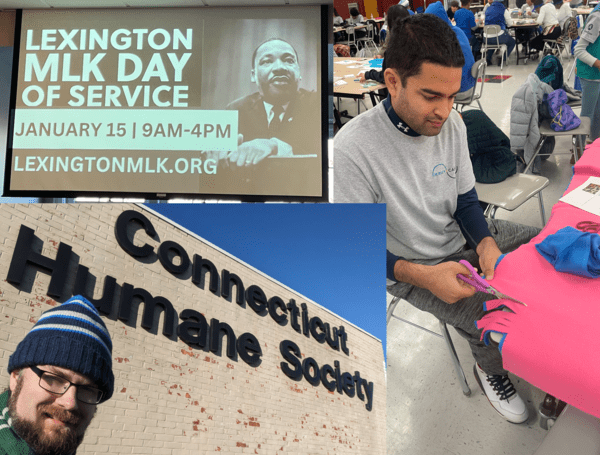
After taking part in this year’s Martin Luther King Jr. Day of Service, we thought we would explore the benefits – beyond the self-satisfaction found in helping others – available to companies that give back through kindness.

These are benefits that can inspire and encourage others to get involved and feel a part of something, while also enhancing the company’s reputation and, potentially, its bottom line.

More specifically, spreading the word, in the right way, of a company’s philanthropic initiatives can:

  • Enhance company culture. Today’s employees want to know they are working for companies that care and take action toward social responsibility. They want to see the company’s principles and support for employees, the community and the environment communicated. It can engender them a sense of pride toward their employer. Further, providing employees with time to volunteer with their team can promote comradery and build a corporate culture where employees feel more fulfilled, challenged and want to stay and grow.
  • Assist in recruiting top talent. Millennials and Gen Z want to give back in meaningful ways and they are increasingly looking to employers to not only support, but enable, these social good contributions. They are looking to join companies that provide opportunities to volunteer, to take part in fundraising initiatives and to support the causes that matter to them.
  • Raise awareness of your company among your target audience. It is not only employees who are interested in socially minded employers; customers want to patronize companies that support causes important to them.

By sharing news and updates of charitable donations and volunteering efforts via articles, photos and videos shared via eblasts, social media channels and newsletters, leadership can ensure prospective and existing customers, job candidates, and current employees see their commitment to giving back and realize this is an organization worthy of their time, attention and money. To help ensure this, consider these best practices for communicating charitable endeavors on social media:

  • Craft your post with care for clarity, tone and importantly, brevity, as well as spelling and grammar.
  • Include photos and short video clips where possible.
  • Tag the nonprofits you supported. They may repost to their networks.
  • Call out employees where appropriate for their volunteer efforts and tag them on posts.
  • Encourage employees to like and share on their social media channels as well.

Finally, a good public relations partner can define a clear strategy communicating the social good works of the company and its employees. Having a strategy is important, not only for promotional purposes, but also to ensure you and your employees communicate thoughtfully, consistently and respectfully while focusing on the best channels and language to best support the efforts of the company and its employees. Not every fundraising initiative is worthy of a press release. Again, a PR professional can help you determine the best communications channel for sharing messaging.

For our part, team members at Kimball Hughes PR had an amazing time volunteering in their local communities on MLK Day. They organized dog and cat food at the Connecticut Humane Society, made cards for veterans with the Lexington Day of Service and packaged emergency relief and disaster kits with Jersey Cares for victims of recent storms and natural disasters. At Kimball Hughes PR, we encourage a culture of giving back by providing paid time off to volunteer for MLK Day as well as during the Insurance Industry Charitable Foundation’s Week of Giving. We seek team input on all company charitable initiatives, whether through our pro bono client work or our annual charitable gift made to a nonprofit cause important to our team on behalf of our clients.

From paid-time-off to volunteer to matching employee charitable donations, organizational leaders should not only be sure to create opportunities to give back, but also to communicate their efforts and those of their employees. While not every charitable effort is newsworthy, a photo on social media of an employee helping to clean a beach or assist in a food kitchen can go a long way in advancing your reputation as a company that cares and one that is worth the investment and support of employees, customers and others.

Sustainable Energy Fund committed nearly $4 million to 2014-2015 energy projects in PA

At its recent annual public meeting in Lower Macungie Township, Sustainable Energy Fund (SEF), a nonprofit non-governmental organization dedicated to educating, supporting and financing energy users seeking sustainable energy options, announced it had committed nearly $4 million dollars to regional renewable and sustainable energy projects during its fiscal 2014-2015 calendar year.

Those commitments, totaling $3,952,871, represent low-cost loans to help fund a variety of energy projects across approximately 20 different organizations, including nursing homes, condominium developments, day care centers, museums, municipal governments, non-profits and various commercial enterprises.

A sampling of these projects include:

  • $1 million for Community Energy Renewables in Radnor, Pa., to allow the organization to develop future solar PV projects.
  • Nearly $45,000 for Fairmount Homes in Ephrata, Pa., for a retrofit lighting project incorporating LED lighting at the organization’s Wheat Ridge Drive location.
  • Approximately $34,000 for Youth Advocate Programs in Harrisburg to retrofit the organization’s North 3rd Street location lighting with energy-saving LED lights.

“We continue to see in both the non- and for-profit sectors a recognized need to control costs, plan for the long-term and commit to more sustainable energy alternatives,” said John Costlow, president and CEO of SEF.

Sustainable Energy Fund issues 20 grants to Pennsylvania students

Travel grants will allow students to attend Energypath 2015 in July

Sustainable Energy Fund (SEF), a nonprofit non-governmental organization dedicated to educating, supporting and financing energy users seeking sustainable energy options, today announces it has issued all of its 20 available travel grants to students planning to attend Energypath 2015 at the University of Scranton beginning next week. The travel grants are sponsored by West Penn Power Sustainable Energy Foundation (WPPSEF).

Recipients include:

  • Matthew T. Brockett, Edinboro University
  • Sydney M. Bynum, Washington & Jefferson College
  • Devin Clark, Robert Morris University
  • Marysol Frost, Lock Haven University
  • Kelli Gohn, Penn State University
  • Benjamin Holmes, Ambridge High School
  • Kealeb Hyde, Washington & Jefferson College
  • Kayla Griffith Kalinoski, Penn State University
  • Abigail Katsos, Washington & Jefferson College
  • Nick Kolesar, Penn State University
  • Nick Lehmann, Penn State University
  • Zachary Phillips, Shippensburg University
  • Mike Reichart, Penn State University
  • Allen Rutter, Penn State University
  • Rebecca Schmitt, Gettysburg College
  • Michael Sell, Saint Francis University
  • Corry Shaffer, Shippensburg University
  • Alaria Sun, Quiet Creek Herb Farm and School
  • Sue Tran, Washington & Jefferson College
  • David Samuel Zuckerman, Wilson College

“Working with our partner WPPSEF, these travel grants ensure tomorrow’s leaders in the sustainable energy space are able to attend the leading conference on these issues in the region” said John Costlow, president and CEO of SEF which hosts Energypath annually.

The travel grants are part of larger $10,000 grant WPPSEF made to SEF in April to fund additional programming for Energypath, as well as to provide travel funding. Students living in or attending school in the WPPSEF region are eligible for the grants. The Energypath events begin July 20 with a series of energy camps ahead of the July 23 opening of the conference.

Energypath is dedicated to increasing the knowledge and passion for sustainable energy among industry professionals, policymakers and academia. This year’s event will be held at the University of Scranton, July 23 & 24.

Sustainable Energy Fund launches 
energy savings program for nonprofits

Sustainable Energy Fund (SEF), a not-for-profit, non-governmental organization dedicated to educating, supporting and financing energy users seeking a sustainable energy future, has launched its Nonprofit Energy Savings Agreement (NESA) to provide expertise and funding to nonprofits seeking to install energy efficient features into their buildings.

NESA will use utility bill savings created by the added energy efficiencies to repay SEF for its upfront investment. The utility customer, in this case a nonprofit, will retain a portion of the utility bill savings while SEF is being repaid. Once SEF is repaid, the utility customer will receive all of the utility bill savings.

Contractors working through the program will be required to provide performance guarantees, ensuring the nonprofits involved receive a minimum annual savings on their utility bills. According to SEF, if those savings arent achieved, NESA will compensate those utility customers for the difference.

This program is an invaluable resource for nonprofits that might not otherwise have the financial means to undertake a sizable, energy efficiency capital improvement project,said John Costlow, president and CEO of the SEF. The ultimate savings that can be achieved will help these nonprofits focus more resources on their mission rather than their operational costs.

According to SEF, the small commercial building market in the U.S. requires $35.64 billion in capital to appropriately conduct energy efficiency retrofits. Such retrofits would result in $138 billion in savings in the subsequent decade following construction. However, organizations are typically stymied by lack of funding, expertise and awareness. SEF will help reduce such barriers with shared industry expertise and funding.

For more information on NESA, please visit www.thesef.org or call (610) 264-4400.

Sustainable Energy Fund hires Philadelphia firm to design an energy self-sufficient building

Sustainable Energy Fund (SEF), a nonprofit non-governmental organization dedicated to educating, supporting and financing energy users seeking sustainable energy options, today announces it has awarded a contract to Re:Vision Architecture of Philadelphia to create a conceptual design for a commercially viable net zero commercial building.

As a net-zero project, the building will be extremely energy efficiency and create at least as much energy as it uses over a year from renewable energy. It will effectively minimize utility bills to a minimum monthly fee.

“SEF intends to show how a net-zero commercial office space can be commercially viable in the small office environment,” says John Costlow, president of SEF. “Net zero technology has been viable for some time but the challenge is to accomplish it at or near market rates while also significantly lowering traditional operating costs.”

Re:Vision Co-Founder and Principal Scott Kelly applauded SEF for inviting the architecture firm in early during the project’s concept stage.

“We’re thrilled to have found in SEF a partner focused on the end-goal of a net-zero building that is willing to bring in an architectural design partner so early in the development stages because early big moves have significant design and cost implications,” says Kelly. “There are multiple ways to get to net-zero in design and construction. Together, our shared goal is to create a compelling and efficient model that exemplifies SEF’s core mission and principles.”

Re:Vision was founded in 2002 as a green architecture firm dedicated to sustainability and transparent social and environmental performance standards.

Conceptual designs of the SEF project will be unveiled at EnergyPath 2015, held at the University of Scranton in July.