Public Distrust in the Media is Expanding, But So Are Avenues for Good PR

An integrated approach has long been key to successful public relations campaigns, but as public trust in the media continues to wane, a multi-pronged approach is increasingly important.

An October 2024 survey from Gallup found Americans continue to have record-low trust in the media. According to their findings, just 31% of those surveyed reported “a great deal” or “fair amount” of confidence in the media to report the news “fully and accurately,” compared to 32% last year. Another 36% responded they have no trust in the media. Not surprisingly, these numbers are down dramatically since Gallup began the survey in 1972, when trust in the media hovered around 70%. Since 2018, the percentage of individuals who reported a great deal of confidence in the media has fallen continuously from 45% to 31%.

In this environment, it has become critical to consider PR tools and resources beyond just the media interview. A strategic, multi-faceted approach can be tremendously impactful when it comes to raising awareness for your brand. Introducing additional channels allows you to control your message more than a traditional news story alone.

Thought Leadership

Thought leadership features insights and expertise by industry leaders designed to educate the reader around trends and challenges. This content is not meant to promote or sell.  Thought leadership helps build credibility for organizations and/or the c-suite. Unlike a news article written by a reporter, thought leadership is penned by the executive, or ghost written on their behalf based on the thought leaders thorough interviews with a communications team or PR agency (preferably one staffed by former journalists). This helps ensure the company retains control of the messaging and narrative. Articles are then published by third-parties – typically trade media – or on the owned channels of the organization. Thought leadership is not only attractive to companies looking to build their media profiles, but for editors seeking to fill “pages” as newsrooms continue to shrink.

This education or insight-based content approach is proven to raise awareness. In fact, seven in 10 decisionmakers surveyed by Edelman and LinkedIn for a 2024 report said they are “very likely to think positively” about companies that produce consistent and smart thought leadership. And 67% of decisionmakers and c-suite leaders said thought leadership has led them to “research a product or service they were not previously considering.”

Social Media

Of course, with shrinking newsrooms, have come growing voices on social media. While most companies now have some type of presence on social media, they may not leverage these channels to their full advantage. As distrust in mass media grows, people are turning to social media channels like LinkedIn, X, Facebook, YouTube, TikTok or Instagram.

In its newsletter feature, LinkedIn provides a built-in publishing platform for company leaders – or anyone – to share content that lands faithfully in the inboxes and newsfeeds of their followers and newsletter subscribers each time an article is published. We see increasing value and reach in this particular communications tactic. Again, comms teams must be careful to limit or avoid promotion in this content as readers will likely reject promotional content. However this provides another platform to weigh in on industry trends and consumer issues, as well as educate, while reaching a wide and growing audience.

Social media also allows companies to amplify any published thought leadership on their own social media channels to enhance visibility and further the article’s reach. The publications will often do the same with quality thought leadership published on their platforms.

Owned Media

Finally, other owned media, like blogs continue to be a compelling tool to raise brand awareness and demonstrate expertise as trust in the media declines. A blog, hosted on a company website, that is frequently updated with original content demonstrating your company’s expertise, can also help to raise your profile. White papers, short videos on company-branded YouTube or Vimeo and more can do the same. Again, this content can be circulated across social media to stretch its reach.

Connecting with Today’s News Consumer

While legendary newsman Walter Cronkite may have been known as the “most trusted man in America,” for many American households, today’s news anchors, reporters and editors are not as warmly perceived. Fortunately, as we head into 2025, more options exist for us to see and/or hear the news. People can choose where and how they want to consume their news, and companies will need to continually find new ways to meet them where they want to be met.

A good public relations agency can recommend the best strategies and tactics for your company and that should include a multilayered approach that considers more than media relations.
Reputation is What Others Think You are

An important factor influencing an organization’s reputation is how it is represented in the media. With this in mind, Kimball Hughes PR recently ran an independent survey of business professionals to get their perspective on how media coverage of their organization reflected on their reputation and, ultimately, their brand.

What we found was broad dissatisfaction among respondents with how their brands are perceived and represented through the media.

Among two significant reputational goals — having a regular presence in news media and being clearly differentiated from their competition in those media — a clear majority of those surveyed (more than 60 percent) did not believe these goals were met.

If these findings are any indication, brands hoping to benefit from any post-COVID economic boom have significant work to do in working with the media.

Survey results:

My organization’s reputation, as it is communicated in the media, social media and other public venues, represents our stated mission, vision and values.

  • 9% Strongly agree
  • 45% Agree
  • 18% Neutral
  • 27% Disagree
  • 0% Strongly disagree

Senior leadership is regularly quoted in news and trend stories about our industry.

  • 0% Strongly agree
  • 18% Agree
  • 18% Neutral
  • 27% Disagree
  • 36% Strongly disagree

If I conducted a Google News search today of topics most important to my industry, I would find my organization quoted or written about in recent news from legitimate, third-party business or trade media outlets or sites.

  • 9% Strongly agree
  • 9% Agree
  • 18% Neutral
  • 9% Disagree
  • 54% Strongly disagree

Our brand reputation, as communicated by the media, adequately differentiates our organization from competitors in the markets we serve.

  • 0% Strongly agree
  • 18% Agree
  • 9% Neutral
  • 36% Disagree
  • 36% Strongly disagree

Worried about your brand’s reputation? Contact Kimball Hughes PR for a free, no obligation SWOT Analysis of your brand’s reputation within the media that provides top line, practical and actionable advice on what you can do to make improvements.

Hotel reputation management in the age of the instant review

Yelp, TripAdvisor, Hotels.com… The web has given travelers have so many ways to evaluate, select, book and review hotels. How do hotels manage their reputations proactively and honestly?


Hotels must actively manage their online reputations.
Unique Hotels Group / Foter / CC BY-SA 2.0

Our president Gary Kimball has some advice, which he shares with Hotel Business Review:

Hotels should look at how they are allocating their precious marketing and public relations dollars. This means comparing the value of social media buzz to advertising and print and broadcast media coverage. A review in a popular blog or traditional media like The New York Times or Travel + Leisure can do wonders in building awareness. But those readers may still seek online reviews before making decisions.

Read more at HotelExecutive.com.

Socially Irresponsible

Some small business owners don’t believe in using experts for social media engagement and content development. They see the practice as novel and unproven – until it isn’t.

Such is the case of The Union Street Guest House in Hudson, N.Y. This picturesque small town inn quickly discovered the demonstrative impact of social media when comments about a fines-for-reviews policy hit the inn’s Facebook page and Yelp, the popular online review site.

According to an ABC News story resulting from the social media dust-up, the inn claims its “policy” was posted to its website as a tongue-in-cheek response to a wedding from years ago and should have been taken down. The policy in essence stated bridal parties would be fined $500, taken from deposit monies, for each negative review the inn might receive connected to a particular wedding or event.

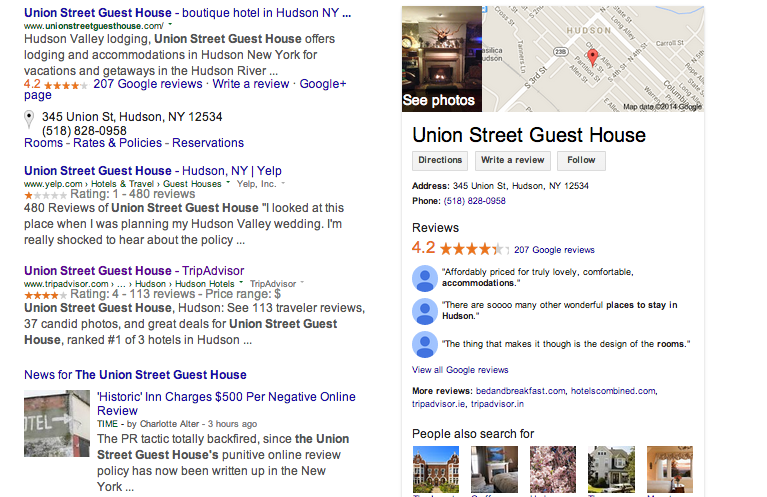
A Google search for the inn's name brings with it a wealth of negative online content that will impact the business' bottom line.

A Google search for the inn’s name brings with it a wealth of negative online content that will impact the business’ bottom line.

Unfortunately, a simple Google search of the inn’s name now produces both a link to the inn’s website, as well as countless social media and news articles referencing this not-so-amusing policy.

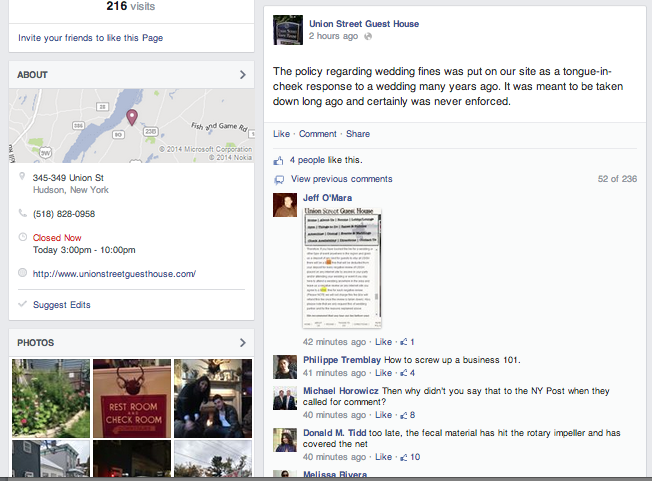
The result is a Search Engine Optimization nightmare for the inn coupled with a runaway train of negative comments on its Facebook page (more than 200 at this writing; although it appears the inn may now be deleting posts from its Facebook page).

Since this firestorm hit mainstream media, the inn's Facebook page has been inundated with negative posts.

Since this firestorm hit mainstream media, the inn’s Facebook page has been inundated with negative posts.

The news coverage and social media firestorm – with only a half-hearted response from management that appears to have since been deleted  – have created a massive public relations problem to overcome. This isn’t the type of crisis you wait out. And without a strategy for responding to and recovering from this communications nightmare, The Union Street Guest House is likely to see a steep decline in business, assuming it has the wherewithal to survive at all.

Small businesses are successful because they do what they do well. Where they often fail is when they try to do something outside of their expertise.

By consulting with a social media professional or brand content specialist, small businesses can avoid errors – even tongue-in-cheek responses – that might not seem substantial at the time, but with an extra set of trained eyes, can be seen for the potential disasters they are and thus avoided. Alternatively, bringing in the professionals after a crisis has erupted is not optimal, but it can mean the difference between staying in business or going under.

Most freelancers or public relations agencies can find equitable arrangements with small businesses that won’t break the bank, and can avoid or attempt to correct business-ending mistakes.

For a free consultation on how working with a public relations agency can help protect and promote your business, please contact me at rhughes@kimballpr.com.

Managing Your Small Business’ Online Reputation

Congratulations! You've taken your business online. So how do you leverage this into new customers or clients while also protecting your reputation?

Congratulations! You’ve taken your business online. So how do you leverage this into new customers or clients while also protecting your reputation?

Congratulations intrepid entrepreneur! If you’ve taken the plunge and launched your small business into the social media space, you’ve taken a bold step that offers many risks and rewards.

More than 72 percent of U.S. adults who go online use social networking sites, according to the Pew Internet & American Life Project. By choosing to put your brand out there, a bevy of potential rewards (i.e., Likes, followers, sharing blog posts, positive reviews and online recommendations) await your brand. With a little effort applied to communication your messages, attention to superior online customer service that reflects your brand and by trying to genuinely connect with your customers, you can turn your social media presence into a noteworthy repository of goodwill for your business that reward you handsomely over time.

The effort is also not without risk.

In the days before social media, one bad customer experience typically translated to the customer telling 10 friends of their displeasure. With the advent of social media, however, your brand runs the risk of being shamed before 100 or 1,000 social media followers. For some power networkers, those numbers are substantially higher.

It’s imperative small businesses understand, on average, about 46 percent of web users turn to social media before making a purchase to decide if the business or product is “trustworthy” or reputable. This means, to paraphrase a legendary phrase from actress Zsa Zsa Gabor, you are what the online community says you are.

On Oct. 18 at Parx Casino in Bensalem, Pa., small business owners that include restaurants, outdoor and adventure destinations, bed & breakfasts and others will gather for Visit Bucks County’s Annual Membership Meeting. Attendees will have an opportunity to attend a morning seminar on establishing and maintaining online presences to help their businesses grow.

As one of the featured speakers, I’ll be sharing insights and tips on how these businesses can protect and defend their online reputations. I’ll offer examples of good, and not so good, online customer service. In addition I’ll provide insider tips for managing these online presences under a variety of circumstances.

Check back on this blog next week for some top line thoughts on the subject as well as insights and anecdotes offered by some of the small businesses I meet with at the VBC Annual Meeting.

photo credit: <a href=”http://www.flickr.com/photos/infusionsoft/4820986909/”>Infusionsoft</a&gt; via <a href=”http://photopin.com”>photopin</a&gt; <a href=”http://creativecommons.org/licenses/by-nd/2.0/”>cc</a&gt;