Kimball Hughes Public Relations 12 Days of Public Relations

Thank you for following along with Kimball Hughes Public Relation’s 12 Days of PR. We hope you have found value from our thinking on how and why public relations can help for- and non-profit organizations. Please enjoy and feel free to use all 12 insights throughout the year. Have a safe and happy holiday season!

On the 1st day of our engagement, my new client gave to me…

A request to raise awareness around their brand. Public relations empowers clients to share compelling stories in ways that build their credibility, while transforming them into go-to resources for their specialties. It starts with a comprehensive media plan. After gaining an understanding of their goals, target audiences and key messages, we craft a thoughtful plan chock-full of tactics – that get results – leveraging media relations, thought leadership, speaking opportunities and more. 

On the 2nd day of our engagement, my new client gave to me…

A one-off press release.  A stand-alone press release will do little to amplify your brand and is usually not worth the investment of time or money. Rather, press releases should be one component of a comprehensive, ongoing media strategy designed to showcase your company’s expertise. A thorough media plan that incorporates newsworthy and thoughtful press release distribution, consistent with your company’s key messages, will help you to propel your brand and position your company for success. 

On the 3rd day of our engagement, my new client gave to me…

A call for more control over their messaging. These days, smart PR incorporates both earned and owned media. In addition to traditional media interviews where a client cannot totally control what ends up on the page, owned media, which leverages blogs, social media, white papers, sponsored content and more, allows clients to share their messages with editorial control. We work with our clients to determine the best approach for them, often incorporating a mix of both mediums for optimal exposure.

On the 4th day of our engagement, my new client gave to me…

A crisis involving negative online reviews. Negative online reviews can quickly escalate dealing a major blow to a business – if not properly addressed. We start with an assessment of the facts. We determine if a response is warranted, and if so what type. We also confirm the review adheres to the host site’s review policies. If appropriate, we’ll quickly draft a tactful response to deter further discord or advise clients how to petition for the review’s removal ­– helping them keep their reputations intact.

On the 5th day of our engagement, my new client gave to me…

A CEO who had never spoken to the media. Getting in front of the camera or interviewing with a reporter can be challenging. Proper preparation is key, incorporating these three rules: Don’t lie, don’t guess and don’t assume. Liars get caught, guessers make mistakes, and those who assume get caught off guard. We work with our clients to provide interactive media training, including live interview scenarios conducted by our team former journalists, to ensure your spokesperson is interview-ready. 

On the 6th day of our engagement, my new client gave to me…

A question on how we measure PR. When investing in PR, a common question is – how do you measure success? First we establish clear, obtainable goals that will drive PR efforts and work to achieve them. We measure for unique monthly visitors to the host site, share of voice, tone, reach and more. One of our favorite ways to measure PR success, however, is through the client’s new business wins after the prospect has read about them in earned media we coordinated.

On the 7th day of our engagement, my new client gave to me…

A request to grab headlines like their competitors. When prospects express frustration with their competitors dominating news headlines, we conduct a competitive media analysis to benchmark coverage and develop a roadmap to success. That success requires a campaign with consistent thoughtful outreach. We tailor our campaigns to best position our clients as reliable, informed and go-to media sources focused on issues, not self-promotion. This approach has yielded remarkable results for our clients, growing share of voice among their competitors by more than 70% in mere months.

On the 8th day of our engagement, my new client gave to me…

A question asking what media outlets are best for them. Choosing the right media target starts with understanding of the client’s audiences, preferences and goals. Are they looking to target C-suite executives, a geographic segment or specific community? Will they be comfortable being interviewed or do they have a wealth of expertise better suited for opinion or thought leadership contributed articles? Once we understand target audiences, the client’s style and how they define PR success, we dive into our deep database to identify the media outlets that will most effectively and efficiently reach their target audiences. 

On the 9th day of our engagement, my new client gave to me…

SMEs with valuable content to share. Thought leadership or contributed content can be invaluable, not only to establish yourself as an industry expert and go-to resource for the media, but to raise the profile of your business. We work with subject matter experts (SMEs) to determine topics in line with industry trends matching their interests and expertise. In partnership with the SME, we develop a nonpromotional article sharing genuine insight relevant to the focus of that audience – with key messaging strategically interspersed. In authoring thought leadership published by a leading industry trade, our clients have seen their SME’s profiles grow exponentially along with their brand recognition. 

On the 10th day of our engagement, my new client gave to me…

A request for coverage in a specific media outlet. Prospective clients often ask if we can get them in the Wall Street Journal. This can be possible with an ongoing, concerted effort along with the right story to tell. A successful PR program requires a sustained strategy to build credibility highlighting the client’s expertise. Media value insights that go beyond products or promotion and speak to bigger industry issues or trends. Media placements can be achieved through regular, relevant outreach, a stream of trade or regional interviews, contributed content and a thoughtful social media presence. 

On the 11th day of our engagement, my new client gave to me…

A question asking how much PR costs. Engaging with a PR firm is like buying a computer. Some are sleek; recognized name brands, others are smaller and tailored to a specific task. Just like the capabilities and pricing of a new computer may vary, so do those of PR firms. A hefty price tag or brand name doesn’t guarantee the best product or service. Look for a firm that understands your industry, specializes in your specific needs and goals and gets high marks from current and former clients alike. As in all things, you usually get what you pay for.

On the 12th day of our engagement, my new client gave to me…

Their plans to attend an upcoming industry conference. Conference attendance can be a major investment. When done right, it yields a strong return that amplifies your brand’s reputation, creates new connections and sometimes new business. We work with our clients to profit from that investment with media attention. We advise our clients on the events most likely to draw media onsite. Then, we secure introductory meetings and interviews with journalists, and work with clients to prepare them for interviews with media training, if necessary, as well as carefully crafted talking points and more. 

The Lesson of 2023: Messaging Matters More Than Ever

From the explosive exploration and application of generative AI across society, to bank failures and financial upheaval, inflation and more, 2023 was the year that surprised no one and everyone at the same time while keeping us all wondering what might follow.

This was also a year where proper messaging, or the failure to provide proper messaging, played into the headlines at a level we hadn’t seen since the height of the pandemic.

Introducing:  AI

Across the calendar, 2023 was the year where everyone wanted to talk about technology, specifically artificial intelligence. From an ill-considered public discussion about using AI to advance diversity at Levi’s to the very public spectacle that was the firing and rehiring of Sam Altman at OpenAI — and all manner of speculation of how AI would improve nearly every business — poor messaging drove headlines and cost their brands.

In March, Levi’s announced plans to use AI-generated clothing models to allow customers to see clothes on models who looked more like them. The initiative was met with backlash for failing to include in their messaging the platforms to find the AI models or information on how to customize the models, as well as what the change would mean for human models. The company was forced to issue a follow-up statement clarifying the initiatives and explaining, among other things, that it was not meant to substitute real action on diversity, equity and inclusion at the company.

Of course, the messaging around Sam Altman’s firing and rehiring at OpenAI made our list of messaging gone wrong in 2023. First, the board of directors of OpenAI fired Altman with a public announcement claiming he was “not consistently candid in his communications with the board,” and that the board “had no confidence in his ability to exercise his responsibilities.” After Microsoft swooped in to try to pick up Altman and his colleagues, pressure from employees and investors mounted, prompting OpenAI to post on X that Altman would be returning as CEO.

It seemed not a day passed this year when the public square did not feature a discussion about the digital world. And, regardless of your technological interest or acumen, few can honestly say they were not aware of or participating in the buzz around AI.

Failing Fabulously

Meanwhile, the financial sector was rocked when a few banks formerly ranked as among the 30 largest in the US imploded despite reassurances from business and government officials. In fact, one of the failed banks committed financial suicide due largely to poor messaging. Silicon Valley Bank, in the wake of rising inflation and interest rates, issued a statement in March that made no mention of its financial strength and instead focused exclusively on losses, manifesting an old-fashioned bank run that effectively killed the institution.

Additionally, theories and speculation on inflation and a potential recession offered real-world consequences for the global economy. Notes from a March meeting of the US Federal Reserve didn’t mince the words of Fed economists, noting bank failures were likely to cause “… a mild recession later this year.” This set off a chain of events that saw Silicon Valley leaders like Google, Meta and others publicly trim headcounts while other industries took a long, wait-and-see approach to spending in 2023.

The Value of Words

In short, buzz and speculation that included the active participation of brands and businesses through their messaging not only influenced public perception, but that messaging also drove consumer decision-making.

In a world increasingly attuned and sensitive to business and industry messaging, 2023 offered a bevy of examples too numerous to mention here that reinforce the adage, words matter. One of the key takeaways from this as we look to 2024 and beyond is that minds, as well as markets, can move more dramatically than ever based on how messaging is conceived and delivered. Brands and nonprofits will do well to apply this lesson to their new year planning. And, of course, Kimball Hughes PR is always here to help craft as well as pressure-test the words and content that shape the perceptions of those audience(s) most important to your organization.

A Holiday Message from Kimball Hughes Public Relations

This month the world will observe 11 faith-centric holidays and several more seasonal observances. For millions, every December offers a buffet of celebrations, time spent with friends and loved ones as well as moments of great delight, remembrance and, in some instances, challenge and struggle.

To our remarkable clients who greet us in partnership and invite us to apply our skills and talents to help navigate the successes and obstacles of their work, we offer our sincere appreciation. We endeavor to bring our best selves and thinking to each engagement, and we hope doing so further contributes to the qualities we believe distinguish our agency from our competitors.

Each day we are fortunate to work with remarkable professionals within the agency who all check their egos at the door and work – genuinely – as a team toward the mutual benefit of our clients, one another and the agency. Rare is the work environment where apprehension is absent, constructive collaboration is abundant and good humor and appreciation is ample and appreciated. This reality exists because each individual on our team chooses to manifest it daily.

Of course, without our families and loved ones, we would lack the emotional, mental, and frankly, the actual physical space to excel at our craft. Thank you is both an inadequate response to all you do to help make our good work viable and joyful, as well as the best and most concise articulation of how important you are to our personal and professional lives. So, thank you.

Whatever holiday you might observe, whether your December is spent in joy or somber remembrance, the team at Kimball Hughes PR wishes you peace, good will and success now, in 2024 and beyond.

KHPR Reflections: Top Moments of 2023

It’s been an exciting and fast-moving year for the team at Kimball Hughes Public Relations, full of special personal moments, career wins and of course, challenges. As the year rapidly comes to a close, we wanted to take the time to look back and reflect on our favorite moments of 2023. What were some of yours?

Rod Hughes: Perhaps my favorite moment from 2023 – among many – was an April trip to Carmel, California. I’ve been there before, but this trip was special because I played tour guide to my partner, David, who also fell in love with Carmel. After a busy few years focused on growing the agency, this Carmel trip was a needed and welcome respite where so many great memories were made.

Eileen Coyne: In the spring of 2023, my family took the trip of a lifetime. Navigating different languages, subway systems and coffee orders, we enjoyed whirlwind tours of London and Paris, travelled through the Alps, and completed our Griswald-like adventure in Italy.

James McKinsey: After getting married at the end of last year, my wife and I took a honeymoon to Glacier National Park. Seeing the bison and experiencing the mountains were an incredible place to celebrate the beginning of our lives together.

Hari Rajagopalan: This year, I took a trip down to Cancun to wrap up the summer. A nice week at the beach, relaxing and enjoying some beautiful weather and great food was exactly what I needed to recharge.

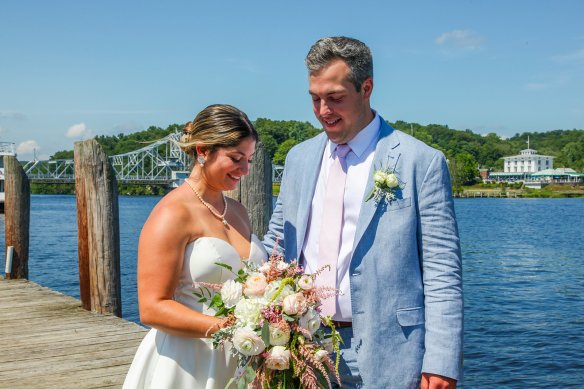
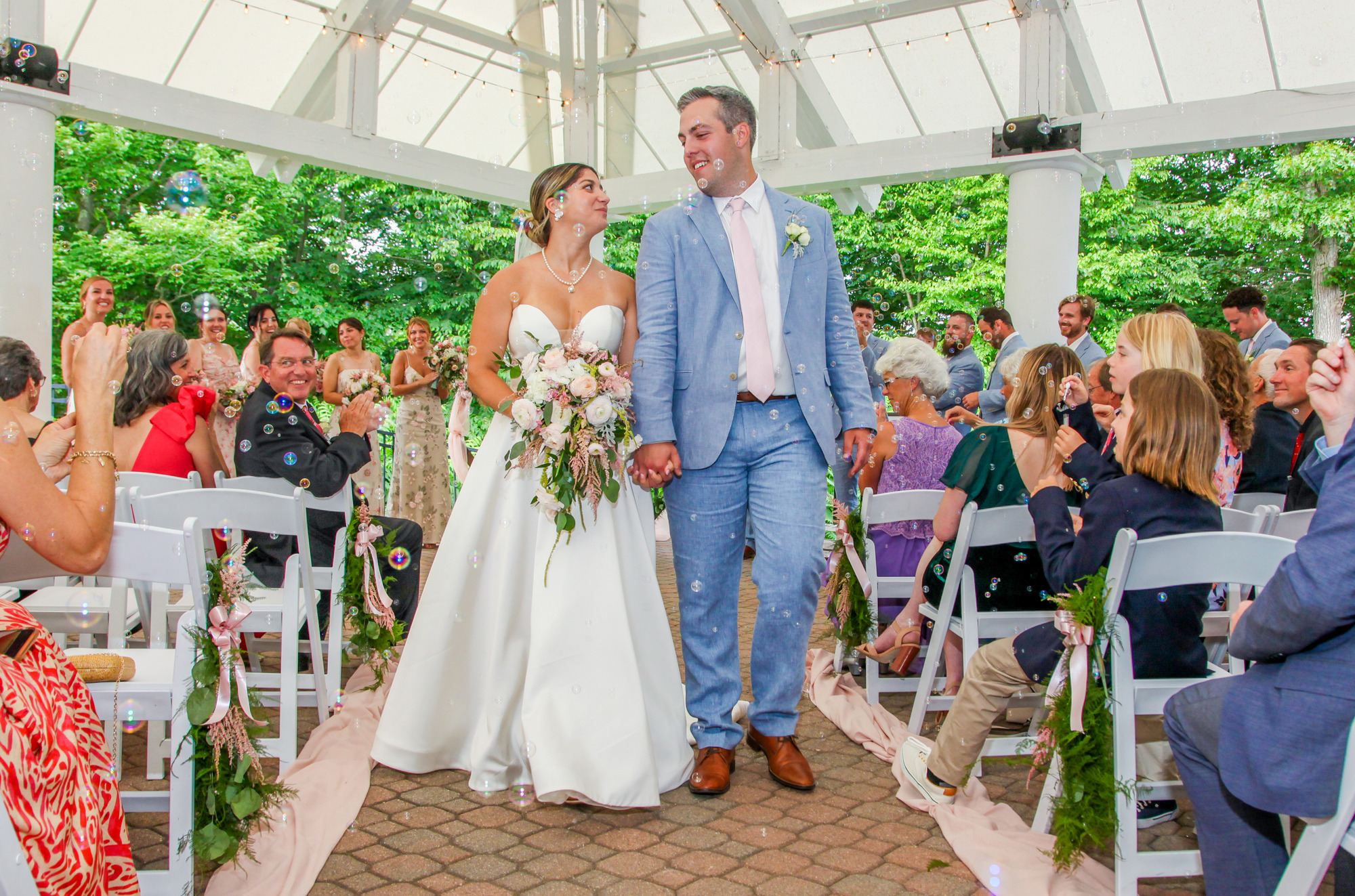
Cassidy Taylor: My favorite memory from 2023 has quickly become my favorite memory yet. This summer, I married my best friend and partner, Matt, in front of our closest friends and family. We had a beautiful ceremony followed by a memorable celebration with lots of dancing and laughter.

Kate Glaviano: While not just one moment, the best part of 2023 was making time with my friends to travel and spend time together. After years of huge life changes and a few moves to different states, it’s been grounding to reconnect, see new places and laugh hysterically with the people who know me best. 

Liz Rubino: One of my favorite memories from 2023 was when my grandson was born right before my birthday. Seeing his brother and our family enjoying the day was the best gift ever.  

The Right Fit: The Benefits of Partnering with a Boutique PR Agency

Road Runner always outran Wile E. Coyote. The massive, formidable Death Star was no match for Luke Skywalker’s tiny x-wing fighter. And of course, we all know how David fared against Goliath. In each instance, the little guy triumphed, reminding us that bigger is not always better.

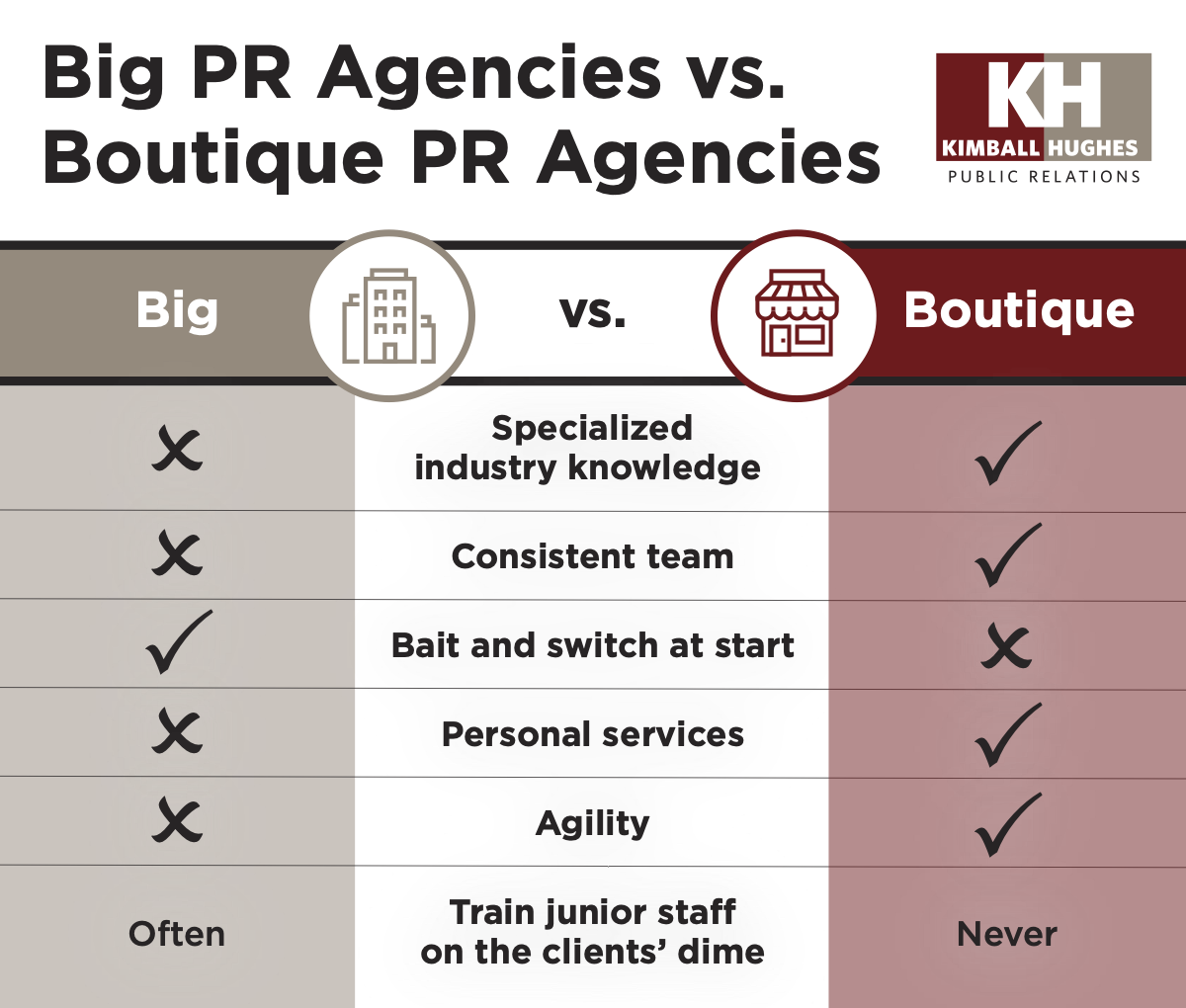
The same holds true when it comes to public relations agencies. Boutique-sized public relations agencies may not boast the large teams and vast service offerings that their larger counterparts do, but when it comes to specialized knowledge, nimbleness, and personal service, selecting the right boutique agency can provide unmatched success.

A Specialized Focus

Often a boutique agency will specialize in select industries where they have expertise. Their team will consist of seasoned employees who have worked within the industry itself or worked for years on accounts for companies in that industry. For example, at Kimball Hughes Public Relations, one of our specialties is insurance. Our team members have worked for numerous insurance clients from a PR agency perspective, have worked in-house for communications teams at insurance companies and even worked as reporters on the insurance beat. Moreover, boutique PR agencies pride themselves on employing experienced professionals to lead accounts; they simply cannot afford to risk their reputations by staffing client work with new or less experienced staff.

A boutique PR agency with a specialty will have knowledge of hot button issues and emerging trends. They will be able to do more than simply promote your brand or your executives, they will have the inside knowledge to be able to position your subject matter experts as thought leaders within the industry. They will know the conferences at which to be seen and secure media interviews that matter to your stakeholders. A specialized PR agency will have strong media contacts within the niche and help to position your leaders as go-to sources for future stories.

A Nimble Approach

Like Jerry the mouse, smaller agencies can be nimble – speedy too, like Road Runner. Without the red tape of a larger agency, a smaller agency can react to news more quickly and prepare a thoughtful response for your team to review and distribute in a timely manner.

A small PR firm will also be a nimble ally in a crisis. In those circumstances and others, you will have direct and prompt access to your agency account manager, someone you know and trust, who understands your organization and your industry who is also ready to help protect your company’s reputation anytime day or night.

That agility also comes in handy when a media strategy is not working. Valuing each and every client relationship as if it were the firm’s only relationship, a smaller agency will constantly be monitoring for results. When those results don’t manifest, they’ll recognize it immediately and pivot to a new strategy.

Personal Service

Finally, when you work with a boutique agency, your daily contact and team are likely to be people you met at the start of your relationship with the agency. The bait and switch is rare with boutique PR agencies. In fact, in many cases, you may know a number of people within the agency and they will know you and be familiar with your company’s needs. Small PR firms work closely with clients and staff to ensure  all team members are in the know so they can quickly spot-fill or act as an extra set of hands when necessary. Further, these folks will make an effort to get to know you and to understand your team’s marketing and communications goals to ensure your team is getting the results your c-suite wants to see.

For smaller PR agencies, clients are truly partners. We value relationships and want to deliver for our clients.  

So, smaller agencies may not wield a multi-story downtown headquarters the size of the Death Star. But they can be a powerful force. Give Kimball Hughes PR a call to talk to us about our specialized expertise, knowledgeable team and proven results.

Lifting the Veil: Parallels Between Building a PR Strategy and Planning a Wedding

Many say that planning a wedding is akin to having a full-time job. This is a reality I learned planning my own wedding. I got married this past July.

As I was wrapping up work in preparation for the wedding, I was struck by the similarities between planning a wedding and preparing a public relations strategy. While one focuses on florals and outfit coordination and the other on messaging tactics, media placements and KPIs, both are tied to reality by timelines, budgets, audience expectations and the seasoned professionals who know the marketplace.

Defining Your Happily Ever After

When planning any program, strategy or event, it is important to have a vision of what your end outcome will be. For example, most marriers aim to have a beautiful wedding, where all guests enjoy themselves and the couple has a long and harmonious happily ever after.

To position their wedding for success, couples often identify a theme. Some aspire to have a grand, black-tie gala while others want a more laid back, yet festive beach affair. Personally, I planned for a casual, yet sophisticated garden party.

When launching a public relations campaign, the strategy can be similar. Consider what your business ultimately wants to gain from this strategy. Similar to the couple-to-be’s goal of happy guests, your goal may be to have a roster of eager prospects. Or you may be looking to bring more awareness to your company, introduce a new product or line of business or change the way your organization’s reputation is perceived. Each goal requires a different approach, making it important to select and focus on one before the work begins.

Engaging the Right Partners

Once your vision has been clearly defined and you have a better understanding of what is needed to accomplish your goal, look for the tools and resources that will help you succeed.

In the wedding world, little can be accomplished without the support of key specialists. The venue, caterer, photographer, florist and DJ will all come together to create your vision of the perfect day.

Putting together and successfully implementing a public relations strategy does not and should not have to be a one-person job. Consider seeking out a partner with expertise to meet your needs. Just as the wedding vendors can connect you with recommended business partners who they know and trust, PR professionals can connect you with media that will reach your target audience. In the case of my wedding, my vendors all came highly recommended by my venue, meaning they knew exactly what equipment to come prepared with and had worked together before, helping the day go off without a hitch.

There are a multitude of resources to help accomplish your public relations goals. A full-service public relations agency can help you throughout the entire process, from defining your goals and audience to setting tactics, implementing a plan and measuring success.

Additionally, the right partners will be flexible. A good wedding vendor will do what they can to meet your changing needs. For instance, my photographer’s original quote was out of budget, but they worked with us and added in the extra benefit of an engagement shoot for free. Similarly, when my venue told me the ice cream truck I had my heart set on was unavailable, they were able to lean into their relationships to source a different one.

Similarly, a good media team will also know how to pivot to best meet your needs. They will recognize when a change in approach or messaging is needed to adjust to breaking news or current trends.

Catering to Your Audience

While a wedding is ultimately put together to celebrate the couple, it is important to take the rest of the guests into consideration. Certain accommodations are arranged with guests in mind, such as transportation, lodging and the menu. For instance, my guests who were vegetarian or vegan were provided with separate meals.

Similarly, your PR strategy must cater to your audience. Just like a steak dinner won’t work for a mostly vegan guest list, a trendy influencer partnership on TikTok is unlikely to help an insurance organization meet their goal of reaching more brokers and agents. When building a public relations strategy, it is critical to identify your audience and understand what they are reading and viewing.

Taking an audience-first approach will help ensure the vision you are trying to achieve will have the intended effect on the right people whether it’s a ballroom full of happy, stuffed, dancing wedding guests or a list of prospective clients now interested in inquiring about your products and services.

While seemingly worlds apart, wedding and public relations planning share similarities. Building a rock-solid foundation with a clear vision, the right partners and an audience-first approach will make ironing out the details, whether they be dress fittings and menu selections or pitching and coordinating media interviews more successful in the long run.

Q&A with Will Jones, Editor-in-Chief of Independent Agent Magazine

About Will Jones: Will graduated from Coventry University with a bachelor’s degree in english and journalism in 2010. Before joining the Independent Agent Magazine team in 2017, he gained exposure to the insurance industry while working for an insurance brokerage based in Portland, Oregon, where he currently lives with his wife, two children and border collie.

What motivated you to enter trade media, specifically covering the insurance industry?

Ever since I had my first byline published when I was 15 years old in a soccer fanzine called The Gooner, I wanted to be a writer. Writing about soccer was my first choice of subject matter with everything else second. Ultimately, having a niche, no matter what it is, motivated me to enter insurance and remain here.

What do you enjoy most about covering the insurance space?

There is a lot to love about covering insurance. First of all, everybody needs it, so everyone can relate in some way. Second, it’s considered an unattractive industry to be a part of, but I love owning that and trying to change people’s minds. And now, the longer I’ve been covering the insurance industry, the more I understand and the more I enjoy it.

What are you most proud from your career as a journalist?

In all honesty, being paid to write is an accomplishment in itself. I went to university and got a bachelor’s in “English and Journalistic Studies.” However, graduating in 2010 meant that employment, nevertheless paid writing work, was hard to find. I did a lot of online internships, set up blogs, traveled and was paid pennies per word for freelance work before finding my way here. I don’t think I got paid to write until I was 24 and didn’t get full-time writing work until I was 28. I nearly gave up on multiple occasions. There was a lot of rejection.

What would you say was your biggest challenge in covering the insurance space?

From an industry perspective, there is a lot of technical information to interpret. I am not an expert, but my work is read by experts. That is always a challenge. Also, we face many of the same challenges other publications face, such as finding the balance between print and digital publishing, walking the line between advertorial and editorial content and maintaining relationships with sources. Also, given some of the bad news announced by many major companies recently, making sure our coverage is fair, objective and equal is another challenge.

What would you say is the best story you’ve broken over your years in the industry?

As a magazine, we don’t typically “break stories.” However, instead, our success relies on getting ahead of trends and making predictions so when we’re writing a story six weeks before publication, the information is still relevant at the time of publication.

What advice would you give to a reporter just starting out in covering the insurance industry?

The insurance industry is full of very welcoming people, so I have been very fortunate to meet and work with people that are open to spending time with me to help me learn. If you can approach the industry humbly and start building relationships that expand your contact list, you’ll be able to move forward much quicker. The more people you know, the easier it gets. That won’t happen immediately but by reaching out to people, setting up introductory calls and subscribing to the trade e-newsletters, you’ll start to figure it out.

Can you share some of the top industry trends you’re looking out for over the next five to 10 years?

Currently, the hard market is set to dominate the industry for the foreseeable future. However, what the market looks like when we get to the end of it is a different matter. A lot of people are assuming  this hard market is going to be like other hard markets where it returns to normal once the cycle is over. I find that hard to believe. Technology adoption, CAT events, inflation, post-pandemic impacts, political instability, the list goes on. I don’t think this is just going to come out in the wash.

Can you tell us about a hobby/passion you have outside of work that helps you unwind and recharge?

As a father of a 2-year-old and 5-year-old, “unwind” and “recharge” don’t really come into my vocabulary. But when I do get a day to myself, watching soccer is what I’d do first. I am also a runner and have recently moved from road running to trail running. Living in Oregon provides lots of great opportunities for that.

About the magazine: Independent Agent magazine is the authoritative source of information for professionals who sell insurance for independent agencies. Independent Agent primarily serves property-casualty independent insurance agents and brokers and is a benefit of membership of the Independent Insurance Agents & Brokers of America.

Protect Your Investment: Know What to Ask When You are Hiring a Public Relations Agency

Throughout my 20 years in public relations, I – and my colleagues – have found ourselves frequently playing clean-up after another public relations agency has failed to deliver what was promised to a client.

When I talk with organizations that have worked with PR agencies in the past, typically six out of 10 tell me the relationship ended badly. The reasons tend to fall into a few familiar categories:

  • Poor communication between the agency and the client
  • Frequent agency staff turnover
  • Meeting senior agency leaders at the pitch meeting, but only interacting with less-experienced agency personnel after the contracts are signed
  • Lack of alignment either on strategy, content, writing quality, values and personalities

Like any professional or personal relationship, there is likely a bit of blame to be had on both sides when an investment by both parties in achieving a successful public relations partnership fails.

However, in my experience, often these agency hiring misfires could have been avoided if the right questions had been asked in the agency screening process. Understanding who you are hiring and establishing shared expectations from the start can help ensure the relationship starts off as strongly as possible. To do so, there are five key questions I recommend asking your potential public relations agency during the screening process, including:

  1. What distinguishes your agency from your competition?
  2. Will you include former clients in your list of references that we can contact?
  3. Who will serve as the account manager, and can we meet him or her before signing the agreement?
  4. If the plan you create for us isn’t working out, what is your pivot strategy to ensure success?
  5. Please describe your ideal working relationship with clients so we can level-set expectations both from our perspective and among the agency team.

Additional questions you should consider asking any public relations agency you might be looking to hire should include:

  • What kind of response time can I expect from your team to my emails, texts or phone calls?
  • If the account manager isn’t a member of senior leadership, what role will leadership play in the development and execution of our public relations plan?
  • What is your process for learning about our organization, and how long should we expect that process to take?
  • How will you help us prepare for any media interviews you might secure on our behalf?
  • Can we see samples of your writing relevant to our industry or organization type?
  • What kind of time commitment should we expect to make to ensure our work with the agency is a success?
  • Please describe the frequency and type of ongoing communication you expect to have with our organization throughout the engagement.

Asking the right questions will help you get a better sense of the agency you are potentially hiring as well as how they intend to engage with you.

Too many business and nonprofit leaders ask questions of public relations agencies that either cannot be answered in the initial pitch meeting or demonstrate a lack of understanding of how public relations works. In our next blog, we’ll cover questions you shouldn’t ask in these initial meetings if you want to be taken seriously while also making the most of the time you do have to evaluate if the agency at the table or on a video call is a good fit.

Remember, public relations is more than an investment of money. It’s one of time, effort and trust. Knowing what to ask will help ensure those you ultimately hire are worthy of that investment.

When Conferences Go Wrong: Have a Plan

Some conferences go smoothly. Others end in the wake of an active shooter event. There is a lot of grey between those two extremes, and organizations sending personnel to conferences ought to have a communications plan in place for the unexpected.

Last month, my colleague Eileen Coyne and I were attending RISKWorld in Atlanta (April 30 to May 3). On the final day of the conference, ahead of the closing keynote, an active shooter event took place a few miles from the conference location.

Our first notification of trouble came in the form of an ABC News alert. Text alerts from our hotel and the convention followed. Digital signage at the conference turned green with white text, alerting everyone to shelter in place and that the conference center was not part of the active shooter scene.

We immediately reached out to our families as well as colleagues to advise them that we were fine, that the conference was shutting down and the event in question was not nearby. As it turned out, the shooting took place two blocks from our hotel. It would be hours before the hotel would come out of lockdown and allow guests to come and go.

In speaking with other attendees, it became clear that if their companies had formal crisis communications plans at all (and about half of most US organizations do not), they did not have protocols for staff attending off-site events during an emergency.

Given the current social climate, all organizations need to develop crisis protocols for off-site events. Contacting the staff attending the event, confirming they are safe and cascading that message across the organization – and potentially to the family of those staffers involved — should be part of any crisis communications strategy. This applies whether it’s your CEO speaking at the conference as well as employee attendees or sales team members staffing the company’s vendor booth.

Whether the crisis originates from the actions of a person or persons, Mother Nature or something else, having a plan for out-of-town staffers in case of emergency is key. And, importantly, those traveling should be trained in the details of the plan — including phone contacts and protocols if cell or other communication services are disrupted.

According to the FBI, active shooter deaths and injuries are at a 5-year high this year. Companies with traveling personnel who spend any significant time on the road should receive active shooter training. This includes the basic principles of run, hide and fight, as well as what to do when and if authorities arrive on scene if you are present during an active shooter event.

This may all appear extreme. And it may be, until your organization is receiving urgent calls from worried families, coworkers or clients in the middle of a crisis event. Being able to respond quickly, with a protocol to follow and facts in hand can help keep your team safe during a chaotic and worrying situation and allow you to communicate factually with all parties concerned.

Stepping Up for Charity

Throughout the year, Kimball Hughes Public Relations participates in a number of philanthropic endeavors alongside our partners and clients in an effort to give back to local communities and those in need. We enjoy supporting all the good our clients do in whatever ways we can, but when we can also get them comprehensive, quality news coverage on their charitable endeavors – that is a sincere thrill.

We did just that earlier this month when Pennsylvania Lumbermens Mutual Insurance Company (PLM) held a head-shaving event fundraiser during their National Meeting benefiting the St. Baldrick’s Foundation, a nonprofit organization supporting childhood cancer research. We secured the attendance of three Philadelphia network-affiliate television news crews to show their audience 17 members of PLM’s team, including CEO John Smith and Assistant Vice President of Marketing Lindsey DiGangi, shaving their heads after raising more than $150,000 for the important cause. Agency Vice President Eileen Coyne and PR Manager Hari Rajagopalan were in attendance at the event, enjoying live string band music from the famous Philadelphia Mummers. Kimball Hughes PR was honored to make a monetary contribution to PLM’s fundraiser as well. Well done, PLM. We’re proud to work with you. To learn more about the St Baldrick’s Foundation and their mission, please visit https://www.stbaldricks.org/

Our team at Kimball Hughes PR is also getting our collective steps in for charity by participating in the fourth annual Insurance Industry Charitable Foundation (IICF) Step Up Challenge. From April 24 to May 21, 2023, the team at Kimball Hughes PR, alongside thousands of insurance professionals, their friends and families will participate in a four-week exercise competition to raise funds for children and communities in need across the US and UK. This will be our team’s third year participating and we’re looking forward to some friendly competition benefiting local nonprofits. Last year, agency President Rod Hughes took home the gold among our team with a whopping 331,329 steps. This year, it’s anyone’s game.

Both teams and individuals are welcome to participate in the challenge. A total of four IICF winners, the top two from the team and individual categories, will be able to allocate a grant to a nonprofit of their choice. To learn more about and sign up for the fourth annual IICF International Step Up Challenge, visit their website, https://stepup.iicf.org/