Behind the Picket Lines: Communicating in Times of Employee Discord

Years ago, autumn was not just about pumpkin spice, leaf peeping, back to school and football. It was also celebrated as the end of summer’s re-runs with a new line-up of fresh television shows released each September. While those days are long gone with the advent of streaming platforms, this year looked a bit different. We were back to reruns.

The Writers Guild of America was on strike for more than five months, forcing a rapid halt to the production of new content for Hollywood. Then, its resolution in late September was followed with a strike by the Screen Actors Guild-American Federation of Television and Radio Artists, who have been behind the picket lines for more than 100 days now. Both unions were and are respectively pushing for long-term pay, control over artificial intelligence and employment consistency.

And it is not just Hollywood on strike these days. Roughly 46,000 workers with the United Auto Workers union in Kentucky, Michigan and Texas found themselves behind picket lines this fall demanding improved wages and benefits.

These strikes, coupled with employee push back on employer demands for a return to office point to the fact that today’s employees have a bigger voice, and their actions are forcing employers to listen. From a communications perspective, unhappy or disgruntled employees who take their complaints public can lead to a brand reputation problem. Fortunately, a smart, proactive plan for internal and external company communications can help diffuse situations and paint your company in the best light.

Best Practices for Communicating Amid Employee Issues

While a strike, social media backlash to a corporate return-to-work mandate, or round of layoffs may burden and inconvenience leadership with staffing shortages, overtime pay and/or mounting legal fees, the reputational damage could be the most destructive –  particularly if the press gets wind of it.

One of the best ways to get ahead of reputational issues related to employee discord is to work with a public relations team to build a comprehensive plan for internal and external communications. This way, leadership is better prepared and will have direction on how to maintain good communication with employees, vendors, stakeholders and the community. Among other best practices, leadership should consider the following in a time of employee discord:

  • Keep an open dialogue with employees.

Employees want to feel heard. With many employer return-to-work mandates, employees did not feel their needs were being considered.

Many employees like the cost savings and flexibility of remote work and feel they are more productive as a result. Employers who feel strongly about employees returning to work should communicate with employees rather than simply mandating a change. They should make the case for employees as to why a return to the office is necessary and even consider acknowledging the sacrifice employees made to work from home during the pandemic. After having that dialogue, leadership might determine that offering an incentive to bring employees back or a hybrid option could help maintain or improve employee morale and prevent discord.

  • Control emotions and cool tempers.

Communications between the U.A.W. and auto manufacturing plants have become heated with Stellantis issuing a press release that began with the fighting words, “we are outraged.”

Aside from pride, big dollars are at stake, causing emotions and tempers to run hot. But a good public relations professional can help a leadership team craft messaging that carries a human element and reflects a more considered approach. A public relations team would caution executives from letting anger show through, particularly in negotiation-related communications.

  • Keep your media team updated with all developments to avoid surprises.

Whether it is a salacious email leak connected to a member of the leadership team or a negative social media post gaining momentum, it is critical to keep your public relations team updated regarding developments during a time of employee discord.

You never know what will erupt into headlines and damage the reputation of your company. If your public relations team is made aware of the situation with time to spare, they can proactively prepare a plan and smart messaging to try to prevent a situation from spiraling out of control.

While a good public relations team may not be able to do anything about the employee discord forcing reruns upon us this fall, they can help company leadership better communicate – and recognize the value of open and frequent dialogue. Hopefully, we will see these workers and executives come to common ground soon, but until then, let us encourage a focus on good communication.

From Love Story to Bad Blood: The Pros and Cons of Influencer Campaigns in Public Relations

Influencer marketing can be a powerful tool for brands and public relations professionals looking to boost their reach and credibility. According to Influencer Marketing Hub, the influencer industry is set to grow to approximately $21.1 billion in 2023. However, despite many success stories, there are downsides. For example, according to Truelist, 63% of marketers and brands have been victims of influencer fraud. In addition, fake followers remain a top concern for 50% of marketers.

Perhaps no one understands the Jump Then Fall of the influencer world better than Taylor Swift. With more than 250 million followers on Instagram and more than 90 million followers on X (formerly Twitter), Swift can surely add the title “influencer” to her long list of accolades. Her recent relationship with Kansas City Chiefs’ Tight End, Travis Kelce, and her subsequent ties to the team serves as an outstanding example of both the pros and cons of utilizing influencers.

The Power of Influencer Campaigns

Influencer campaigns can be a dynamic component of public relations strategies, extending a brand’s message to a wider audience and enhancing credibility through association. While there is currently no formal influencer relationship between Swift and the Chiefs outside of her romantic relationship with Kelce, the team and the National Football League (NFL) are benefitting from the Invisible String that ties them together.

Wide Audience Reach: Swift’s immense popularity and influential status make her an ideal choice for brands looking to reach a diverse and massive audience. For instance, since her first appearance at a Chief’s game there has been a nearly 400% increase in Travis Kelce jersey sales. Brands who partner with certain influencers that connect with their audience and have a wide reach are sure to see similar results in their bottom line.

Authenticity and Trust: One of the primary reasons influencer marketing works is because it leverages the trust influencers have built with their followers. According to Marketing Dive, 69% of consumers trust influencers, then friends and then family before information from a brand.

Targeted Marketing: Since the first rumors of their relationship were released, interest in Travis Kelce has gone up by 25% and his favorability has gone up by 10%. Based on the many social media posts, a large portion of Kelce’s new fans are “Swifties,” otherwise known as Swift’s biggest fans. This is significant for both the Chiefs and for Kelce’s sponsors as 45% of these individuals are millennials and 52% are female. This is in contrast to the NFL’s typical fan, as 70% of the NFL’s fanbase is male and 65% are aged 25-39.

The Challenges of Influencer Campaigns

Despite the undeniable advantages, influencer campaigns come with challenges. Swift’s history with both the media and the public showcase just how quickly the tides can change.

High Costs: Hiring a superstar such as Swift, or even someone on a much smaller scale can be costly. While the average cost to hire a nano-influencer (1,000-10,000 followers) is only $10 to $100 per post, that cost can soar to $5,000 to $10,000 per post for macro-influencers (500,000-1 million followers), and organizations are paying the cost. In fact, 23% of respondents to Influencer Marketing Hub’s survey stated they plan to spend more than 40% of their budget on influencers this year, potentially taking vital resources away from other marketing efforts.

Loss of Control: When collaborating with influencers, brands must relinquish some control over their messaging. This can be risky if an influencer’s actions or statements do not align with the brand’s values or objectives.

Saturation and Authenticity Concerns: In the case of Swift’s relationship with Kelce and the NFL, many fans appear irritated, saying the NFL and the Chiefs are going overboard with mentions of Swift. Kelce seems to agree, saying, “They’re overdoing it a little bit, especially my situation.”

Influencer campaigns are valuable tools, offering a range of benefits such as broad reach, authenticity and targeted marketing. Nevertheless, they come with challenges like high costs, loss of control and concerns about authenticity. By carefully weighing the pros and cons and tailoring influencer campaigns to fit specific needs and circumstances, PR professionals and brands can leverage this powerful tool to enhance their public image and reach new audiences.

The Right Fit: The Benefits of Partnering with a Boutique PR Agency

Road Runner always outran Wile E. Coyote. The massive, formidable Death Star was no match for Luke Skywalker’s tiny x-wing fighter. And of course, we all know how David fared against Goliath. In each instance, the little guy triumphed, reminding us that bigger is not always better.

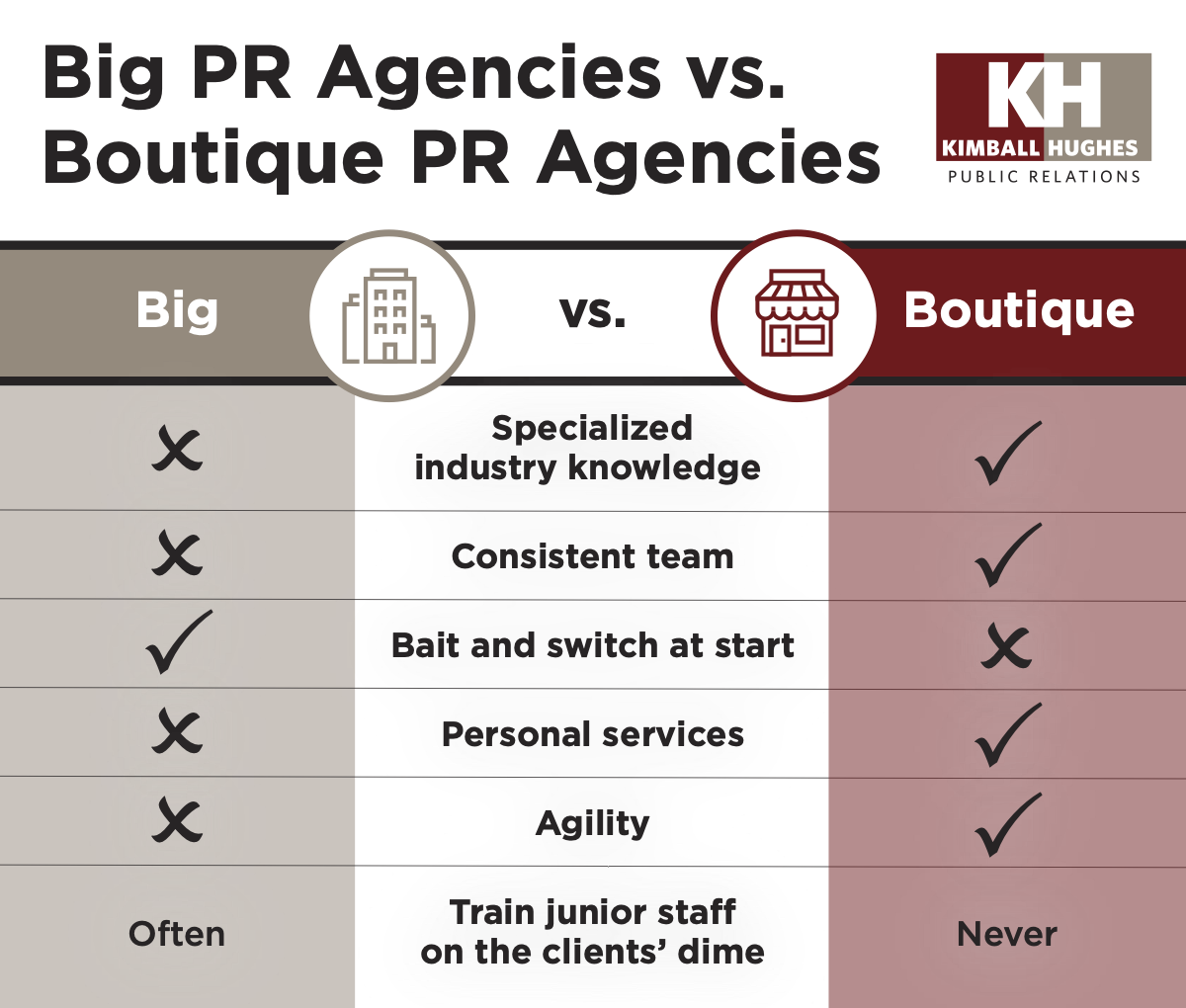
The same holds true when it comes to public relations agencies. Boutique-sized public relations agencies may not boast the large teams and vast service offerings that their larger counterparts do, but when it comes to specialized knowledge, nimbleness, and personal service, selecting the right boutique agency can provide unmatched success.

A Specialized Focus

Often a boutique agency will specialize in select industries where they have expertise. Their team will consist of seasoned employees who have worked within the industry itself or worked for years on accounts for companies in that industry. For example, at Kimball Hughes Public Relations, one of our specialties is insurance. Our team members have worked for numerous insurance clients from a PR agency perspective, have worked in-house for communications teams at insurance companies and even worked as reporters on the insurance beat. Moreover, boutique PR agencies pride themselves on employing experienced professionals to lead accounts; they simply cannot afford to risk their reputations by staffing client work with new or less experienced staff.

A boutique PR agency with a specialty will have knowledge of hot button issues and emerging trends. They will be able to do more than simply promote your brand or your executives, they will have the inside knowledge to be able to position your subject matter experts as thought leaders within the industry. They will know the conferences at which to be seen and secure media interviews that matter to your stakeholders. A specialized PR agency will have strong media contacts within the niche and help to position your leaders as go-to sources for future stories.

A Nimble Approach

Like Jerry the mouse, smaller agencies can be nimble – speedy too, like Road Runner. Without the red tape of a larger agency, a smaller agency can react to news more quickly and prepare a thoughtful response for your team to review and distribute in a timely manner.

A small PR firm will also be a nimble ally in a crisis. In those circumstances and others, you will have direct and prompt access to your agency account manager, someone you know and trust, who understands your organization and your industry who is also ready to help protect your company’s reputation anytime day or night.

That agility also comes in handy when a media strategy is not working. Valuing each and every client relationship as if it were the firm’s only relationship, a smaller agency will constantly be monitoring for results. When those results don’t manifest, they’ll recognize it immediately and pivot to a new strategy.

Personal Service

Finally, when you work with a boutique agency, your daily contact and team are likely to be people you met at the start of your relationship with the agency. The bait and switch is rare with boutique PR agencies. In fact, in many cases, you may know a number of people within the agency and they will know you and be familiar with your company’s needs. Small PR firms work closely with clients and staff to ensure  all team members are in the know so they can quickly spot-fill or act as an extra set of hands when necessary. Further, these folks will make an effort to get to know you and to understand your team’s marketing and communications goals to ensure your team is getting the results your c-suite wants to see.

For smaller PR agencies, clients are truly partners. We value relationships and want to deliver for our clients.  

So, smaller agencies may not wield a multi-story downtown headquarters the size of the Death Star. But they can be a powerful force. Give Kimball Hughes PR a call to talk to us about our specialized expertise, knowledgeable team and proven results.

Lifting the Veil: Parallels Between Building a PR Strategy and Planning a Wedding

Many say that planning a wedding is akin to having a full-time job. This is a reality I learned planning my own wedding. I got married this past July.

As I was wrapping up work in preparation for the wedding, I was struck by the similarities between planning a wedding and preparing a public relations strategy. While one focuses on florals and outfit coordination and the other on messaging tactics, media placements and KPIs, both are tied to reality by timelines, budgets, audience expectations and the seasoned professionals who know the marketplace.

Defining Your Happily Ever After

When planning any program, strategy or event, it is important to have a vision of what your end outcome will be. For example, most marriers aim to have a beautiful wedding, where all guests enjoy themselves and the couple has a long and harmonious happily ever after.

To position their wedding for success, couples often identify a theme. Some aspire to have a grand, black-tie gala while others want a more laid back, yet festive beach affair. Personally, I planned for a casual, yet sophisticated garden party.

When launching a public relations campaign, the strategy can be similar. Consider what your business ultimately wants to gain from this strategy. Similar to the couple-to-be’s goal of happy guests, your goal may be to have a roster of eager prospects. Or you may be looking to bring more awareness to your company, introduce a new product or line of business or change the way your organization’s reputation is perceived. Each goal requires a different approach, making it important to select and focus on one before the work begins.

Engaging the Right Partners

Once your vision has been clearly defined and you have a better understanding of what is needed to accomplish your goal, look for the tools and resources that will help you succeed.

In the wedding world, little can be accomplished without the support of key specialists. The venue, caterer, photographer, florist and DJ will all come together to create your vision of the perfect day.

Putting together and successfully implementing a public relations strategy does not and should not have to be a one-person job. Consider seeking out a partner with expertise to meet your needs. Just as the wedding vendors can connect you with recommended business partners who they know and trust, PR professionals can connect you with media that will reach your target audience. In the case of my wedding, my vendors all came highly recommended by my venue, meaning they knew exactly what equipment to come prepared with and had worked together before, helping the day go off without a hitch.

There are a multitude of resources to help accomplish your public relations goals. A full-service public relations agency can help you throughout the entire process, from defining your goals and audience to setting tactics, implementing a plan and measuring success.

Additionally, the right partners will be flexible. A good wedding vendor will do what they can to meet your changing needs. For instance, my photographer’s original quote was out of budget, but they worked with us and added in the extra benefit of an engagement shoot for free. Similarly, when my venue told me the ice cream truck I had my heart set on was unavailable, they were able to lean into their relationships to source a different one.

Similarly, a good media team will also know how to pivot to best meet your needs. They will recognize when a change in approach or messaging is needed to adjust to breaking news or current trends.

Catering to Your Audience

While a wedding is ultimately put together to celebrate the couple, it is important to take the rest of the guests into consideration. Certain accommodations are arranged with guests in mind, such as transportation, lodging and the menu. For instance, my guests who were vegetarian or vegan were provided with separate meals.

Similarly, your PR strategy must cater to your audience. Just like a steak dinner won’t work for a mostly vegan guest list, a trendy influencer partnership on TikTok is unlikely to help an insurance organization meet their goal of reaching more brokers and agents. When building a public relations strategy, it is critical to identify your audience and understand what they are reading and viewing.

Taking an audience-first approach will help ensure the vision you are trying to achieve will have the intended effect on the right people whether it’s a ballroom full of happy, stuffed, dancing wedding guests or a list of prospective clients now interested in inquiring about your products and services.

While seemingly worlds apart, wedding and public relations planning share similarities. Building a rock-solid foundation with a clear vision, the right partners and an audience-first approach will make ironing out the details, whether they be dress fittings and menu selections or pitching and coordinating media interviews more successful in the long run.

Q&A with Will Jones, Editor-in-Chief of Independent Agent Magazine

About Will Jones: Will graduated from Coventry University with a bachelor’s degree in english and journalism in 2010. Before joining the Independent Agent Magazine team in 2017, he gained exposure to the insurance industry while working for an insurance brokerage based in Portland, Oregon, where he currently lives with his wife, two children and border collie.

What motivated you to enter trade media, specifically covering the insurance industry?

Ever since I had my first byline published when I was 15 years old in a soccer fanzine called The Gooner, I wanted to be a writer. Writing about soccer was my first choice of subject matter with everything else second. Ultimately, having a niche, no matter what it is, motivated me to enter insurance and remain here.

What do you enjoy most about covering the insurance space?

There is a lot to love about covering insurance. First of all, everybody needs it, so everyone can relate in some way. Second, it’s considered an unattractive industry to be a part of, but I love owning that and trying to change people’s minds. And now, the longer I’ve been covering the insurance industry, the more I understand and the more I enjoy it.

What are you most proud from your career as a journalist?

In all honesty, being paid to write is an accomplishment in itself. I went to university and got a bachelor’s in “English and Journalistic Studies.” However, graduating in 2010 meant that employment, nevertheless paid writing work, was hard to find. I did a lot of online internships, set up blogs, traveled and was paid pennies per word for freelance work before finding my way here. I don’t think I got paid to write until I was 24 and didn’t get full-time writing work until I was 28. I nearly gave up on multiple occasions. There was a lot of rejection.

What would you say was your biggest challenge in covering the insurance space?

From an industry perspective, there is a lot of technical information to interpret. I am not an expert, but my work is read by experts. That is always a challenge. Also, we face many of the same challenges other publications face, such as finding the balance between print and digital publishing, walking the line between advertorial and editorial content and maintaining relationships with sources. Also, given some of the bad news announced by many major companies recently, making sure our coverage is fair, objective and equal is another challenge.

What would you say is the best story you’ve broken over your years in the industry?

As a magazine, we don’t typically “break stories.” However, instead, our success relies on getting ahead of trends and making predictions so when we’re writing a story six weeks before publication, the information is still relevant at the time of publication.

What advice would you give to a reporter just starting out in covering the insurance industry?

The insurance industry is full of very welcoming people, so I have been very fortunate to meet and work with people that are open to spending time with me to help me learn. If you can approach the industry humbly and start building relationships that expand your contact list, you’ll be able to move forward much quicker. The more people you know, the easier it gets. That won’t happen immediately but by reaching out to people, setting up introductory calls and subscribing to the trade e-newsletters, you’ll start to figure it out.

Can you share some of the top industry trends you’re looking out for over the next five to 10 years?

Currently, the hard market is set to dominate the industry for the foreseeable future. However, what the market looks like when we get to the end of it is a different matter. A lot of people are assuming  this hard market is going to be like other hard markets where it returns to normal once the cycle is over. I find that hard to believe. Technology adoption, CAT events, inflation, post-pandemic impacts, political instability, the list goes on. I don’t think this is just going to come out in the wash.

Can you tell us about a hobby/passion you have outside of work that helps you unwind and recharge?

As a father of a 2-year-old and 5-year-old, “unwind” and “recharge” don’t really come into my vocabulary. But when I do get a day to myself, watching soccer is what I’d do first. I am also a runner and have recently moved from road running to trail running. Living in Oregon provides lots of great opportunities for that.

About the magazine: Independent Agent magazine is the authoritative source of information for professionals who sell insurance for independent agencies. Independent Agent primarily serves property-casualty independent insurance agents and brokers and is a benefit of membership of the Independent Insurance Agents & Brokers of America.

Barbie in Crisis: Lessons in Crisis Communications from the BarbieVerse

Anticipated to remain the top-grossing movie of 2023, Barbie has made its mark in the minds of people everywhere. Praised for its uplifting, realistic message told through a fantasy medium, the Barbie brand has once again proven its power over pop culture. As she manages a multitude of relatable crises throughout the film, there is plenty we can all learn from her approach and experiences.

Let’s take a look at two Barbie crises and what parallels may be drawn to how a company should best handle a crisis situation of its own.

Crisis #1: Barbie encounters challenges when she steps away from what she knows

The BarbieVerse is a world of extremes full of bright, fun and energetic elements that add to the appeal. However, as we learn in the movie, living in extremes is unsustainable and at times, exhausting. When Barbie leaves home to step foot in the real world, she finds it difficult to adjust and manage what the real world throws at her.

The same can happen in the business world when faced with a crisis. Remember BP CEO Tony Hayward after the 2010 tragic oil spill in the Gulf of Mexico? He too found it difficult to adjust when the real world came bearing down on him. Instead of moving forward with a thoughtful approach considering those around him, he became infamous for memorable, ill-conceived comments like “you know, I’d like my life back” and “It’s a very big ocean.”

Perspective and strategy are key when presented with a crisis. While business owners are not sitting in Barbie’s Malibu Dreamhouse, then forced into the real world when something goes wrong, such a scenario might not be far off. When crisis hits, remember to maintain perspective, assess the situation and develop a thoughtful plan. Think about how your company’s news will be received by the public and keep a level head.

Crisis #2:  Barbie loses her dreamhouse and her problems compound

Throughout the film, Barbie is challenged to overcome emotions and scenarios that have never existed in her world. From taking back her dreamhouse to taking on the real-world Barbie executives, she is tasked with managing crises that seemingly continue to build on each other.

Unfortunately, if a business owner fails to address a crisis at its start, it can fester and grow into an even bigger problem. Consider Will Smith’s Oscar slap. When Actor Will Smith slapped Comedian Chris Rock at the 2022 Academy Awards, it may have been wiser from a PR perspective for Smith and his team to take a step back and assess. They might have then opted to remove a clearly heated Smith from the situation and develop a carefully thought-out plan for developing positive messaging related to the incident. Instead, Smith went on with his evening. Some even say he appeared defensive in the comments he made while receiving the Oscar.

Again, business leaders in a crisis should take the time to assess their situation, consult with experts and ensure they consider the possible repercussions of their actions and how they might contribute to the greater solution or problem.

Crisis Take Aways

A summer blockbuster with a happy ending, Barbie ultimately found a way to manage her crises and move forward. Business leaders who want to ensure their company is prepared for a crisis should consider partnering with a public relations team that specializes in crisis communications. A good PR partner will encourage your business leaders to abide by these best practices in the event of a crisis:

  • Assess the situation
  • Make a short-term plan
  • Identify a crisis response team and clearly define each member’s roles
  • Create or implement media and social media crisis response protocols
  • Consider your audiences in your messaging
  • Tell the truth

The Barbie phenomenon has taken over our social media feeds. It is no secret that weaved into the layers of satire presented in the film, there are a world of lessons we can all learn from Barbie. While you might not be thinking “what would Barbie do?” when considering your company’s crisis communications plan, it may be time to consider a new perspective.

Exploring Threads: What Does It Mean for Public Relations?

Beyond a potential UFC cage fight, competition is fast and furious for Elon Musk and Mark Zuckerberg as Meta Platforms launched Threads this summer to compete with Twitter, recently rebranded “X”, the popular social media platform Musk purchased last October. So, beyond throwing punches in the ring, the two can now exchange barbs via tweet or thread. But what does all this mean for your public relations strategy?

Threads vs. Twitter/X

First, it’s critical to understand what the two platforms do, how users can find your brand and the audiences the platforms can reach.

Most of us are familiar with Twitter/X and its sometimes frustrating 280 character limit. Now, Threads has burst onto the scene with a 500 character limit and largely the same image and video-sharing capabilities. While there are many similarities between the two platforms, character count is not where the differences end.

Threads was developed through the Instagram app to profile a new space for “real-time updates and public conversations,” according to Meta. The social media giant hopes to expand Threads as it has Instagram so users can follow and connect with other users. Users can access Threads via their Instagram account and handle, giving brand users a foundational audience from the get-go. The Threads feed will provide content from those the user follows as well as content recommended by Meta based on the user’s profile and history.

Again, while not many, key differences do exist between the two platforms that could influence your company’s decision on whether or not to engage it. Variety compiled this list:

  • Threads feeds users post from accounts they follow as well as others, similar to how Meta manages Instagram feeds.
  • Users cannot interact via Threads’ web interface, only read content via the web.
  • Threads does not allow users to only view posts from those the user follows.
  • European Union countries cannot access Threads for the time being.
  • Users cannot search by key word, only by user account. So, users cannot follow topics or trends. This user limitation could prove problematic for brands looking to boost awareness via the platform.

As of July 17, both Twitter/X and Threads have rate limits, which restrict the number of posts a user can view, among other things. Reported spam bot attacks led Threads to follow Twitter’s lead here, according to TechCruch. One controversial aspect of Threads that is drawing attention is that the platform does not allow users to delete their Threads account, unless they delete Instagram as well.

As to which social media platform will get the most traffic long-term, that is still to be determined. While traffic surged for Threads in the days after its launch and Twitter reportedly took a hit, the tides could be changing. On July 18, PC Magazine reported that daily active users (Android only, not iOS) dropped to 23.6 million from 49 million on July 7. At its peak, Threads had 49 million users, compared to Twitter’s 109.4 million.

What’s right for your company?

Only time will tell what the right platform is for your company. While business owners may want to bury their heads in the sand and stick to what they know rather than diving into a new social media platform, no one can deny the value in understanding your options.  

At minimum, business owners should talk to their marketing and PR teams about Threads and understand the pros and cons a presence on the platform could bring to the brand. Marketing and PR teams could see tremendous advantage in a brand communicating via Threads because they would have a longer character limit to more vividly tell stories and share longer-form content. Or they may see considerable value in leveraging the brand’s already existing Instagram and Facebook audience through Threads. Your marketing team could also be drawn to Threads in the early days as advertising is not yet offered and as a result, is unable to interrupt or distract viewers from the brand’s posts. On the flip side, it’s unknown how the platform will change once advertisers join the mix.

And then, of course, it’s no secret that Elon Musk is viewed by some as somewhat controversial. When he lifted previously imposed Twitter bans on high-profile figures earlier this year, some advertisers became uneasy about their participation on the social media platform worried their advertisement could be posted beside objectionable material.

Despite the new competition and some controversy, Twitter, now X, is still a leading social media platform and demonstrated means for many brands to reach their target audiences. So, unless your brand leadership is vehemently opposed to the platform, it might be wise to continue to have a presence. At the same time, explore Threads. While we can’t say whether or not it will be around for the long-term, why not give it a try? If you want to learn more about boosting your presence on social media as part of an integrated publication relations campaign, contact us.

Weighing your Options: Pay-to-Play Media Coverage

While not a novel concept, the idea of pay-to-play media coverage has recently made a resurgence. Organizations, many off-shore, are engaging in an aggressive strategy of cold email outreach to businesses and non-profits offering to secure guaranteed placement of news coverage or thought leadership. What’s more, these organizations assure their prospects there is “absolutely no payment” until the placement is secured.

You don’t pay a penny unless you get your message published or broadcast. Sounds great, right?

Remember, if it sounds too good to be true it probably is.

They Think You’re Great

The email reads well. It is gracious and solicitous, although there is sometimes the occasional typo or grammatical error. These emails seeking to engage you even include a little detail about your company, non-profit or you personally. A nice touch. They seem legit. You can even find their website, although the only button that links to anything is a “Contact Us” selection.

Typically, when a company you never heard of comes calling offering you a remarkable opportunity, it’s a sales pitch, not a legit offer.

Also, often there’s no human behind these emails. These emails are artificial intelligence (AI) generated. They’ve scraped your website for a few details about you or your organization. And they will keep emailing, seeming to wonder why you haven’t replied.

The Fine Print

Despite claims to the contrary, there are a few details absent from these sales tactics.

The first is the outlets in question. Many of these solicitors highlight amazing media outlets: Forbes, CNN, FOX, The Financial Times, Yahoo Business News, etc. What they fail to mention is they are targeting the advertising or sponsored sections or segments of these outlets. What does that mean?

In the case of Forbes, they will sign you up for a paid opportunity you could have secured on your own. What’s more, if you worked directly with Forbes, you would likely be paying to become a regular contributor, writing and publishing up to 11 or 12 articles per year (all labeled as paid or contributed content). But with the model offered by these pay-to-play organizations, you will pay significantly more than the annual Forbes Contributor fees for just one opportunity. They are counting on you not knowing how Forbes, and other outlets, work regarding paid placement and costs.

Where broadcast outlets are concerned, it’s a near guarantee you won’t be appearing on Fox & Friends or Anderson Cooper 360. More likely your brief, paid segment, will run on the backwaters of these outlets’ websites in special “Sponsored Content” sections or on a 3 a.m. Sunday morning broadcast segment with a D-list celebrity host.

Also, for many B2B organizations, the outlets targeted are not strategic to fit their unique target audiences. If your target audience are the readers of Horse & Hound magazine, then a 2 a.m. Saturday segment on TBS is not exactly on point. Sure, you may be reaching a potentially large audience (insomniacs everywhere will be delighted), but is that audience the one you need? In short, these placements are tactical, not strategic.

The Cost

They promise you won’t pay anything until a placement is secured. But when you do, brace yourself. A single placement in Forbes, as an example, could run you two to three times what Forbes charges to be an annual contributor. Not exactly money well spent. And the broadcast placements can be simply astronomical (so they will push you to secure a CNN.com article instead because it’s much cheaper … or so it seems).

Competency

Finally, it comes down to turning over your brand or your personal reputation to individuals and organizations that have no track record in public relations outside of paid placements. They are basically placing paid-advertisements for you (and typically the outlets are doing the writing, not the so-called agency you hired).


And what happens if there’s a problem? What if there’s a mistake or worse? What if the paid opportunity mutates into a crisis situation? Well, these organizations have been paid. Not only do they have no reputation management or crisis communications experience, they don’t offer those services or care to help you. It’s pay-to-play, and you will certainly get what you pay for but likely, not one little thing more.

To cultivate and advance your reputation, a journalist must see a legitimate story and make an independent decision as to whether to cover it or not. There is not a public relations agency on earth that can make The New York Times or CBS News run a story that isn’t deemed newsworthy.

Where paid content is available with major media outlets, the value is limited. Make sure you understand both the benefits and limitations of any paid content opportunity as well as who and when actual humans will have access to that content.

Beware the public relations person who guarantees success. The success you achieved in business, as a non-profit leader or other professional endeavors was never guaranteed from the start. Neither is public relations.

Inspired by The Bear: My Journey from the Kitchen to Public Relations

A few years ago, I quit my job as a chef in Chicago to pursue a career in public relations. Not surprisingly, it prompted many conversations about why I was making this change. Then, in June of 2022 the emergence of FX’s hit show The Bear prompted a newfound interest and respect for kitchen professionals and their skillset, and the questions began again.   

While The Bear is a television show dramatizing work in restaurants, it has been recognized as one of the most realistic portrayals of kitchen culture. This fresh portrayal of kitchens provides the perfect backdrop for an idea I have personally struggled to explain: Many kitchen skills and experiences are transferable to public relations work. From finding inspiration in an environment of chaos, to pushing through pressure to get a dish out (or meet a deadline) and fielding every mishap, small burn and burst pipe along the way, I’ve found these two vastly different careers have many similarities.

Here are just a few of the ways public relations and kitchen life are not all that different:  

Understanding the Value of Good Communications

In a kitchen, you will often hear “corner” when someone is going around a corner, “sharp” when someone is holding a knife and walking or “heard” to convey something is understood. To some, this may seem like over-communicating, but these short, succinct communications often hold the responsibility of safety and/or clarity in a kitchen.

In public relations, we must be acutely aware of the power of words and consider how those words will be received to support a goal. We must also work to determine the best way to communicate a message. We need to find the best way to get the audience’s attention just like the chef needs to find the best way to get the attention of their staff. This can mean finding a target audience where they want to be met and often understanding less is more. We may not use one simple word to communicate like “corner,” but we try to deliver tight, compelling messages that speak to our client’s services or thinking, while providing value to the reader.  

Keeping Your Cool Under Pressure

The Bear does a great job of passing on to the viewer the feeling of immense pressure that looms over a kitchen. Whether its managing ticket times, difficulties with cooks who are out of unison or struggles with finances threatening the future of a restaurant, handling pressure is a prerequisite of the restaurant industry.

Public relations professionals are no strangers to pressure either. For one, communications professionals are depended upon for unbiased, clear-minded insight to position their clients in the best light. Whether it be in a crisis where we must move quickly while working to manage particularly sensitive situations or in daily work with deadlines looming and new opportunities arising, it’s a delicate balancing act. While these scenarios are much different than the never-ending demand of a ticket machine (see The Bear, season 1, ep 7), they require an ability to listen, prioritize, strategize, plan ahead and, of course, take a deep breath and have confidence and trust in you and your teams’ abilities to best support your client.

Wearing Many Hats

Multi-tasking is not a nice-to-have skill in a kitchen; it’s a must. There may be days when two people have to be the line cooks, dishwashers, expeditors and food runners.

Public relations professionals must also master the art of multi-tasking. A public relations professional, especially in the agency environment, must have a finger on the pulse of various industries while also managing client work, maintaining relationships with clients and media, fostering new business, writing content, coordinating interviews and more. Like chefs, most public relations professionals thrive on a fast-moving pace.

Finding Joy in the Presentation

A good chef can prepare a simple dish and elevate it to a remarkable meal. A good chef takes pride in their creations and finds joy and inspiration in seeing people enjoy them.

In public relations, we also take great pride in what we present to our clients – the call back from the Wall Street Journal, the resulting placements from thoughtful pitching, increased share of voice, etc. Our goal in public relations is to highlight the expertise of our clients and find the best places to do so. We strive to get our clients in front of the audiences that are valuable to them and enjoy that same thrill as the chef in seeing their satisfaction in the end. Much like a kitchen, public relations requires you to manage various ups and downs. And when it all comes together, it is incredibly gratifying.

The shift from kitchens to public relations to some may seem like an odd transition, but what you learn in a kitchen is all about communication, balance, productivity, management and doing your best to please the customer. These are invaluable skills that can transfer to any industry. They certainly have in mine.

Protect Your Investment: Know What to Ask When You are Hiring a Public Relations Agency

Throughout my 20 years in public relations, I – and my colleagues – have found ourselves frequently playing clean-up after another public relations agency has failed to deliver what was promised to a client.

When I talk with organizations that have worked with PR agencies in the past, typically six out of 10 tell me the relationship ended badly. The reasons tend to fall into a few familiar categories:

  • Poor communication between the agency and the client
  • Frequent agency staff turnover
  • Meeting senior agency leaders at the pitch meeting, but only interacting with less-experienced agency personnel after the contracts are signed
  • Lack of alignment either on strategy, content, writing quality, values and personalities

Like any professional or personal relationship, there is likely a bit of blame to be had on both sides when an investment by both parties in achieving a successful public relations partnership fails.

However, in my experience, often these agency hiring misfires could have been avoided if the right questions had been asked in the agency screening process. Understanding who you are hiring and establishing shared expectations from the start can help ensure the relationship starts off as strongly as possible. To do so, there are five key questions I recommend asking your potential public relations agency during the screening process, including:

  1. What distinguishes your agency from your competition?
  2. Will you include former clients in your list of references that we can contact?
  3. Who will serve as the account manager, and can we meet him or her before signing the agreement?
  4. If the plan you create for us isn’t working out, what is your pivot strategy to ensure success?
  5. Please describe your ideal working relationship with clients so we can level-set expectations both from our perspective and among the agency team.

Additional questions you should consider asking any public relations agency you might be looking to hire should include:

  • What kind of response time can I expect from your team to my emails, texts or phone calls?
  • If the account manager isn’t a member of senior leadership, what role will leadership play in the development and execution of our public relations plan?
  • What is your process for learning about our organization, and how long should we expect that process to take?
  • How will you help us prepare for any media interviews you might secure on our behalf?
  • Can we see samples of your writing relevant to our industry or organization type?
  • What kind of time commitment should we expect to make to ensure our work with the agency is a success?
  • Please describe the frequency and type of ongoing communication you expect to have with our organization throughout the engagement.

Asking the right questions will help you get a better sense of the agency you are potentially hiring as well as how they intend to engage with you.

Too many business and nonprofit leaders ask questions of public relations agencies that either cannot be answered in the initial pitch meeting or demonstrate a lack of understanding of how public relations works. In our next blog, we’ll cover questions you shouldn’t ask in these initial meetings if you want to be taken seriously while also making the most of the time you do have to evaluate if the agency at the table or on a video call is a good fit.

Remember, public relations is more than an investment of money. It’s one of time, effort and trust. Knowing what to ask will help ensure those you ultimately hire are worthy of that investment.