The Press Release: “In” or “Out” in 2024?

As a journalism major in college, I studied the inverted pyramid. It states that the most important details permeate the widest part of the pyramid, supporting details follow in the middle and supplemental information completes the tip of the upside-down pyramid. As a public relations professional, I know a well-written press release should follow a similar format — but I also know no press release, no matter how well written, should stand on its own.

So, what’s the scoop on press releases for 2024? Those that follow the inverted pyramid format as part of a strategic public relations campaign are still very much “in,” but, if released in a vacuum or poorly written, the press release is most definitely “out.”

This should not come as a surprise in 2024. The demise of the press release has been predicted, incorrectly, for years. Once a powerful, singular tool in the world of PR, the press release has become simply one of countless tools available to the profession. Deployed strategically and creatively, a well-written press release can still help to raise brand awareness.

The Press Release Myth

For many, the idea of public relations often begins and ends with a press release. It’s not that simple anymore. Most reporters receive hundreds of press releases daily and could easily overlook yours even if you pay big bucks to have the best-known PR agency around draft and distribute it.

The truth is you need a continuous effort with the media to build credibility and a reputation as a valued resource among reporters and your audience at large. Journalists are in the business of reporting on news and taking deep dives into important trends; not promoting your company. To select you or your organization as a credible source, first journalists need to know your name. Secondly, they need to know you aren’t merely going to try to promote your product or service. The way journalists come to know these things is through continuous, relevant and topical outreach on subjects they cover and care about. This is the primary reason most PR professionals advise clients not to treat PR like a spigot, turning it off and on at will.

To accomplish all of this, you may use a press release here and there. But it should never be your default tactic, and it should only be used if you have genuine news or insight to announce. Instead, consider the press release as one useful tool in a communication strategy.

Maximizing the Press Release

So, how can a business owner get the most from a press release?

Press releases can offer value when announcing a business launch, new product, merger or acquisition, personnel change, etc. It should be relevant to the audiences you hope to reach and tell the reader the facts of what is happening with your business and leave the promotional language for the marketing and advertising folks. If the goal is establishing credibility among your audience, any hint of self-promotion will steer journalists — and increasingly more savvy news consumers — in the other direction.

Ultimately, business owners should not expect a press release alone to garner media attention. You need a broader campaign where reporters and other key audiences are receiving a steady stream of content on your brand whether through pitches to the media related to industry trends or current events, through content on company blogs, the company website or social media posts. Only with consistency will you build credibility and confidence in your leaders and your brand. Consider consulting with a PR agency to understand what approach might be best for your brand.

Best Practices

When a press release is determined to be a useful component of a broader communications strategy, it must be well-written to demonstrate that credibility. By taking care in your messaging and presentation, you are conveying that you take care in your product or service.

Consider these tips in drafting a good press release:

  • Think like a journalist — keep the inverted pyramid in mind, stick to the facts, and avoid promotion.
  • Announce your “news” up top.
  • Try to find a news hook or element of timeliness.
  • Keep the copy clean and tight.
  • Craft a compelling headline that sums up your news.
  • Consider partnering with a PR agency with former journalists on staff.

Issuing a press release as part of a comprehensive PR strategy can have several benefits including:

  • Boosting company search engine optimization, particularly if the release is picked up by multiple media outlets.
  • Serving as good introductory or reference material for reporters.
  • Providing useful fodder for marketing and other owned content sources.
  • Helping to build credibility and name recognition with a steady drumbeat of newsworthy and relevant releases, combined with other PR initiatives.

While the media landscape continues to change, the press release remains “in” and will continue to be a useful tool — for now. However, business owners should understand a press release, on its own, does not guarantee media coverage. When written well and thoughtfully distributed, it can be an effective component of a comprehensive PR strategy that can build brand trust and elevate your company in the eyes of reporters and customers.
Reflections on a Day of Service: The Value in Communicating the Good You Do

We have all heard charitable giving and volunteerism are good for the community and good for business. Although our central purpose in giving back is hopefully to produce better outcomes for others, wildlife, the environment or countless worthy causes, that business benefit should not be overlooked.

After taking part in this year’s Martin Luther King Jr. Day of Service, we thought we would explore the benefits – beyond the self-satisfaction found in helping others – available to companies that give back through kindness.

These are benefits that can inspire and encourage others to get involved and feel a part of something, while also enhancing the company’s reputation and, potentially, its bottom line.

More specifically, spreading the word, in the right way, of a company’s philanthropic initiatives can:

  • Enhance company culture. Today’s employees want to know they are working for companies that care and take action toward social responsibility. They want to see the company’s principles and support for employees, the community and the environment communicated. It can engender them a sense of pride toward their employer. Further, providing employees with time to volunteer with their team can promote comradery and build a corporate culture where employees feel more fulfilled, challenged and want to stay and grow.
  • Assist in recruiting top talent. Millennials and Gen Z want to give back in meaningful ways and they are increasingly looking to employers to not only support, but enable, these social good contributions. They are looking to join companies that provide opportunities to volunteer, to take part in fundraising initiatives and to support the causes that matter to them.
  • Raise awareness of your company among your target audience. It is not only employees who are interested in socially minded employers; customers want to patronize companies that support causes important to them.

By sharing news and updates of charitable donations and volunteering efforts via articles, photos and videos shared via eblasts, social media channels and newsletters, leadership can ensure prospective and existing customers, job candidates, and current employees see their commitment to giving back and realize this is an organization worthy of their time, attention and money. To help ensure this, consider these best practices for communicating charitable endeavors on social media:

  • Craft your post with care for clarity, tone and importantly, brevity, as well as spelling and grammar.
  • Include photos and short video clips where possible.
  • Tag the nonprofits you supported. They may repost to their networks.
  • Call out employees where appropriate for their volunteer efforts and tag them on posts.
  • Encourage employees to like and share on their social media channels as well.

Finally, a good public relations partner can define a clear strategy communicating the social good works of the company and its employees. Having a strategy is important, not only for promotional purposes, but also to ensure you and your employees communicate thoughtfully, consistently and respectfully while focusing on the best channels and language to best support the efforts of the company and its employees. Not every fundraising initiative is worthy of a press release. Again, a PR professional can help you determine the best communications channel for sharing messaging.

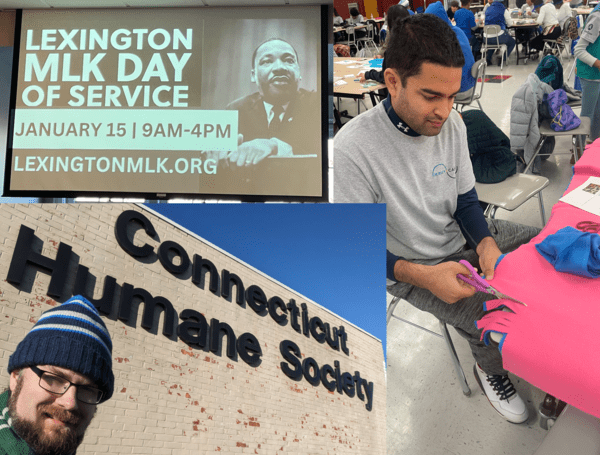
For our part, team members at Kimball Hughes PR had an amazing time volunteering in their local communities on MLK Day. They organized dog and cat food at the Connecticut Humane Society, made cards for veterans with the Lexington Day of Service and packaged emergency relief and disaster kits with Jersey Cares for victims of recent storms and natural disasters. At Kimball Hughes PR, we encourage a culture of giving back by providing paid time off to volunteer for MLK Day as well as during the Insurance Industry Charitable Foundation’s Week of Giving. We seek team input on all company charitable initiatives, whether through our pro bono client work or our annual charitable gift made to a nonprofit cause important to our team on behalf of our clients.

From paid-time-off to volunteer to matching employee charitable donations, organizational leaders should not only be sure to create opportunities to give back, but also to communicate their efforts and those of their employees. While not every charitable effort is newsworthy, a photo on social media of an employee helping to clean a beach or assist in a food kitchen can go a long way in advancing your reputation as a company that cares and one that is worth the investment and support of employees, customers and others.

What’s In (and Out) in Public Relations for 2024

Many of us appreciate starting the new calendar year with a clean slate and some helpful insights to make us more successful. Knowing what has changed and how to better navigate the world in our personal and professional lives certainly helps. And as is the trend at the start of each year in fashion, business and elsewhere, I wanted to share my perspective on what is in, and what is out, in terms of approaches to communication strategies in 2024:

Artificial Intelligence (AI)

IN: Greater scrutiny of artificial intelligence (AI) and Generative AI.

If 2022 showed us what was possible with the birth of ChatGPT, 2023 showed us what was practical as litigation surrounding AI flourished, as noted in a Dec. 14, 2023 blog post by the law firm of Perkins Coie. Going forward, AI in strategic communications will be a resource, not a revolution, leading those who fail to recognize this shift into a world of trouble.

OUT: The idea of replacing communications professionals with AI at least for now. Experimentation has shown us AI has yet to mature to the point where anything but mundane copy automation is possible. Even there, the risks of error, inaccuracy and legal jeopardy abound with AI in a lead content role.

Social Media

IN: LinkedIn as a force multiplier for your communications strategy.

For both for- and nonprofit organizations, LinkedIn has demonstrated that tailored, personal and insightful content is exactly what professionals are seeking. We are all looking to grow professionally, and LinkedIn has become the gold standard in social media for real-world advice, tips and lessons learned. The platform has also rolled out many tools with low entry barriers for organizations to use to support their communications goals.

OUT: X, formerly known as Twitter, for anything of practical use by businesses or nonprofits.

The platform has been on a downward slide in terms of relevance for years. With a fast-shrinking number of quality controls, advertisers and actual users, it will continue a steady slide into irrelevance barring a major turnaround which seems unlikely at the dawn of 2024.

Media Relations

IN: Continued consolidation and evolution in the media space.

The very definition of media outlet remains in flux as news publishers explore new platforms and models, while journalists themselves go entrepreneurial with newsletters, podcasts and streaming services.

OUT: Asking the question, “Who do you know at [media outlet name]?”

While media relations was once a field that relied on relationships to get a foot in the door, today’s journalists are driven by what stories grab eyeballs, regardless of who is pitching it. It is no longer (and, frankly, it has not been for a long while) who you know, but rather the quality of the story to be told and the PR professionals who best understand how to share that story with key journalists and/or outlets.

Messaging

IN: The continued march of pithy messaging to best engage and inform B2B and B2C consumers.

With millennials and Gen Z now in the majority of consumers and increasingly moving into management and entrepreneurial roles, organizations will need to appeal to these audiences by conveying brand personalities that showcase authenticity. Taking an infotainment approach — the combination of information and entertainment, even humor — has proved popular and impactful with these cohorts. However, great care must be taken to avoid unforced errors like the failed 2023 Snoop Dogg/Solo Stove marketing campaign.

OUT: Messaging that even hints at self-promotion.

From the journalists themselves to the feedback of their readers, the jury has come in and stakeholders are tired of being forced to endure a brand’s value proposition or product/service pitches disguised as news. Brands will need to find something relevant to say about the issues, trends and news impacting their audiences that does not center on what they can do or sell. This approach will be critical if they want to continue to maintain relevance with those audiences and the journalists who help them reach those audiences.

Content

IN: Succinct video messaging.

Consumers, as well as the media, are time starved. While video has helped drive increased engagement, the trend continues to move toward ever more brief videos whether it is explaining a concept, pitching a reporter or persuading audiences. Brands should be creating their own video library of short-form content on key topics and issues of greatest importance to their target audiences.

OUT: Long form owned content.

The 60-second video is dead; long live the 30-second video. Smart brands will continue to move away from long-form content on their owned channels (i.e., websites, social media, newsletters, etc.) and take advantage of low- and no-cost video and editing tools, as well as developing strategies to create and provide aggressively brief content that speaks to important trends and topics.

The pace of technology and information continues to gain speed. Smart brand and organizational leaders will recognize the importance of adapting to the preferences and needs of their target audiences while creating plans that leverage new ways of engaging audiences to ensure they maintain awareness and relevance among those who matter most to them.